



MCP-1/CCL2 Protein, Mouse (HEK293)
Based on 2 publication(s) in Google Scholar
MCP-1/CCL2 Protein, Mouse (HEK293) is a cytokine belonging to the CC chemokine family that interacts with the CCR2 chemokine receptor on the cell surface to mediate inflammatory immune responses, viral infections, and tumorigenesis. MCP-1/CCL2 Protein, Mouse (HEK293) is a mouse MCP-1/CCL2 (Q24-R96) expressed by HEK293.
- Species: Mouse
- Source: HEK293
-
Storage:Stored at -20°C for 2 years from date of receipt. After reconstitution, it is stable at 4°C for 1 week or -20°C for longer (with carrier protein). It is recommended to freeze aliquots at -20°C or -80°C for extended storage.


To place orders, for customer services and technical support, please contact: MedChemExpress USA
Tel: 609-228-6898 E-mail: [email protected] [email protected]


-
 Biological Activity
-
Technical Parameters
-
Product Properties
- Documentation
- References
- Help & FAQs




Biological Activity
Description
MCP-1/CCL2 Protein, Mouse (HEK293) is a cytokine belonging to the CC chemokine family that interacts with the CCR2 chemokine receptor on the cell surface to mediate inflammatory immune responses, viral infections, and tumorigenesis. MCP-1/CCL2 Protein, Mouse (HEK293) is a mouse MCP-1/CCL2 (Q24-R96) expressed by HEK293[1].
Background
CCL2, also known as monocyte chemotactic protein 1 (MCP1), is a small cell factor belonging to the CC chemokine family. The CCL2 gene, located in the q11.2-q12 region of human chromosome 17, encodes a monomeric polypeptide with a molecular weight of 9-15 kDa, depending on the level of glycosylation. CCL2 is mainly secreted by monocytes, macrophages and dendritic cells. It is secreted by monocytes, macrophages and dendritic cells, and platelet-derived growth factor is the main inducer of the CCL2 gene. Astrocytes and microglia are also thought to be the source of CCL2[1]. CCL2 signals through binding to and activation of CCR2 and induces a strong chemotactic response and intracellular mobilization of calcium ions. Among other things, CCL2/CCR2 can regulate cell adhesion and chemotaxis of macrophages by activating the β1 integrin and p38-MAPK signaling pathways. In addition to acting as a chemoattractant, CCL2 can also regulate brain endothelial permeability in vitro by altering tight junction (TJ) proteins and regulating the expression of endothelial adhesion molecules and leukocyte integrins as well as cytokine production. In addition, the CCL2-CCR2 signaling axis has been implicated in many inflammatory and neurodegenerative diseases, acting to recruit inflammatory cells into the CNS[2]. Originally described as a "tumor-derived chemokine", CCL2 has been shown to be a potent chemokine for many types of immune cells and a potential target for the treatment of many diseases, such as atherosclerosis, multiple sclerosis, asthma, neuropathic pain, diabetic nephropathy, and cancer[3].
In Vitro
MCP-1/CCL2 (100 ng/mL, 24 h) can induce NO production by co-treatment with IFN-γ, increases ERK phosphorylation and increases iNOS expression, suggesting that the mechanism of NO production is related to the ERK1/2 signaling pathway in peritoneal macrophages of mice, thereby increasing bacterial clearance[3].
CCL2 (0.05 ng/μL) promotes α-synuclein secretion and α-synuclein-induced neuronal apoptosis, and induces microglia proliferation and secretion of TNF-α, IL-1β and NO[4].
In Vivo
MCP-1/CCL2 (intracerebral injection, 5-25 μg, 1 μL/h for 3 days or 0.5 μL/h for 7 days) induces FITC-albumin leakage at lower concentrations (5-20 μg) but fails or moderately induces leukocyte infiltration. Blood-brain barrier permeability and leukocyte infiltration are significantly increased at 25 μg, and extravasation is significantly enhanced in the treated CD-1 mice compared with the control group 6 h after injection. Prolonged administration for 3 or 7 days results in a significant increase in the percentage of brain water content, and decreases expression of the tight junction proteins occludin, claudin-5, ZO-1 and ZO-2[2].
Verified Bioactivity
1. The ED50 is <0.3 μg/mL as measured by CHO-K1/Gα15/mCCR2 cells (human Gα15 and mouse CCR2 stably expressed in CHO-K1 cells).
2. Measured by its ability to chemoattract THP-1 human acute monocytic leukemia cells. The ED50 this effect is <26.8 ng/mL, corresponding to a specific activity is >3.733×10^4 U/mg.
MCE Validation Data
-
Purity - SDS-PAGE
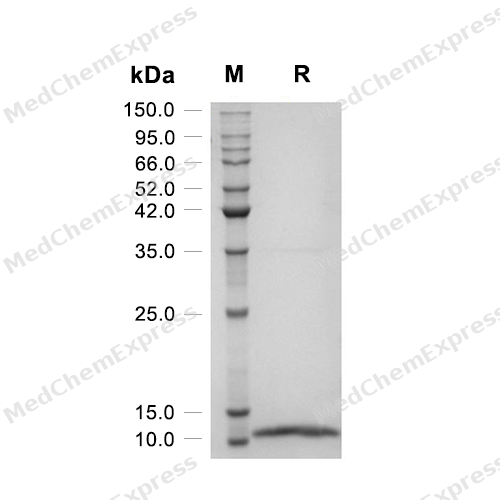
Purity - SDS-PAGE
-
Bioactivity - Cell-Based Assay
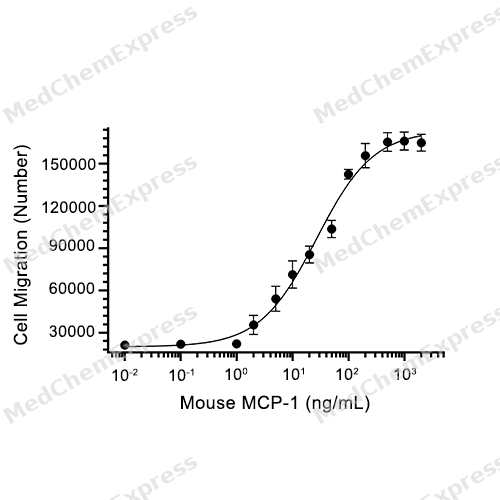
Bioactivity - Cell-Based Assay


Publications (2)
-
Journal Impact Factor
-
Most Recent
-
-
ACS Nano
2026 Jun 30;20(25):18533-18544. PMID: 42304955


Technical Parameters
-
Species Mouse
-
Source HEK293
-
Tag Tag Free
-
Accession
P10148 (Q24-R96)
-
Molecular Construction
-
N-term
-
CCL2 (Q24-R96)
Accession # P10148 -
C-term
-
-
Protein Length
Partial
-
Synonyms
CCL2; Small Inducible Cytokine Subfamily A (Cys-Cys), Member 2; Prev. SCYA2; Chemokine (C-C Motif) Ligand 2; MCP-1; Monocyte Chemotactic Protein 1; MCP1; Small-Inducible Cytokine A2; MCAF; C-C Motif Chemokine 2; HC11; MGC9434; Monocyte Chemotactic And Act
-
AA Sequence
QPDAVNAPLTCCYSFTSKMIPMSRLESYKRITSSRCPKEAVVFVTKLKREVCADPKKEWVQTYIKNLDRNQMR
-
Predicted Molecular Mass
8.5 kDa
-
Molecular Weight
Approximately 8 kDa, based on SDS-PAGE under reducing conditions.
-
Glycosylation
Yes
-
Purity
≥ 95%, as determined by reducing SDS-PAGE.


Product Properties
Lyophilized powder
1.Lyophilized from a 0.22 μm filtered solution of PBS.
2.Lyophilized from a 0.22 μm filtered solution of 20 mM PB, 150 mM NaCl, pH 7.4.
Please refer to the lot-specific COA for specific buffer information.
<1 EU/μg, determined by LAL method.
It is not recommended to reconstitute to a concentration less than 100 μg/mL in ddH2O. For long term storage it is recommended to add a carrier protein (0.1% BSA, 5% HSA, 10% FBS or 5% Trehalose).
Stored at -20°C for 2 years from date of receipt. After reconstitution, it is stable at 4°C for 1 week or -20°C for longer (with carrier protein). It is recommended to freeze aliquots at -20°C or -80°C for extended storage.
Room temperature in continental US; may vary elsewhere.


Documentation
-
Data Sheet (264 KB)
-
SDS (252 KB)
- English - EN (252 KB)
- Français - FR (252 KB)
- Deutsch - DE (252 KB)
- Norwegian - NO (252 KB)
- Español - ES (252 KB)
- Swedish - SV (252 KB)
- Italian - IT (252 KB)
- Korean - KR (252 KB)
- Portuguese - PT (252 KB)
-
Handling Instructions (2659 KB)


References
[1]. Qiongyu Hao, et al. CCL2/CCR2 signaling in cancer pathogenesis. Cell Commun Signal. 2020 May 29;18(1):82. [Content Brief]
[2]. Svetlana M Stamatovic, et al. Monocyte chemoattractant protein-1 regulation of blood-brain barrier permeability. J Cereb Blood Flow Metab. 2005 May;25(5):593-606. [Content Brief]
[3]. Rachel N Gomes, et al. Bacterial clearance in septic mice is modulated by MCP-1/CCL2 and nitric oxide. Shock. 2013 Jan;39(1):63-9. [Content Brief]
[4]. Lijun Zhang, et al. Effect of chemokine CC ligand 2 (CCL2) on α?synuclein?induced microglia proliferation and neuronal apoptosis. Mol Med Rep. 2018 Nov;18(5):4213-4218. [Content Brief]

Calculators
Concentration (start) × Volume (start) = Concentration (final) × Volume (final)


 Powered by Bioz

