



MDK/Midkine Protein, Human (His-Avi)
Based on 1 publication(s) in Google Scholar
Midkine (MDK) protein is a multifunctional cytokine and growth factor that signals through cell surface proteoglycan and non-proteoglycan receptors. MDK regulates inflammatory responses, cell proliferation, adhesion, growth, survival, tissue regeneration, differentiation, and migration and plays a crucial role in inflammation by recruiting neutrophils and macrophages. MDK/Midkine Protein, Human (His-Avi) is the recombinant human-derived MDK/Midkine protein, expressed by E. coli , with C-Avi, N-His labeled tag.
- Species: Human
- Source: E. coli
-
Storage:Stored at -20°C for 2 years from date of receipt. After reconstitution, it is stable at 4°C for 1 week or -20°C for longer (with carrier protein). It is recommended to freeze aliquots at -20°C or -80°C for extended storage.


To place orders, for customer services and technical support, please contact: MedChemExpress USA
Tel: 609-228-6898 E-mail: [email protected] [email protected]


-
 Biological Activity
-
Technical Parameters
-
Product Properties
- Documentation
- Help & FAQs




Biological Activity
Description
Midkine (MDK) protein is a multifunctional cytokine and growth factor that signals through cell surface proteoglycan and non-proteoglycan receptors. MDK regulates inflammatory responses, cell proliferation, adhesion, growth, survival, tissue regeneration, differentiation, and migration and plays a crucial role in inflammation by recruiting neutrophils and macrophages. MDK/Midkine Protein, Human (His-Avi) is the recombinant human-derived MDK/Midkine protein, expressed by E. coli , with C-Avi, N-His labeled tag.
Background
Midkine (MDK) is a secreted protein that serves as a multifunctional cytokine and growth factor, transmitting signals through cell-surface proteoglycan and non-proteoglycan receptors. Engaging in various physiological processes, MDK regulates inflammatory responses, cell proliferation, adhesion, growth, survival, tissue regeneration, differentiation, and migration. It plays a crucial role in inflammatory processes by mediating the recruitment of neutrophils and macrophages to inflammation sites, exhibiting dual activities that include promoting epithelial cell survival and facilitating smooth muscle cell migration following renal and vessel damage. Moreover, MDK suppresses the development of tolerogenic dendritic cells, inhibiting regulatory T cell differentiation and promoting T cell expansion through NFAT signaling and Th1 cell differentiation. MDK's involvement extends to tissue regeneration, contributing to heart damage recovery by negatively regulating inflammatory cell recruitment and mediating cell survival through MAPKs and AKT pathways, along with facilitating liver regeneration, bone repair, and brain development. Interactions with various receptors, such as PTPRZ1, ITGA4:ITGB1 complex, LRP1, and GPC2, underscore MDK's intricate regulatory role in diverse physiological processes.
Verified Bioactivity
Measured by its ability to chemoattract macrophages cells. The ED50 for this effect is 6.419 ng/mL, corresponding to a specific activity is1.558×105 U/mg.
MCE Validation Data
-
Purity - SDS-PAGE
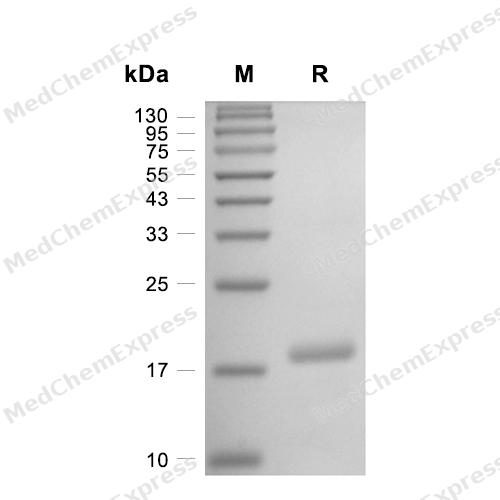
Purity - SDS-PAGE
-
Bioactivity - Cell-Based Assay
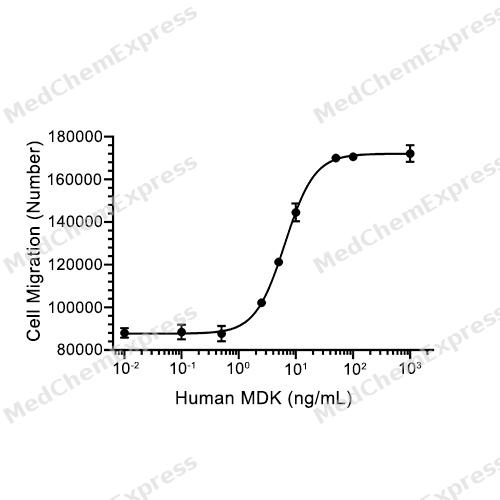
Bioactivity - Cell-Based Assay


Publications (1)
-
Journal Impact Factor
-
Most Recent


Technical Parameters
-
Species Human
-
Source E. coli
-
Tag N-His;N-Avi
-
Accession
P21741-1 (V21-D143)
-
Molecular Construction
-
N-term
-
His-Avi
-
MDK (V21-D143)
Accession # P21741-1 -
C-term
-
-
Protein Length
Full Length of Isoform-1
-
Synonyms
MDK; Midgestation And Kidney Protein; Prev. NEGF2; ARAP; MK; Neurite Outgrowth-Promoting Protein; Neurite Outgrowth-Promoting Factor 2; Retinoic Acid Inducible Factor; Neurite Growth-Promoting Factor 2; Mutant Truncated Midkine B; Amphiregulin-Associated
-
AA Sequence
VAKKKDKVKKGGPGSECAEWAWGPCTPSSKDCGVGFREGTCGAQTQRIRCRVPCNWKKEFGADCKYKFENWGACDGGTGTKVRQGTLKKARYNAQCQETIRVTKPCTPKTKAKAKAKKGKGKD
-
Predicted Molecular Mass
16.5 kDa
-
Molecular Weight
Approximately 16 kDa, based on SDS-PAGE under reducing conditions.
-
Purity
≥ 95%, as determined by reducing SDS-PAGE.


Product Properties
Lyophilized powder
Lyophilized from a 0.22 μm filtered solution of PBS, pH 7.4, 8% trehalose.
<1 EU/μg, determined by LAL method.
It is not recommended to reconstitute to a concentration less than 100 μg/mL in ddH2O.
Stored at -20°C for 2 years from date of receipt. After reconstitution, it is stable at 4°C for 1 week or -20°C for longer (with carrier protein). It is recommended to freeze aliquots at -20°C or -80°C for extended storage.
Room temperature in continental US; may vary elsewhere.


Documentation
-
Data Sheet (236 KB)
-
SDS (252 KB)
- English - EN (252 KB)
- Français - FR (252 KB)
- Deutsch - DE (252 KB)
- Norwegian - NO (252 KB)
- Español - ES (252 KB)
- Swedish - SV (252 KB)
- Italian - IT (252 KB)
- Korean - KR (252 KB)
- Portuguese - PT (252 KB)
-
Handling Instructions (2659 KB)

Calculators
Concentration (start) × Volume (start) = Concentration (final) × Volume (final)


 Powered by Bioz

