



PLAU/uPA Protein, Mouse (HEK293, C-His-Avi)
Based on 1 publication(s) in Google Scholar
PLAU or urokinase-type plasminogen activator (uPA) critically initiates fibrinolysis by cleaving plasminogen to form active plasmin.This enzymatic conversion is critical for regulating clot dissolution and tissue remodeling.PLAU/uPA Protein, Mouse (HEK293, C-His-Avi) is the recombinant mouse-derived PLAU/uPA protein, expressed by HEK293 , with C-His-Avi labeled tag.
- Species: Mouse
- Source: HEK293
-
Storage:Stored at -20°C for 2 years from date of receipt. After reconstitution, it is stable at 4°C for 1 week or -20°C for longer (with carrier protein). It is recommended to freeze aliquots at -20°C or -80°C for extended storage.


To place orders, for customer services and technical support, please contact: MedChemExpress USA
Tel: 609-228-6898 E-mail: [email protected] [email protected]


-
 Biological Activity
-
Technical Parameters
-
Product Properties
- Documentation
- Help & FAQs




Biological Activity
Description
PLAU or urokinase-type plasminogen activator (uPA) critically initiates fibrinolysis by cleaving plasminogen to form active plasmin.This enzymatic conversion is critical for regulating clot dissolution and tissue remodeling.PLAU/uPA Protein, Mouse (HEK293, C-His-Avi) is the recombinant mouse-derived PLAU/uPA protein, expressed by HEK293 , with C-His-Avi labeled tag.
Background
PLAU, also known as urokinase-type plasminogen activator (uPA), plays a crucial role in fibrinolysis by specifically cleaving the zymogen plasminogen to generate the active enzyme plasmin. This enzymatic conversion is a pivotal step in the regulation of blood clot dissolution and tissue remodeling. PLAU's ability to activate plasmin sets in motion a cascade of proteolytic events, contributing to the breakdown of fibrin clots and extracellular matrix components. This process is essential for various physiological functions, including wound healing, tissue repair, and the resolution of blood clots.
Verified Bioactivity
1.Human uPAR, hFc Tag captured on CM5 Chip via Protein A can bind Mouse PLAU, His-Avi Tag with an affinity constant of 0.33-10.24 μM as determined in SPR assay (Biacore T200).
2.Measured by its ability to cleave 1 mM fluorogenic peptide substrate, N-carbobenzyloxy-Gly-Gly-Arg-7-amido-4-methylcoumarin (HY-P0019) that incubate at room temperature in kinetic mode for 5 minutes. The specific activity is >1700 pmol/min/μg.
3.Measured by its ability to cleave 2 mM fluorogenic peptide substrate, N-carbobenzyloxy-Gly-Gly-Arg-7-amido-4-methylcoumarin (HY-P0019) that incubate at room temperature in kinetic mode for 5 minutes. The specific activity is 3000-7000 pmol/min/μg.
MCE Validation Data
-
Purity - SDS-PAGE
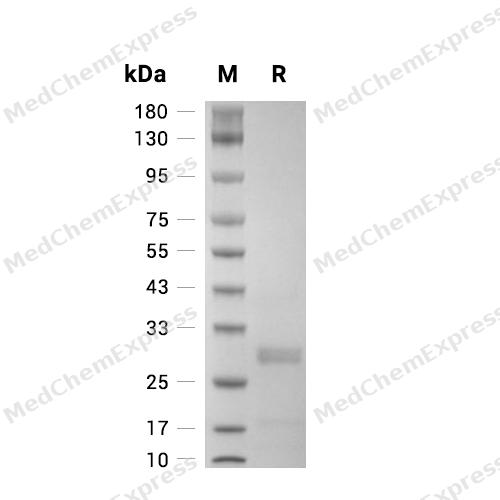
Purity - SDS-PAGE


Publications (1)
-
Journal Impact Factor
-
Most Recent


Technical Parameters
-
Species Mouse
-
Source HEK293
-
Tag C-Avi;C-His
-
Accession
P06869 (G21-F433)
-
Molecular Construction
-
N-term
-
PLAU (G21-F433)
Accession # P06869 -
His-Avi
-
C-term
-
-
Protein Length
Full Length of Mature Protein
-
Synonyms
PLAU; Plasminogen Activator, Urinary; Plasminogen Activator, Urokinase; PLAU Protein; UPA; BDPLT5; Urokinase-Type Plasminogen Activator; U-PA; URK; ATF; U-Plasminogen Activator; QPD
-
AA Sequence
GSVLGAPDESNCGCQNGGVCVSYKYFSRIRRCSCPRKFQGEHCEIDASKTCYHGNGDSYRGKANTDTKGRPCLAWNAPAVLQKPYNAHRPDAISLGLGKHNYCRNPDNQKRPWCYVQIGLRQFVQECMVHDCSLSKKPSSSVDQQGFQCGQKALRPRFKIVGGEFTEVENQPWFAAIYQKNKGGSPPSFKCGGSLISPCWVASAAHCFIQLPKKENYVVYLGQSKESSYNPGEMKFEVEQLILHEYYREDSLAYHNDIALLKIRTSTGQCAQPSRSIQTICLPPRFTDAPFGSDCEITGFGKESESDYLYPKNLKMSVVKLVSHEQCMQPHYYGSEINYKMLCAADPEWKTDSCKGDSGGPLICNIEGRPTLSGIVSWGRGCAEKNKPGVYTRVSHFLDWIQSHIGEEKGLAF
-
Predicted Molecular Mass
49 kDa
-
Molecular Weight
Approximately 28-35 kDa, based on SDS-PAGE under reducing conditions, due to the enzyme lysis and glycosylation.
-
Glycosylation
Yes
-
Purity
≥ 95%, as determined by reducing SDS-PAGE or Bis-Tris PAGE.


Product Properties
Lyophilized powder
1.Lyophilized from a 0.22 μm filtered solution of PBS, pH 7.4, 8% trehalose.
2.Lyophilized from a 0.22 μm filtered solution of 20 mM PB, 150 mM NaCl, pH 6.0, 8% trehalose.
3.Lyophilized from a 0.22 μm filtered solution of PBS, pH 7.4.
Please refer to the lot-specific COA for specific buffer information.
<1 EU/μg, determined by LAL method.
It is not recommended to reconstitute to a concentration less than 100 μg/mL in ddH2O.
Stored at -20°C for 2 years from date of receipt. After reconstitution, it is stable at 4°C for 1 week or -20°C for longer (with carrier protein). It is recommended to freeze aliquots at -20°C or -80°C for extended storage.
Room temperature in continental US; may vary elsewhere.


Documentation
-
Data Sheet (238 KB)
-
SDS (252 KB)
- English - EN (252 KB)
- Français - FR (252 KB)
- Deutsch - DE (252 KB)
- Norwegian - NO (252 KB)
- Español - ES (252 KB)
- Swedish - SV (252 KB)
- Italian - IT (252 KB)
- Korean - KR (252 KB)
- Portuguese - PT (252 KB)
-
Handling Instructions (2659 KB)

Calculators
Concentration (start) × Volume (start) = Concentration (final) × Volume (final)


 Powered by Bioz

