



RelA/NFkB p65 Protein, Human (GST)
Based on 3 publication(s) in Google Scholar
RelA/NF-kappa-B p65 is a key transcription factor that mediates inflammatory, immune, and cellular processes in response to multiple stimuli. Inactive in the cytoplasm, it forms a complex with I-kappa-B. RelA/NFkB p65 Protein, Human (GST) is the recombinant human-derived RelA/NFkB p65, expressed by E. coli, with N-GST labeled tag.
- Species: Human
- Source: E. coli
-
Storage:Stored at -20°C for 2 years from date of receipt. After reconstitution, it is stable at 4°C for 1 week or -20°C for longer (with carrier protein). It is recommended to freeze aliquots at -20°C or -80°C for extended storage.


To place orders, for customer services and technical support, please contact: MedChemExpress USA
Tel: 609-228-6898 E-mail: [email protected] [email protected]


-
 Biological Activity
-
Technical Parameters
-
Product Properties
- Documentation
- Help & FAQs




Biological Activity
Description
RelA/NF-kappa-B p65 is a key transcription factor that mediates inflammatory, immune, and cellular processes in response to multiple stimuli. Inactive in the cytoplasm, it forms a complex with I-kappa-B. RelA/NFkB p65 Protein, Human (GST) is the recombinant human-derived RelA/NFkB p65, expressed by E. coli, with N-GST labeled tag.
Background
RelA/NF-kappaB p65 is a multifaceted transcription factor integral to diverse cellular processes, acting as the endpoint of signal transduction cascades governing inflammation, immunity, differentiation, growth, tumorigenesis, and apoptosis. Functioning within NF-kappaB heterodimeric complexes, RelA pairs predominantly with NFKB1/p50 and REL, exerting transcriptional activation of target genes. This complex is held inactive in the cytoplasm by binding with NF-kappaB inhibitor (I-kappa-B) proteins. Upon stimulation, I-kappa-B is phosphorylated by I-kappa-B kinases, triggering its degradation, liberating the active NF-kappaB complex. RelA demonstrates a weak DNA-binding site, directly participating in DNA binding within the NF-kappaB complex. Beyond direct transcriptional activation, RelA modulates promoter accessibility, indirectly influencing gene expression. Intriguingly, RelA also interacts with a myriad of proteins, including various inhibitors, kinases, deacetylases, and other cofactors, underscoring its role in intricate cellular networks. Furthermore, in the context of microbial infection, RelA plays a key role in regulating the IFN response during SARS-CoV-2 infection and has been implicated in latent HIV-1 transcriptional reactivation.
MCE Validation Data
-
Purity - SDS-PAGE
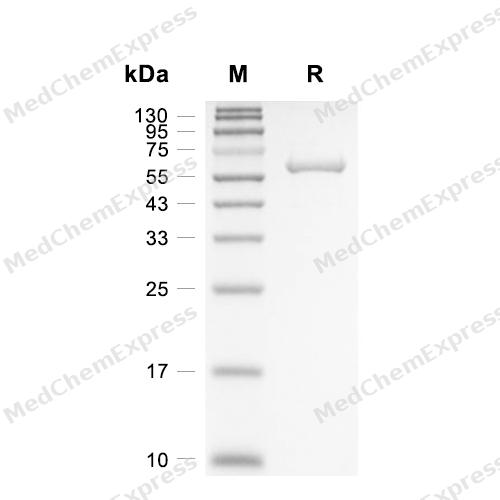
Purity - SDS-PAGE


Publications (3)
-
Journal Impact Factor
-
Most Recent
-
Pharmacol Res
2025 Aug 26:220:107933. PMID: 40876522 -
Phytomedicine
Combined transcriptomics and network pharmacology to elucidate the mechanisms of rutin in treating ischemic stroke rat. [Abstract]2025 Sep 15:148:157267. PMID: 40975038 -
J Transl Med
Mechanism by which CAP regulates the "cold-heat" balance in osteosarcoma model mice: an integrative study of metabolomics, transcriptomics, and network pharmacology. [Abstract]2025 Oct 27;23(1):1177. PMID: 41146125


Technical Parameters
-
Species Human
-
Source E. coli
-
Tag N-GST
-
Accession
Q04206-1 (M1-Y306)
-
Molecular Construction
-
N-term
-
GST
-
RelA (M1-Y306)
Accession # Q04206-1 -
C-term
-
-
Protein Length
Partial
-
Synonyms
RELA; NF-Kappa-B Transcription Factor P65; Prev. NFKB3; P65 Iso5 Isoform Delta 10; Nuclear Factor Of Kappa Light Polypeptide Gene Enhancer In B-Cells 3; Alternative Protein RELA; P65; NF-Kappa-B P65delta3; V-Rel Avian Reticuloendotheliosis Viral Oncogene
-
AA Sequence
MDELFPLIFPAEPAQASGPYVEIIEQPKQRGMRFRYKCEGRSAGSIPGERSTDTTKTHPTIKINGYTGPGTVRISLVTKDPPHRPHPHELVGKDCRDGFYEAELCPDRCIHSFQNLGIQCVKKRDLEQAISQRIQTNNNPFQVPIEEQRGDYDLNAVRLCFQVTVRDPSGRPLRLPPVLSHPIFDNRAPNTAELKICRVNRNSGSCLGGDEIFLLCDKVQKEDIEVYFTGPGWEARGSFSQADVHRQVAIVFRTPPYADPSLQAPVRVSMQLRRPSDRELSEPMEFQYLPDTDDRHRIEEKRKRTY
-
Molecular Weight
Approximately 58 kDa, based on SDS-PAGE under reducing conditions.
-
Purity
≥ 95%, as determined by reducing SDS-PAGE.


Product Properties
Lyophilized powder.
Lyophilized from a 0.22 μm filtered solution of PBS, pH 7.4, 8% trehalose.
<1 EU/μg, determined by LAL method.
It is not recommended to reconstitute to a concentration less than 100 μg/mL in ddH2O.
Stored at -20°C for 2 years from date of receipt. After reconstitution, it is stable at 4°C for 1 week or -20°C for longer (with carrier protein). It is recommended to freeze aliquots at -20°C or -80°C for extended storage.
Room temperature in continental US; may vary elsewhere.


Documentation
-
Data Sheet (237 KB)
-
SDS (251 KB)
- English - EN (251 KB)
- Français - FR (251 KB)
- Deutsch - DE (251 KB)
- Norwegian - NO (251 KB)
- Español - ES (251 KB)
- Swedish - SV (251 KB)
- Italian - IT (251 KB)
- Korean - KR (251 KB)
- Portuguese - PT (251 KB)
-
Handling Instructions (2659 KB)

Calculators
Concentration (start) × Volume (start) = Concentration (final) × Volume (final)


 Powered by Bioz

