



SCGN Protein, Human (His)

Based on 1 Customer Validation
SCGN Protein is a calcium-sensor protein with a regulatory role in glucose metabolism and the secretion of several peptide hormones. Secretagogin (SCGN) is a three-domain hexa-EF-hand Ca2+-binding protein. SCGN is a Ca2+-dependent generic molecular chaperone involved in protein homeostasis with broad substrate specificity. The overexpression of SCGN efficiently prevents cells from heat shock and oxidative damage. SCGN enhances pancreatic insulin secretion and is a useful biomarker of endocrine tumors, stroke, and psychiatric conditions. SCGN Protein, Human (His) is the recombinant human-derived SCGN protein, expressed by E. coli , with N-His labeled tag.
- Species: Human
- Source: E. coli
-
Storage:Stored at -20°C for 2 years from date of receipt. After reconstitution, it is stable at 4°C for 1 week or -20°C for longer (with carrier protein). It is recommended to freeze aliquots at -20°C or -80°C for extended storage.


To place orders, for customer services and technical support, please contact: MedChemExpress USA
Tel: 609-228-6898 E-mail: [email protected] [email protected]


-
 Biological Activity
-
Technical Parameters
-
Product Properties
- Documentation
- References
- Help & FAQs




Biological Activity
Description
SCGN Protein is a calcium-sensor protein with a regulatory role in glucose metabolism and the secretion of several peptide hormones. Secretagogin (SCGN) is a three-domain hexa-EF-hand Ca2+-binding protein. SCGN is a Ca2+-dependent generic molecular chaperone involved in protein homeostasis with broad substrate specificity. The overexpression of SCGN efficiently prevents cells from heat shock and oxidative damage. SCGN enhances pancreatic insulin secretion and is a useful biomarker of endocrine tumors, stroke, and psychiatric conditions[1][2][3]. SCGN Protein, Human (His) is the recombinant human-derived SCGN protein, expressed by E. coli , with N-His labeled tag.
Background
Secretagogin (SCGN) is a biomarker of neuroendocrine cells, and a gene product of the SCGN gene located on chromosome 6p22.3-p22.1. SCGN is a calcium binding protein that is highly expressed in neuroendocrine cells, and six EF-hand calcium-binding proteins are postulated to be involved in transmitting calcium signals to control cell proliferation. SCGN enhances pancreatic insulin secretion, and is a useful biomarker for endocrine tumors, stroke, and psychiatric conditions. SCGN also exerts a neuroprotective role in neurodegenerative diseases, such as Alzheimer's disease. In addition, RIN-5F insulinoma cell clones exhibit retarded cell growth following overexpression of SCGN, suggesting their involvement in growth control and differentiation or inhibition of cell replication by Ca2+ signal modulation[1].
extracellular SCGN is readily internalized into the C2C12 cells in an energy-dependent manner. SCGN internalizes via clathrin-mediated endocytosis, following which, SCGN localizes largely in the cytosol. Exogenous SCGN treatment induces a global proteomic reprogramming in C2C12 cells[2].
SCGN is expressed largely in pancreatic β-cells, certain parts of the brain, and also in neuroendocrine tissues. The expression of SCGN is altered in several diseases, such as diabetes, cancers, and neurodegenerative disorders. In the presence of Ca2+, SCGN efficiently prevents the aggregation of a broad range of model proteins in vitro. Ca2+ induces the conversion of a closed compact apo-SCGN conformation into an open extended holo-SCGN conformation via multistate intermediates, consistent with the augmentation of chaperone activity of SCGN[3].
MCE Validation Data
-
Purity - SDS-PAGE
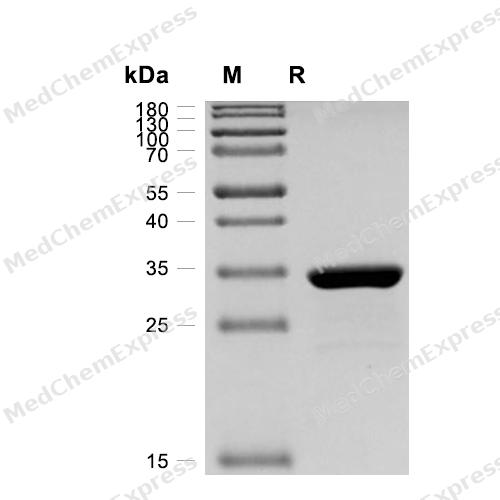
Purity - SDS-PAGE


Technical Parameters
-
Species Human
-
Source E. coli
-
Tag N-His
-
Accession
O76038 (D2-P276)
-
Molecular Construction
-
N-term
-
His
-
SCGN (D2-P276)
Accession # O76038 -
C-term
-
-
Protein Length
Full Length
-
Synonyms
SCGN; SEGN; Secretagogin, EF-Hand Calcium Binding Protein; Secretagogin; SECRET; Setagin; DJ501N12.8; Calbindin-Like; CALBL
-
AA Sequence
DSSREPTLGRLDAAGFWQVWQRFDADEKGYIEEKELDAFFLHMLMKLGTDDTVMKANLHKVKQQFMTTQDASKDGRIRMKELAGMFLSEDENFLLLFRRENPLDSSVEFMQIWRKYDADSSGFISAAELRNFLRDLFLHHKKAISEAKLEEYTGTMMKIFDRNKDGRLDLNDLARILALQENFLLQFKMDACSTEERKRDFEKIFAYYDVSKTGALEGPEVDGFVKDMMELVQPSISGVDLDKFREILLRHCDVNKDGKIQKSELALCLGLKINP
-
Molecular Weight
Approximately 32 kDa, based on SDS-PAGE under reducing conditions.
-
Purity
≥ 95%, as determined by reducing SDS-PAGE.


Product Properties
Lyophilized powder.
Lyophilized from a 0.22 μm filtered solution of PBS, pH 7.4.
<1 EU/μg, determined by LAL method.
It is not recommended to reconstitute to a concentration less than 100 μg/mL in ddH2O. For long term storage it is recommended to add a carrier protein (0.1% BSA, 5% HSA, 10% FBS or 5% Trehalose).
Stored at -20°C for 2 years from date of receipt. After reconstitution, it is stable at 4°C for 1 week or -20°C for longer (with carrier protein). It is recommended to freeze aliquots at -20°C or -80°C for extended storage.
Room temperature in continental US; may vary elsewhere.


Documentation
-
Data Sheet (264 KB)
-
SDS (251 KB)
- English - EN (251 KB)
- Français - FR (251 KB)
- Deutsch - DE (251 KB)
- Norwegian - NO (251 KB)
- Español - ES (251 KB)
- Swedish - SV (251 KB)
- Italian - IT (251 KB)
- Korean - KR (251 KB)
- Portuguese - PT (251 KB)
-
Handling Instructions (2659 KB)


References
[1]. Yunlong Dong, et al. Secretagogin, a marker for neuroendocrine cells, is more sensitive and specific in large cell neuroendocrine carcinoma compared with the markers CD56, CgA, Syn and Napsin A. Oncol Lett. 2020 Mar;19(3):2223-2230. [Content Brief]
[2]. Radhika Khandelwal, et al. Extracellular secretagogin is internalized into the cells through endocytosis. FEBS J. 2022 Jun;289(11):3183-3204. [Content Brief]
[3]. Amrutha H Chidananda, et al. Secretagogin is a Ca2+-dependent stress-responsive chaperone that may also play a role in aggregation-based proteinopathies. J Biol Chem. 2022 Sep;298(9):102285. [Content Brief]

Calculators
Concentration (start) × Volume (start) = Concentration (final) × Volume (final)


 Powered by Bioz

