



SOST Protein, Human (HEK293, His)
Based on 1 Customer Validation
SOST proteins act as potent inhibitors of bone growth by effectively inhibiting Wnt signaling and subsequent bone formation. SOST exerts its inhibitory effect by interacting with key Wnt pathway components, including LRP4, LRP5, and LRP6. SOST Protein, Human (HEK293, His) is the recombinant human-derived SOST protein, expressed by HEK293 , with C-6*His labeled tag.
- Species: Human
- Source: HEK293
-
Storage:Stored at -20°C for 2 years from date of receipt. After reconstitution, it is stable at 4°C for 1 week or -20°C for longer (with carrier protein). It is recommended to freeze aliquots at -20°C or -80°C for extended storage.


To place orders, for customer services and technical support, please contact: MedChemExpress USA
Tel: 609-228-6898 E-mail: [email protected] [email protected]


-
 Biological Activity
-
Technical Parameters
-
Product Properties
- Documentation
- Help & FAQs




Biological Activity
Description
SOST proteins act as potent inhibitors of bone growth by effectively inhibiting Wnt signaling and subsequent bone formation. SOST exerts its inhibitory effect by interacting with key Wnt pathway components, including LRP4, LRP5, and LRP6. SOST Protein, Human (HEK293, His) is the recombinant human-derived SOST protein, expressed by HEK293 , with C-6*His labeled tag.
Background
SOST protein serves as a potent negative regulator of bone growth by effectively inhibiting Wnt signaling and subsequent bone formation. Through interactions with key components of the Wnt pathway, including LRP4, LRP5, and LRP6, SOST exerts its inhibitory influence. Notably, its interaction with LRP4, mediated via the extracellular domain, facilitates the suppression of Wnt signaling, while interactions with LRP5, specifically through the first two YWTD-EGF repeat domains, contribute to the inhibition of Wnt-mediated signaling. These molecular interactions underscore the crucial role of SOST in modulating the intricate signaling cascades that govern bone development, providing essential regulatory mechanisms to maintain bone homeostasis.
Verified Bioactivity
1.Immobilized Human SOST, His Tag at 1 μg/mL (100 μL/well) on the plate. Dose response curve for Human LRP-6, mFc Tag with the EC50 of 18.6 ng/mL determined by ELISA.
2.Immobilized Human LRP-6 Protein, mFc Tag (HY-P77990) at 1 µg/mL (100µL/well) can bind biotinylated Human SOST. The ED50 for this effect is 11.96 ng/mL.
MCE Validation Data
-
Purity - SDS-PAGE
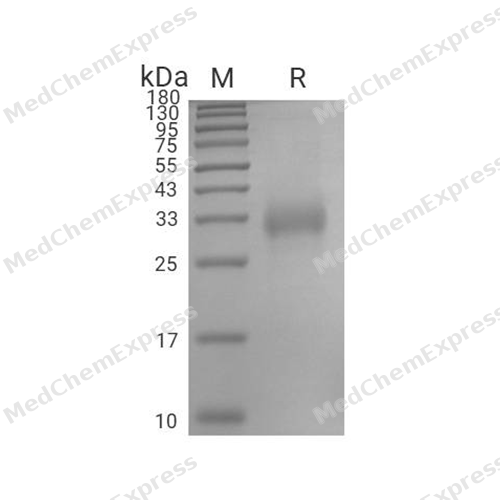
Purity - SDS-PAGE
-
Bioactivity - ELISA
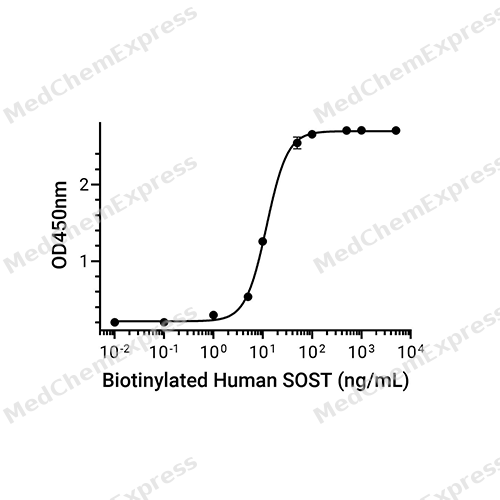
Bioactivity - ELISA


Technical Parameters
-
Species Human
-
Source HEK293
-
Tag C-6*His
-
Accession
Q9BQB4-1 (Q24-Y213)
-
Molecular Construction
-
N-term
-
SOST (Q24-Y213)
Accession # Q9BQB4-1 -
6*His
-
C-term
-
-
Protein Length
Full Length of Isoform-1
-
Synonyms
SOST; Sclerosteosis; Sclerostin; SOST1; DAND6; CDD; VBCH
-
AA Sequence
QGWQAFKNDATEIIPELGEYPEPPPELENNKTMNRAENGGRPPHHPFETKDVSEYSCRELHFTRYVTDGPCRSAKPVTELVCSGQCGPARLLPNAIGRGKWWRPSGPDFRCIPDRYRAQRVQLLCPGGEAPRARKVRLVASCKCKRLTRFHNQSELKDFGTEAARPQKGRKPRPRARSAKANQAELENAY
-
Predicted Molecular Mass
22.3 kDa
-
Molecular Weight
Approximately 28-38 kDa, based on SDS-PAGE under reducing conditions.
-
Glycosylation
Yes
-
Purity
≥ 95%, as determined by reducing SDS-PAGE.


Product Properties
Lyophilized powder
1.Lyophilized from a 0.22 μm filtered solution of 20 mM Tris-HCl, 250 mM NaCl, pH 8.0.
2.Lyophilized from a 0.22 μm filtered solution of 20 mM NaAc-Hac, 8% trehalose, 0.02% Tween 80, pH 5.0.
Note: For SPR assay, please replace the buffer. Primary amine components (e.g., Tris, imidazole) can affect protein-coupled chips.
Please refer to the lot-specific COA for specific buffer information.
<1 EU/μg, determined by LAL method.
It is not recommended to reconstitute to a concentration less than 100 μg/mL in ddH2O.
Stored at -20°C for 2 years from date of receipt. After reconstitution, it is stable at 4°C for 1 week or -20°C for longer (with carrier protein). It is recommended to freeze aliquots at -20°C or -80°C for extended storage.
Room temperature in continental US; may vary elsewhere.


Documentation
-
Data Sheet (237 KB)
-
SDS (252 KB)
- English - EN (252 KB)
- Français - FR (252 KB)
- Deutsch - DE (252 KB)
- Norwegian - NO (252 KB)
- Español - ES (252 KB)
- Swedish - SV (252 KB)
- Italian - IT (252 KB)
- Korean - KR (252 KB)
- Portuguese - PT (252 KB)
-
Handling Instructions (2659 KB)

Calculators
Concentration (start) × Volume (start) = Concentration (final) × Volume (final)


 Powered by Bioz

