



Thioredoxin/TXN Protein, Human
Based on 1 publication(s) in Google Scholar
Thioredoxin/TXN protein participates in multiple redox reactions, utilizing its active center dithiol for reversible oxidation and disulfide bond formation. It catalyzes important dithiol-disulfide exchange and plays a key role in S-nitrosylation of cysteine residues in response to intracellular nitric oxide. Thioredoxin/TXN Protein, Human is the recombinant human-derived Thioredoxin/TXN protein, expressed by E. coli , with tag free.
- Species: Human
- Source: E. coli
-
Storage:Stored at -20°C for 2 years from date of receipt. After reconstitution, it is stable at 4°C for 1 week or -20°C for longer (with carrier protein). It is recommended to freeze aliquots at -20°C or -80°C for extended storage.


To place orders, for customer services and technical support, please contact: MedChemExpress USA
Tel: 609-228-6898 E-mail: [email protected] [email protected]


-
 Biological Activity
-
Technical Parameters
-
Product Properties
- Documentation
- Help & FAQs




Biological Activity
Description
Thioredoxin/TXN protein participates in multiple redox reactions, utilizing its active center dithiol for reversible oxidation and disulfide bond formation. It catalyzes important dithiol-disulfide exchange and plays a key role in S-nitrosylation of cysteine residues in response to intracellular nitric oxide. Thioredoxin/TXN Protein, Human is the recombinant human-derived Thioredoxin/TXN protein, expressed by E. coli , with tag free.
Background
Thioredoxin/TXN Protein actively engages in diverse redox reactions, employing the reversible oxidation of its active center dithiol to form a disulfide bond, and catalyzes crucial dithiol-disulfide exchange reactions. Beyond its classical redox functions, Thioredoxin plays a pivotal role in the reversible S-nitrosylation of cysteine residues within target proteins, contributing to the cellular response to intracellular nitric oxide. Notably, it exerts regulatory control over caspase-3 activity by nitrosylating the active site cysteine of CASP3 in response to nitric oxide. Moreover, Thioredoxin demonstrates its influence on the FOS/JUN AP-1 DNA-binding activity in ionizing radiation cells, modulating AP-1 transcriptional activity through its oxidation/reduction status. Additionally, Thioredoxin is implicated in the augmentation of interleukin-2 receptor TAC (IL2R/P55) expression, highlighting its multifaceted role in cellular processes beyond redox regulation.
Verified Bioactivity
Measured by its ability to catalyze the reduction of insulin. The reaction leads to precipitation, which can be measured by absorbance at 650 nm and the specific activity is 5-11 A650/min/mg.
MCE Validation Data
-
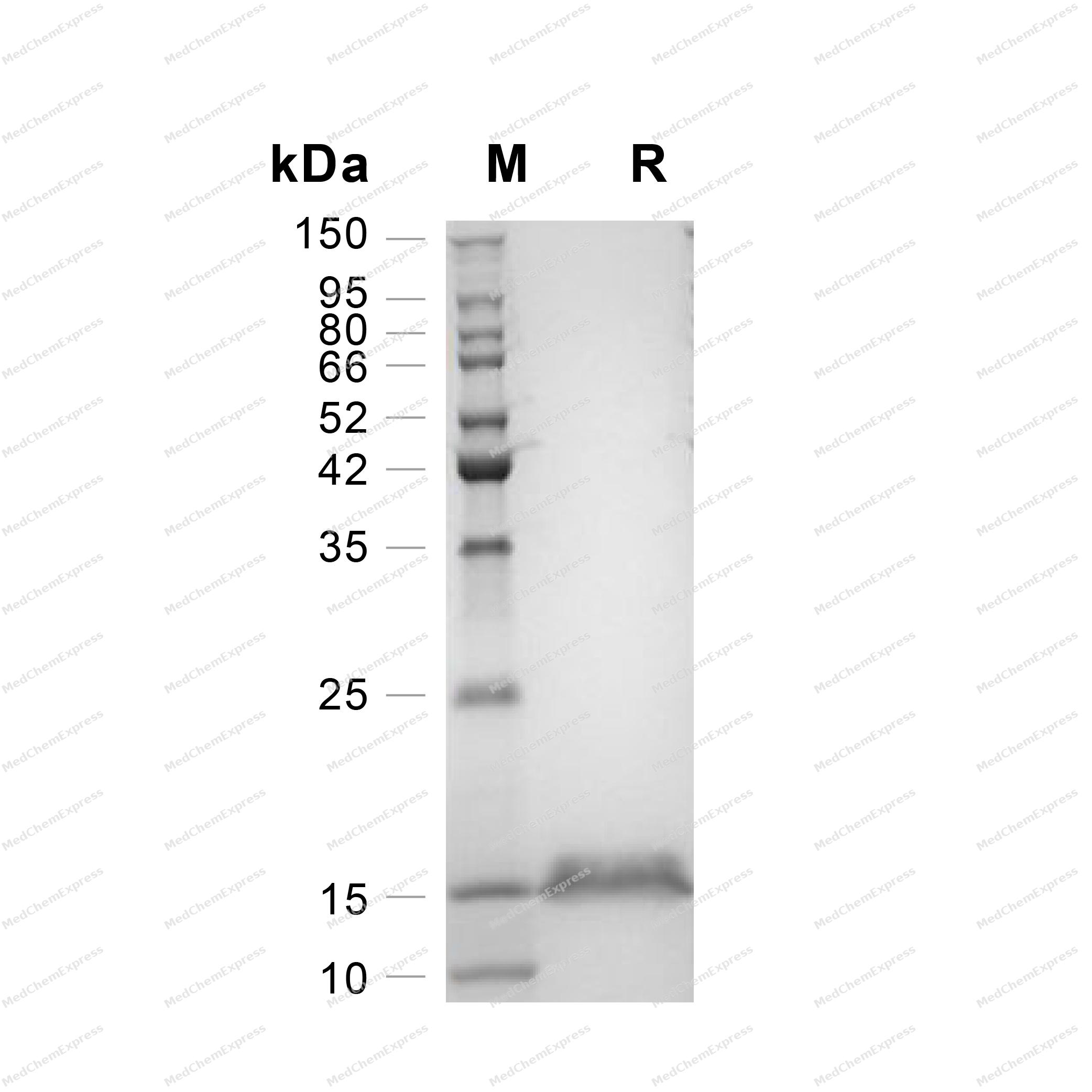
Purity - SDS-PAGE
Purity - SDS-PAGE


Publications (1)
-
Journal Impact Factor
-
Most Recent


Technical Parameters
-
Species Human
-
Source E. coli
-
Tag Tag Free
-
Accession
P10599 (M1-V105)
-
Gene ID7295
-
Molecular Construction
-
N-term
-
TXN (M1-V105)
Accession # P10599 -
C-term
-
-
Protein Length
Full Length
-
Synonyms
TXN; TRDX; TRX; TRX1; Thioredoxin; Trx; ATL-derived factor; ADF; Surface-associated sulphydryl protein; SASP; TXN Delta 3; Thioredoxin-2; Allergen Hom S Trx; Thioredoxin Delta 3; Thioredoxin, Mitochondrial; Testicular Tissue Protein Li 199; ADF; Surface-A
-
AA Sequence
MVKQIESKTAFQEALDAAGDKLVVVDFSATWCGPCKMIKPFFHSLSEKYSNVIFLEVDVDDCQDVASECEVKCMPTFQFFKKGQKVGEFSGANKEKLEATINELV
-
Predicted Molecular Mass
11.7 kDa
-
Molecular Weight
Approximately 16 kDa, based on SDS-PAGE under reducing conditions.
-
Purity
≥ 95%, as determined by reducing SDS-PAGE.


Product Properties
Lyophilized powder
Lyophilized from a 0.22 μm filtered solution of PBS, pH 7.4.
<1 EU/μg, determined by LAL method.
It is not recommended to reconstitute to a concentration less than 100 μg/mL in ddH2O. For long term storage it is recommended to add a carrier protein (0.1% BSA, 5% HSA, 10% FBS or 5% Trehalose).
Stored at -20°C for 2 years from date of receipt. After reconstitution, it is stable at 4°C for 1 week or -20°C for longer (with carrier protein). It is recommended to freeze aliquots at -20°C or -80°C for extended storage.
Room temperature in continental US; may vary elsewhere.


Documentation
-
Data Sheet (235 KB)
-
SDS (251 KB)
- English - EN (251 KB)
- Français - FR (251 KB)
- Deutsch - DE (251 KB)
- Norwegian - NO (251 KB)
- Español - ES (251 KB)
- Swedish - SV (251 KB)
- Italian - IT (251 KB)
- Korean - KR (251 KB)
- Portuguese - PT (251 KB)
-
Handling Instructions (2659 KB)

Calculators
Concentration (start) × Volume (start) = Concentration (final) × Volume (final)


 Powered by Bioz

