



TIM Protein, Human (His)

Based on 1 Customer Validation
TIM protein is a highly efficient metabolic enzyme that catalyzes the rapid interconversion between dihydroxyacetone phosphate (DHAP) and D-glyceraldehyde-3-phosphate (G3P) during glycolysis and gluconeogenesis. Its key role in glucose metabolism is complemented by an additional responsibility: the production of methylglyoxal, a reactive cytotoxic by-product. TIM Protein, Human (His) is the recombinant human-derived TIM protein, expressed by E. coli , with N-6*His labeled tag.
- Species: Human
- Source: E. coli
-
Storage:Stored at -80°C for 1 year from date of receipt. It is stable at -20°C for 3 months after opening. It is recommended to freeze aliquots at -80°C for extended storage. Avoid repeated freeze-thaw cycles.


To place orders, for customer services and technical support, please contact: MedChemExpress USA
Tel: 609-228-6898 E-mail: [email protected] [email protected]


-
 Biological Activity
-
Technical Parameters
-
Product Properties
- Documentation
- Help & FAQs




Biological Activity
Description
TIM protein is a highly efficient metabolic enzyme that catalyzes the rapid interconversion between dihydroxyacetone phosphate (DHAP) and D-glyceraldehyde-3-phosphate (G3P) during glycolysis and gluconeogenesis. Its key role in glucose metabolism is complemented by an additional responsibility: the production of methylglyoxal, a reactive cytotoxic by-product. TIM Protein, Human (His) is the recombinant human-derived TIM protein, expressed by E. coli , with N-6*His labeled tag.
Background
Triosephosphate isomerase (TIM) stands out as an exceptionally efficient metabolic enzyme crucial for catalyzing the rapid interconversion between dihydroxyacetone phosphate (DHAP) and D-glyceraldehyde-3-phosphate (G3P) in the central pathways of glycolysis and gluconeogenesis. Beyond its pivotal role in glucose metabolism, TIM assumes an additional responsibility in the production of methylglyoxal, a reactive and cytotoxic side-product. Methylglyoxal exhibits the potential to modify and induce alterations in proteins, DNA, and lipids, emphasizing the dual nature of TIM's involvement in fundamental metabolic processes and the generation of cytotoxic byproducts.
MCE Validation Data
-
Purity - SDS-PAGE
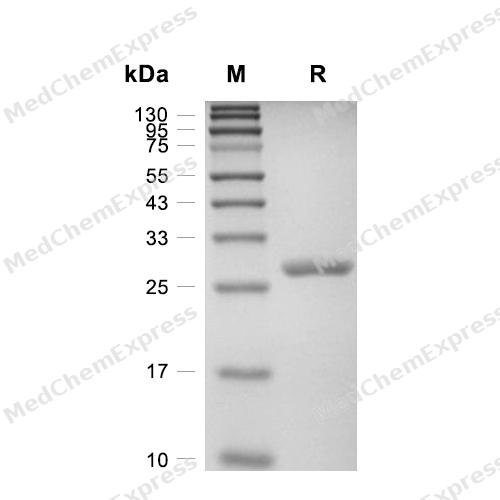
Purity - SDS-PAGE


Technical Parameters
-
Species Human
-
Source E. coli
-
Tag N-6*His
-
Accession
P60174 (M1-Q249)
-
Molecular Construction
-
N-term
-
6*His
-
TIM (M1-Q249)
Accession # P60174 -
C-term
-
-
Protein Length
Full Length
-
Synonyms
TPI1; TIM; Triosephosphate Isomerase 1; TPI; Triosephosphate Isomerase; Epididymis Secretory Protein Li 49; Triose-Phosphate Isomerase; HEL-S-49; Methylglyoxal Synthase; TPID
-
AA Sequence
MAPSRKFFVGGNWKMNGRKQSLGELIGTLNAAKVPADTEVVCAPPTAYIDFARQKLDPKIAVAAQNCYKVTNGAFTGEISPGMIKDCGATWVVLGHSERRHVFGESDELIGQKVAHALAEGLGVIACIGEKLDEREAGITEKVVFEQTKVIADNVKDWSKVVLAYEPVWAIGTGKTATPQQAQEVHEKLRGWLKSNVSDAVAQSTRIIYGGSVTGATCKELASQPDVDGFLVGGASLKPEFVDIINAKQ
-
Predicted Molecular Mass
28.8 kDa
-
Molecular Weight
Approximately 30 kDa, based on SDS-PAGE under reducing conditions.
-
Purity
≥ 95%, as determined by reducing SDS-PAGE.


Product Properties
Solution
Supplied as a 0.22 μm filtered solution of 20 mM Tris-HCl, 1 mM DTT, 10% Glycerol, pH 8.0.
Note: For SPR assay, please replace the buffer. Primary amine components (e.g., Tris, imidazole) can affect protein-coupled chips.
<1 EU/μg, determined by LAL method.
Stored at -80°C for 1 year from date of receipt. It is stable at -20°C for 3 months after opening. It is recommended to freeze aliquots at -80°C for extended storage. Avoid repeated freeze-thaw cycles.
Shipping with dry ice.


Documentation
-
Data Sheet (236 KB)
-
SDS (252 KB)
- English - EN (252 KB)
- Français - FR (252 KB)
- Deutsch - DE (252 KB)
- Norwegian - NO (252 KB)
- Español - ES (252 KB)
- Swedish - SV (252 KB)
- Italian - IT (252 KB)
- Korean - KR (252 KB)
- Portuguese - PT (252 KB)
-
Handling Instructions (2659 KB)

Calculators
Concentration (start) × Volume (start) = Concentration (final) × Volume (final)


 Powered by Bioz

