



TREM-2 Protein, Mouse (HEK293, His)

Based on 1 Customer Validation
TREM-2 protein forms a signaling complex with TYROBP, activates cells upon ligand binding, and acts as a receptor for amyloid beta, lipoproteins, and apolipoproteins. It promotes their uptake by microglia, triggering activation, proliferation, migration, apoptosis and cytokine expression. TREM-2 Protein, Mouse (HEK293, His) is the recombinant mouse-derived TREM-2 protein, expressed by HEK293 , with C-6*His labeled tag.
- Species: Mouse
- Source: HEK293
-
Storage:Stored at -20°C for 2 years from date of receipt. After reconstitution, it is stable at 4°C for 1 week or -20°C for longer (with carrier protein). It is recommended to freeze aliquots at -20°C or -80°C for extended storage.


To place orders, for customer services and technical support, please contact: MedChemExpress USA
Tel: 609-228-6898 E-mail: [email protected] [email protected]


-
 Biological Activity
-
Technical Parameters
-
Product Properties
- Documentation
- Help & FAQs




Biological Activity
Description
TREM-2 protein forms a signaling complex with TYROBP, activates cells upon ligand binding, and acts as a receptor for amyloid beta, lipoproteins, and apolipoproteins. It promotes their uptake by microglia, triggering activation, proliferation, migration, apoptosis and cytokine expression. TREM-2 Protein, Mouse (HEK293, His) is the recombinant mouse-derived TREM-2 protein, expressed by HEK293 , with C-6*His labeled tag.
Background
TREM-2 Protein forms a receptor signaling complex with TYROBP, mediating signaling and cell activation upon ligand binding. It acts as a receptor for amyloid-beta protein 42, facilitating its uptake and degradation by microglia, resulting in microglial activation, proliferation, migration, apoptosis, and cytokine expression. Additionally, TREM-2 serves as a receptor for lipoprotein particles and apolipoproteins, enhancing their uptake in microglia. It binds phospholipids and regulates microglial proliferation, phagocytosis of apoptotic neurons, and response to oxidative stress. Furthermore, TREM-2 suppresses PI3K and NF-kappa-B signaling, promotes anti-apoptotic NF-kappa-B signaling during oxidative stress, and plays a role in microglial MTOR activation and metabolism. It is involved in age-related changes in microglial numbers and triggers immune responses in macrophages and dendritic cells. TREM-2 also mediates cytokine-induced multinucleated giant cell formation and is implicated in osteoclast differentiation. The protein interacts with TYROBP, and this interaction is crucial for stabilizing the TREM-2 C-terminal fragment.
Verified Bioactivity
Measured by its binding ability in a functional ELISA. Immobilized Mouse TREM2, at 1 μg/mL (100 μL/well) can bind Anti-TREM2 Antibody, the ED50 is ≤46.44 ng/mL, corresponding to a specific activity is ≥2.153×10⁴ units/mg.
MCE Validation Data
-
Purity - SDS-PAGE
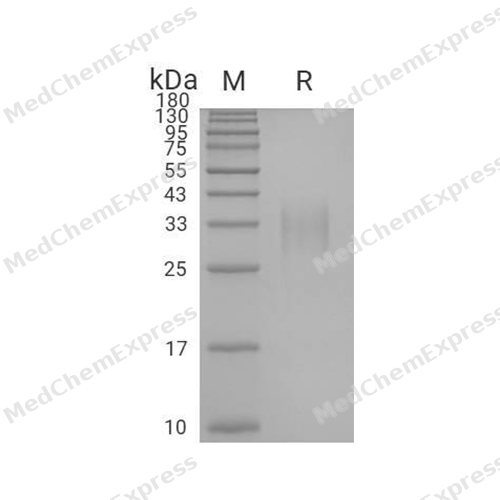
Purity - SDS-PAGE
-
Bioactivity - ELISA
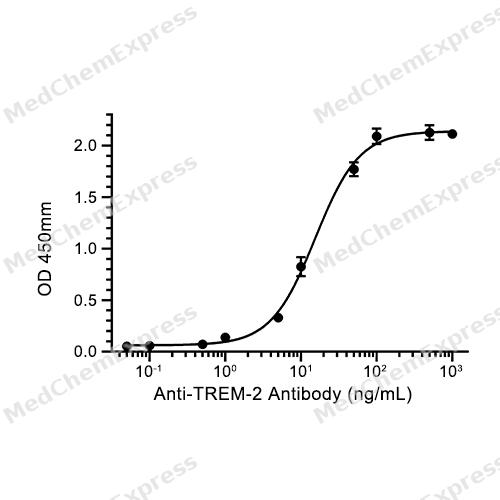
Bioactivity - ELISA


Technical Parameters
-
Species Mouse
-
Source HEK293
-
Tag C-6*His
-
Accession
Q99NH8-1 (L19-P168)
-
Molecular Construction
-
N-term
-
TREM-2 (L19-P168)
Accession # Q99NH8-1 -
6*His
-
C-term
-
-
Protein Length
Extracellular Domain
-
Synonyms
TREM2; Trem2b; Triggering Receptor Expressed On Myeloid Cells 2; Trem2c; TREM-2; Triggering Receptor Expressed On Myeloid Cells 2a; Triggering Receptor Expressed On Monocytes 2; PLOSL2; Trem2a; AD17
-
AA Sequence
LNTTVLQGMAGQSLRVSCTYDALKHWGRRKAWCRQLGEEGPCQRVVSTHGVWLLAFLKKRNGSTVIADDTLAGTVTITLKNLQAGDAGLYQCQSLRGREAEVLQKVLVEVLEDPLDDQDAGDLWVPEESSSFEGAQVEHSTSRNQETSFP
-
Predicted Molecular Mass
17.3 kDa
-
Molecular Weight
Approximately 25-40 kDa, based on SDS-PAGE under reducing conditions.
-
Glycosylation
Yes
-
Purity
≥ 95%, as determined by reducing SDS-PAGE.


Product Properties
Lyophilized powder
1.Lyophilized from a 0.22 μm filtered solution of 20 mM PB, 150 mM NaCl, pH 7.4.
2.Lyophilized from a 0.22 μm filtered solution of 20 mM Tris-HCl, 8% trehaolse, 2% mannitol, 0.05% Tween 80, pH 8.0.
3.Lyophilized from a 0.22 μm filtered solution of PBS, pH 7.4.
Please refer to the lot-specific COA for specific buffer information.
Note: For SPR assay, please replace the buffer. Primary amine components (e.g., Tris, imidazole) can affect protein-coupled chips.
<1 EU/μg, determined by LAL method.
It is not recommended to reconstitute to a concentration less than 100 μg/mL in ddH2O. For long term storage it is recommended to add a carrier protein (0.1% BSA, 5% HSA, 10% FBS or 5% Trehalose).
Stored at -20°C for 2 years from date of receipt. After reconstitution, it is stable at 4°C for 1 week or -20°C for longer (with carrier protein). It is recommended to freeze aliquots at -20°C or -80°C for extended storage.
Room temperature in continental US; may vary elsewhere.


Documentation
-
Data Sheet (237 KB)
-
SDS (251 KB)
- English - EN (251 KB)
- Français - FR (251 KB)
- Deutsch - DE (251 KB)
- Norwegian - NO (251 KB)
- Español - ES (251 KB)
- Swedish - SV (251 KB)
- Italian - IT (251 KB)
- Korean - KR (251 KB)
- Portuguese - PT (251 KB)
-
Handling Instructions (2659 KB)

Calculators
Concentration (start) × Volume (start) = Concentration (final) × Volume (final)


 Powered by Bioz

