111 Results for "

Chimeras.

" in MedChemExpress (MCE) Product Catalog:
Products (111)

111 Results for "Chimeras." in MCE Product Catalog:

Cat. No.: HY-130646
CAS No.: 2472645-27-3
Target:  

PROTACs PARP

Research Areas:  

Cancer

iVeliparib-AP6 is a proteolysis-targeting chimera (PROTAC) molecule designed based on Veliparib (HY-10129), which targets PARP1/2. The DC50s of iVeliparib-AP6 for inducing the degradation of PARP1 and PARP2 are 36 nM and 63 nM, respectively, and its IC50s are 69 nM and 21 nM, respectively. iVeliparib-AP6 contains a Veliparib-based PARP inhibitor warhead linked to a CRBN E3 ligase binder; it uses Thalidomide (HY-14658) as a ligand to recruit CRBN E3 ubiquitin ligase and exerts the PARP2 degradation mechanism .
loading...
    loading...
Cat. No.: HY-184195
PROTAC AR Degrader-13 is a proteolysis-targeting chimera (PROTACs) that targets the androgen receptor (AR). PROTAC AR Degrader-13 has a DC50 of 0.90 nM in LNCaP cells and a DC50 of 0.23 nM in hDPC cells. PROTAC AR Degrader-13 induces AR degradation, downregulates TGF-β1 expression, upregulates β-catenin levels, and restores the Wnt/β-catenin pro-proliferation signaling in hair follicles. In a testosterone-induced androgenetic alopecia mouse model, PROTAC AR Degrader-13 accelerates hair regeneration rate, increases hair density and hair diameter. PROTAC AR Degrader-13 can be used for the research of androgenetic alopecia .
loading...
    loading...
Cat. No.: HY-189146
Research Areas:  

Cancer

HDTAC EGFR Degrader-1 is an EGFR HDTAC (hypoxia-activated targeted protein degradation chimera) degrader with a DC50 of 1.76 μM. HDTAC EGFR Degrader-1 consists of a linker, a tumor hypoxia-activated group (HAG, a group that generates ROS under tumor hypoxic conditions), and an EGFR ligand. HDTAC EGFR Degrader-1 drives EGFR degradation through the proteasomal pathway. HDTAC EGFR Degrader-1 downregulates Caspase-3 under hypoxic conditions. HDTAC EGFR Degrader-1 can be used in research on non-small cell lung cancer harboring EGFR mutations (EGFR ligand: FAAH-IN-2 (HY-79511); HAG: Thalidomide-O-COOH (HY-103597); linker: NH2-PEG3 (HY-W007545)) .
loading...
    loading...
Cat. No.: HY-L129
128 compounds

Proteolysis-targeting chimera (PROTAC) has been developed to be a useful technology for targeted protein degradation. PROTACs consist of a ligand for E3 ligase (E3 ligase binder), a linker and a ligand (mostly small-molecule inhibitor) for protein of interest(target binder). Upon binding to the target protein, the PROTACs can recruit E3 for target protein ubiquitination, which is subjected to proteasome-mediated degradation. Therefore, PROTACs execute their functions by degrading the target proteins rather than inhibiting them, which has a great superiority in overcoming resistance caused by target mutation or overexpression. To date, PROTAC technology has been applied to a variety of targets, including AR, ER, BTK, BET, and BCR-ABL to overcome resistance.

MCE carefully prepared a unique collection of 128 ligands for target proteins, which have been reported to be used in PROTAC design. MCE Target Protein Ligand Library is a useful tool for PROTAC development.

Cat. No.: HY-L128
187 compounds

Proteolysis-targeting chimera (PROTAC) has been developed to be a useful technology for targeted protein degradation. PROTACs consist of a ligand for E3 ligase (E3 ligase binder), a linker and a ligand (mostly small-molecule inhibitor) for protein of interest(target binder). Upon binding to the target protein, the PROTACs can recruit E3 for target protein ubiquitination, which is subjected to proteasome-mediated degradation.

Although there are more than 600 E3 ubiquitin ligases, only several with small molecule ligands have been used for designing PROTACs, including Skp1-Cullin-F box complex containing Hrt1 (SCF), Von Hippel-Lindau tumor suppressor (VHL), Cereblon (CRBN), inhibitor of apoptosis proteins (IAPs), and mouse double minute 2 homolog (MDM2).

MCE carefully prepared a unique collection of 187 ligands for E3 ligase, which have been reported to be used in PROTAC design. MCE E3 ligase ligand library is a useful tool for PROTAC development.

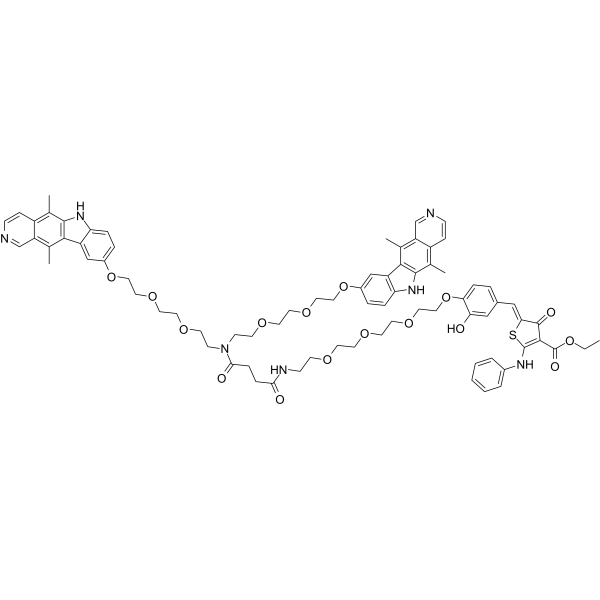
Cat. No.: HY-141878
CAS No.: 2767983-76-4
Research Areas:  

Neurological Disease

di-Ellipticine-RIBOTAC is a RNase recruiting chimera (RIBOTAC) degrader, capable of specifically binding and degrading expanded G4C2 RNA repeat (r(G4C2) exp). di-Ellipticine-RIBOTAC selectively binds the three-dimensional (3D) structure formed by r(G4C2) exp and that recruits an endogenous ribonuclease (RNase) to cleave r(G4C2) exp. di-Ellipticine-RIBOTAC selectively degrades the mutant chromosome 9 open reading frame 72 (C9orf72) allele and reduces quantities of toxic dipeptide repeat proteins (DPRs) translated from r(G4C2) exp. di-Ellipticine-RIBOTAC significantly improves the pathological phenotype of amyotrophic lateral sclerosis/ frontotemporal dementia (c9ALS/FTD) in cells and mouse models. di-Ellipticine-RIBOTAC can be used for the study of amyotrophic lateral sclerosis (ALS) and frontotemporal dementia (FTD) .
loading...
    loading...
Cat. No.: HY-187390
BRD4 RIMTAC-1 is a BRD4 PROTAC degrader based on the RIPK1-mediated targeted chimera (RIMTAC) technology. It hijacks the endogenous RIPK1-VHL complex via the RIPK1 inhibitor moiety to indirectly recruit the VHL E3 ligase, forming a BRD4-Compound 10-RIPK1-VHL quaternary complex, and degrades BRD4 through the ubiquitin-proteasome system (UPS). BRD4 RIMTAC-1 exhibits selectivity over other BET proteins, induces concentration- and time-dependent, reversible post-translational degradation of BRD4 without altering the target mRNA level. BRD4 RIMTAC-1 potently induces endogenous BRD4 degradation in RAW264.7 and HEK-293T cells, with DC50 values of 179.1 nM and 54.12 nM, respectively. BRD4 RIMTAC-1 can be used for the research of cancer and inflammation-related diseases .
loading...
    loading...
Cat. No.: HY-141878A
CAS No.: 2767983-77-5
Research Areas:  

Neurological Disease

di-Ellipticine-RIBOTAC TFA is a RNase recruiting chimera (RIBOTAC) degrader, capable of specifically binding and degrading expanded G4C2 RNA repeat (r(G4C2) exp). di-Ellipticine-RIBOTAC TFA selectively binds the three-dimensional (3D) structure formed by r(G4C2) exp and that recruits an endogenous ribonuclease (RNase) to cleave r(G4C2) exp. di-Ellipticine-RIBOTAC TFA selectively degrades the mutant chromosome 9 open reading frame 72 (C9orf72) allele and reduces quantities of toxic dipeptide repeat proteins (DPRs) translated from r(G4C2) exp. di-Ellipticine-RIBOTAC TFA significantly improves the pathological phenotype of amyotrophic lateral sclerosis/ frontotemporal dementia (c9ALS/FTD) in cells and mouse models. di-Ellipticine-RIBOTAC TFA can be used for the study of amyotrophic lateral sclerosis (ALS) and frontotemporal dementia (FTD) .
loading...
    loading...
Cat. No.: HY-181906
Research Areas:  

Cancer

ZnPc-PEG2-VH032 is a VHL-pathway-dependent photodegradation targeting chimera (PDTAC) and cytotoxic agent. ZnPc-PEG2-VH032 (HY-120217) binds to the VHL ligand domain, and then specifically degrades VHL under light irradiation, a process independent of non-specific ROS-mediated protein damage. ZnPc-PEG2-VH032 uses Zinc phthalocyanine (HY-19204) as a photosensitizer, and generates ROS via type I and type II photodynamic pathways under 680 nm LED irradiation. On one hand, it targets and degrades the bound VHL protein through ROS; on the other hand, it exerts direct photodynamic cytotoxicity. Meanwhile, the degradation of VHL downregulates the phosphorylation level of CDK2/4, induces cell cycle arrest in tumor cells, further enhances the sensitivity of tumor cells to oxidative damage caused by ROS, and achieves a synergistic anti-tumor effect. ZnPc-PEG2-VH032 exerts significant in vivo efficacy in an orthotopic mouse model of non-muscle invasive bladder cancer (NMIBC) .
loading...
    loading...
Cat. No.: HY-169385
CAS No.: 2925060-81-5
Research Areas:  

Cancer

ATC-324 is an bivalent AR (Androgen Receptor) degrader based on the protein degradation technology platform AUTOphagy-TArgeting Chimera (AUTOTAC). ATC-324 induces the formation of AR/p62 complex, leading to autophagy-lysosomal degradation of AR. ATC-324 can reduce nuclear AR levels and downregulate target gene expression of AR and AR-v7, and also has a degradation effect on common AR mutants in PCa . ATC-324 is composed of target-binding ligand (TBL) Enzalutamide (HY-70002) and p62/SQSTM1 autophagy-targeting ligand (ATL) YT 6-2 analog-1 (HY-169386), connected by Boc-NH-PEG4-CH2CH2NH2 (HY-W008352). Among them, the active control of the target protein ligand is Enzalutamide carboxylic acid (HY-70002B), and the conjugate composed of the autophagy-targeting ligand and the linker is YT 6-2-PEG3-C2-NH2 (HY-169387).
loading...
    loading...
Cat. No.: HY-182959
Hsp70TAC PD-1 Degrader-2 is a PD-L1 Hsp70TAC (Hsp70-targeting Chimeras) degrader with Kd values of 0.36 μM. Hsp70TAC PD-1 Degrader-2 forms a ternary complex with Hsp70 and PD-L1 to drive PD-L1 degradation. Hsp70TAC PD-1 Degrader-2 induces degradation of mature membrane-bound PD-L1 in an Hsp70-dependent manner and via caveolin-mediated endocytosis and lysosomal trafficking. Hsp70TAC PD-1 Degrader-2 accumulates preferentially in tumor cells with elevated Hsp70 expression for tumor-selective PD-L1 degradation. Hsp70TAC PD-1 Degrader-2 can be used for the research of cancer, such as breast invasive carcinoma, glioblastoma multiforme, diffuse large b-cell lymphoma . (Pink: PD-1/PD-L1 ligand (HY-19745A); Blue: Hsp70 ligand (HY-182979); Black: linker (HY-182982)).
loading...
    loading...

