111 Results for "

Chimeras.

" in MedChemExpress (MCE) Product Catalog:
Products (111)

111 Results for "Chimeras." in MCE Product Catalog:

Cat. No.: HY-158985A
Target:  

Autophagy AUTACs

Research Areas:  

Cancer

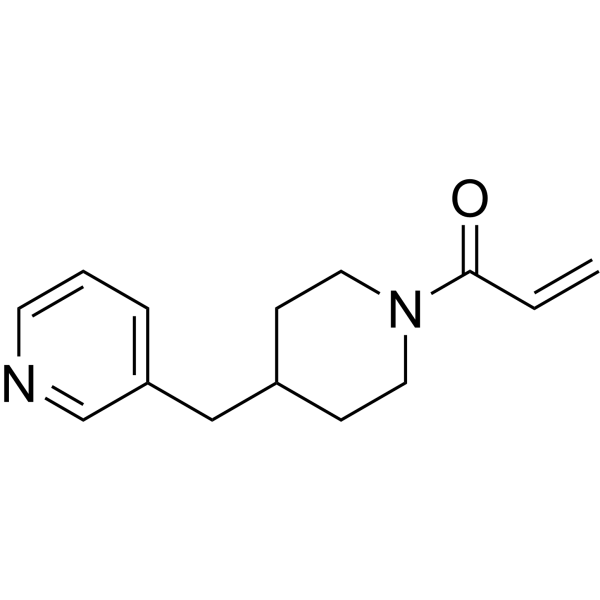
Amino-PEG3-2G degrader-1 hydrochloride is the hydrochloride salt form of Amino-PEG3-2G degrader-1 (HY-158985). Amino-PEG3-2G degrader-1 hydrochloride is a conjugate of a PEG Linker and a pyrazole-linked FBnG tag for ubiquitin-proteasome system (UPS) induction. Amino-PEG3-2G degrader-1 hydrochloride can be used to synthesize autophagy-targeting chimeras (AUTACs) .
loading...
    loading...
Cat. No.: HY-158408
CAS No.: 3062992-25-7
Target:  

ULK Mitophagy TSPO

Research Areas:  

Neurological Disease

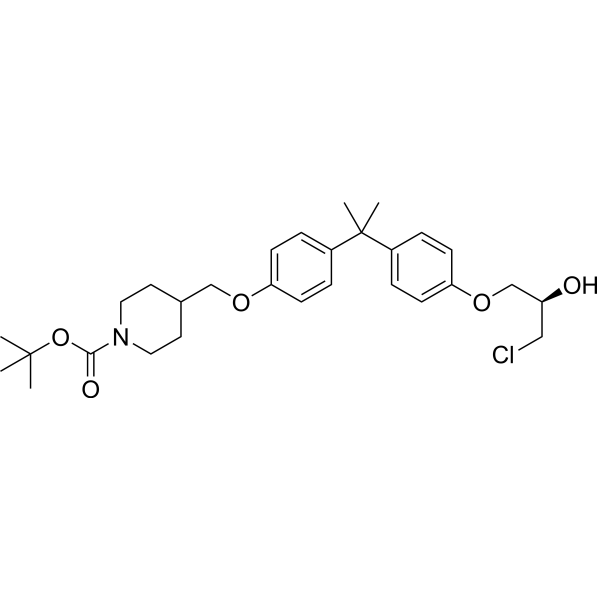
NZ-66 is a ULK1-Recruiting Chimera (ULKREC) and heterobifunctional chimeric molecule composed of a BL-918-derived ULK1 agonist linked to a mitochondrial outer membrane-targeting TSPO ligand via a six-carbon hexane linker. NZ-66 is a mitophagy inducer recruits ULK1 to mitochondria to induce ULK1-dependent mitophagy, enhanced by mitochondrial insult, independently of the PRKN/PINK axis. NZ-66 can be used for the research of parkinson’s disease .
loading...
    loading...
Cat. No.: HY-169133
CAS No.: 2991588-80-6
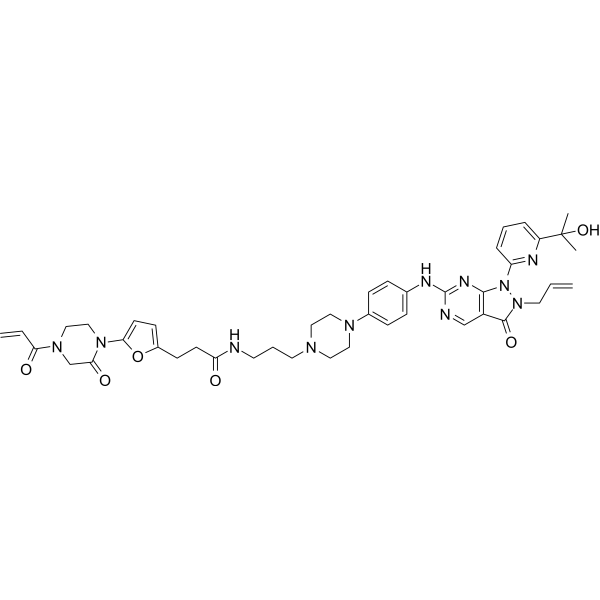
GDCNF-11 is a type of HSP90 interaction-mediated protein degradation chimera (HIM-PROTAC) degrader that targets and degrades GPX4, with a DC50 of 0.08 μM. GDCNF-11 mediates the ubiquitination and proteasome-dependent degradation of GPX4 by recruiting GPX4 to form a ternary complex with HSP90, increases intracellular lipid peroxides and ROS, and ultimately triggers Ferroptosis. GDCNF-11 inhibits tumor growth in mouse models, downregulates GPX4 protein in xenograft tumors, and upregulates the lipid peroxidation marker. GDCNF-11 can be used for the research of fibrosarcoma .
loading...
    loading...
Cat. No.: HY-163019
CAS No.: 2189497-60-5
EN884 is a BRD4 degrader via a SKP1- and proteasome-dependent manner. EN884 can be used in synthetic proteolysis targeting chimeras (PROTACs) .
loading...
    loading...
Cat. No.: HY-400766
Target:  

Drug Intermediate

Research Areas:  

Cancer

BWA-522 intermediate-2 is a BWA-522 intermediate. BWA-522 is an orally available small molecule protein-targeting chimera (PROTACs) with significant degradation effect on AR-FL and AR-V7 .
loading...
    loading...
Cat. No.: HY-143342
CAS No.: 2858812-89-0
Target:  

DUBTACs Wee1

Research Areas:  

Cancer

LEB-03-144 is a WEE1 DUBTAC (deubiquitinase-targeting chimera) linking AZD1775 (Adavosertib) to the OTUB1 recruiter EN523 through a C3 alkyl linker. LEB-03-144 shows significant WEE1 stabilization in HEP3B hepatoma cancer cells .
loading...
    loading...
Cat. No.: HY-162966
CAS No.: 3060519-67-4
Research Areas:  

Cancer

MS7829 is a deubiquitinase-targeting chimera (DUBTAC) that targets cGAS. MS7829 recruits OTUB1 to cGAS, binds covalently to OTUB1, stabilizes the protein abundance of cGAS, and activates the cGAS-STING-IRF3 innate immune signaling pathway in an OTUB1-dependent manner. MS7829 is applicable to cancer-related research .
loading...
    loading...
Cat. No.: HY-P1556
CAS No.: 141676-35-9
Target:  

PKG

Research Areas:  

Cardiovascular Disease

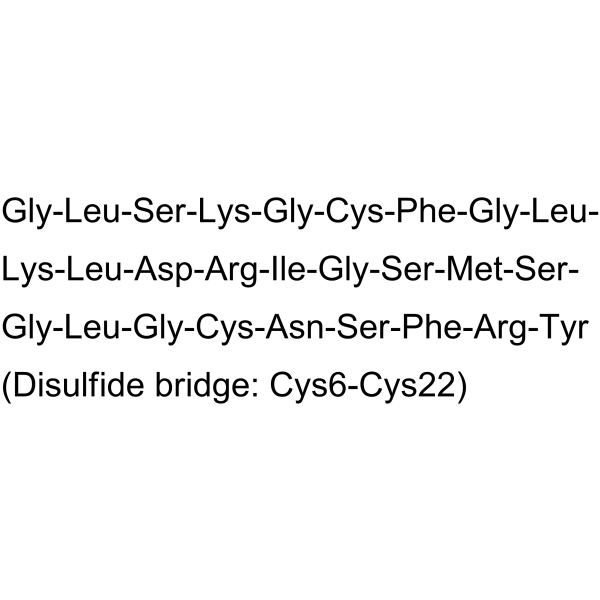
Vasonatrin Peptide (VNP) is a chimera of atrial natriuretic peptide (ANP) and C-type natriuretic peptide (CNP). Vasonatrin peptide possesses the venodilating actions of CNP, the natriuretic actions of ANP, and unique arterial vasodilating actions not associated with either ANP or CNP. Vasonatrin Peptide protects the diabetic heart against ischemia-reperfusion injury by inhibiting ER stress via the cGMP-PKG signaling pathway .
loading...
    loading...
Cat. No.: HY-173189B
CAS No.: 72351-33-8
Synonyms: 2′,5′-ApApA TEA; 2′,5′-trioligoadenylate TEA; 5'-O-Triphosphoryladenylyl-(2'→5')-adenylyl-(2'→5')-adenosine TEA
Target:  

RSV DNA/RNA Synthesis

Research Areas:  

Infection Cancer

2-5A TEA (2′,5′-ApApA TEA) is a 5'-triphosphorylated (2',5') oligoadenylate. When covalently linked to an antisense molecule complementary to the target sequence, 2-5A TEA activates RNase L, which subsequently degrades the target RNA bound to the 2-5A TEA chimera. 2-5A TEA can be used in research related to respiratory syncytial virus infection, colorectal adenocarcinoma and melanoma .
loading...
    loading...
Cat. No.: HY-176130
CAS No.: 3115333-82-6
Research Areas:  

Neurological Disease

MRL828 is a heterobifunctional molecule that targets aggregated tau protein. As an autophagy-targeting chimera (ATTEC), MRL828 selectively labels aggregated tau protein for clearance via the autophagy (autophagy)-lysosome pathway. The activity of MRL828 depends on autophagosomes rather than lysosomes, and it induces autophagosome-dependent secretion. MRL828 acts as an intracellular aggregate inhibitor and a secretory autophagy inducer, reducing intracellular levels of aggregated tau protein through autophagosome-dependent secretory autophagy instead of lysosomal degradation. MRL828 can be used in the research of neurodegenerative diseases such as Alzheimer's disease .
loading...
    loading...
Cat. No.: HY-153735
CAS No.: 2087490-46-6
Target:  

PROTACs ERK

Research Areas:  

Cancer

ERK-CLIPTAC is a ERK CLIPTAC (click chemistry-synthesized proteolysis-targeting chimera) degrader. ERK-CLIPTAC forms intracellularly via click chemistry from ERK1/2-IN-14 (HY-175578) and Tz-thalidomide (HY-101460). The formed ERK-CLIPTAC recruits the E3 ubiquitin ligase CRBN to ERK1/2, thereby inducing ubiquitination and subsequent degradation of ERK1/2. Due to its lack of cell permeability, ERK-CLIPTAC cannot induce ERK1/2 degradation in cells. ERK-CLIPTAC can be used in research related to melanoma and colorectal cancer .
loading...
    loading...
Cat. No.: HY-178496
Research Areas:  

Cancer

DDO3602 is a PARP1 HSPTAC (HSP90-mediated proteolysis-targeting chimera) degrader, with a DC50 of 490.3 nM against PARP1; its Kd values for PARP1 and HSP90 are 66.5 nM and 1.64 nM, respectively. DDO3602 induces the formation of an unnatural PARP1-HSP90 ternary complex, recruits E3 ubiquitin ligase, and promotes PARP1 degradation via the ubiquitin-proteasome pathway. DDO3602 induces G2/M cell cycle arrest, DNA damage, inhibits cell migration, and exhibits antiproliferative activity in breast cancer cells. DDO3602 can be used in breast cancer-related research .
loading...
    loading...
Cat. No.: HY-161744
CAS No.: 2410081-55-7
Target:  

AUTOTACs Autophagy

Research Areas:  

Cancer

PBA-1106 is an autophagy-targeting chimera (AUTOTAC) that induces p62 self-oligomerization. PBA-1106 increases the autophagic flux of Ub-conjugated aggregates .
loading...
    loading...
Cat. No.: HY-156814
CAS No.: 3093738-79-2
Target:  

Hedgehog

Research Areas:  

Cancer

HPP-9 is a Proteolysis-Targeting ChimerasPROTACs) based on Hedgehog Pathway Inhibitor-1 (HPI-1), with the pIC50 of 6.71, that can degrade BET bromodomains. HPP-9 has antitumor activity [1[.
loading...
    loading...
Cat. No.: HY-170453
Research Areas:  

Cancer

iHAC is an inhibitor HSP90-anchoring chimera, that covalently binds BRD4 ligand (+)-JQ-1 to HSP90, and inhibits the proliferation of cancer cells. iHAC activates the anti-tumor immune response, inhibits the recurrence and metastasis of 4T1 breast cancer in mouse models .
loading...
    loading...
Cat. No.: HY-158985
CAS No.: 2267315-06-8
Target:  

AUTACs Autophagy

Research Areas:  

Cancer

Amino-PEG3-2G degrader-1 (compound ) is a conjugate of a PEG Linker and a pyrazole-linked FBnG tag for ubiquitin-proteasome system (UPS) induction. Amino-PEG3-2G degrader-1 can be used to synthesize autophagy-targeting chimeras (AUTACs) .
loading...
    loading...
Cat. No.: HY-176071
Research Areas:  

Cancer

TEC 4 is a ByeTAC (Bypassing E-Ligase-Targeting Chimera) BRD4 degrader, with 33% BRD4 remaining at 500 nM in Ramos B-cells. TEC 4 shows toxicity for Ramos B-cells, with an IC50 of 30.5 nM. ByeTACs directly recruits a protein to the proteasome via interactions with Rpn-13 for degradation. Pink: BRD4 lignad (HY-78695); Blue: Rpn-13 ligand (HY-159808); Black: linker (HY-W008352) .
loading...
    loading...
Cat. No.: HY-175179
Research Areas:  

Cancer

LO-3-61, a JQ-1 (HY-13030) analog bearing a truncated fumaramide handle, is a PROTAC (proteolysis-targeting chimeras)-like BRD4 degrader. LO-3-61 degrades both the long and short isoforms of BRD4 CUL4DcAr16-dependently in cells. LO-3-61 shows selectivity for BRD3 and BRD4 degradation in MDA-MB-231 cells .
loading...
    loading...
Cat. No.: HY-176521A
Research Areas:  

Cancer

AR/BRD4 RIPTAC-1 (Compound II-5) TFA is an orally active Regulatory-inducible proximity-targeting chimera (RIPTAC). AR/BRD4 RIPTAC-1 TFA induces the formation of a stable ternary complex between the androgen receptor (AR) and BRD4, thereby blocking BRD4 function. AR/BRD4 RIPTAC-1 TFA inhibits the growth and proliferation of tumor cells. AR/BRD4 RIPTAC-1 TFA holds promise for use in prostate cancer research .
loading...
    loading...
Cat. No.: HY-152247
CAS No.: 2673364-10-6
Target:  

MAP3K

Research Areas:  

Cancer

DDO3711, a PP5-recruiting phosphatase recruitment chimeras (PHORCs), is formed by connecting a small molecular apoptosis signal-regulated kinase 1 (ASK1) inhibitor to a PP5 activator through a chemical linker. DDO3711 specifically inhibits ASK1 (IC50 =164.1 nM) not ASK2 (IC50>20 μM). DDO3711 significantly dephosphorylates p-ASK1 T838 by recruiting PP5 and shows the ASK1-dependent antiproliferative activity. DDO3711 has anti-cancer activity and has the potential for abnormally phosphorylated oncoproteins research .
loading...
    loading...

