9 Results for "

6-Phosphoglucono-δ-lactone

" in MedChemExpress (MCE) Product Catalog:
Products (9)

9 Results for "6-Phosphoglucono-δ-lactone" in MCE Product Catalog:

Cat. No.: HY-W587796
CAS No.: 2641-81-8
Synonyms: 6-PGδL; 6-Phosphonoglucono-D-lactone
6-Phosphoglucono-δ-lactone (6-PGδL), a reversal substrate of glucose-6-phosphate dehydrogenase (G6PD), is an intermediate compound in the oxidative branch of the pentose phosphate pathway (PPP). 6-Phosphoglucono-δ-lactone produced from D-glucose-6-phosphate by glucose-6-phosphate dehydrogenase (G6PDH) and is converted to 6-phosphoglutonate by lactonase. 6-Phosphoglucono-δ-lactone can be used for heart failure, type 2 diabetes and cancers research .
loading...
    loading...
Cat. No.: HY-125863C
CAS No.: 9001-40-5
Synonyms: G6PD, Bacillus sp.
Research Areas:  

Metabolic Disease

Glucose-6-phosphate dehydrogenase, Bacillus sp. (G6PD, Bacillus sp.) (EC 1.1.1.49) is an NADP-dependent antioxidant metabolic enzyme. Glucose-6-phosphate dehydrogenase, Bacillus sp. is induced by sublethal doses of Menadione (HY-B0332) and increasing concentrations of NaCl in Bacillus sp. F26. Glucose-6-phosphate dehydrogenase, Bacillus sp. catalyzes the oxidation of glucose-6-phosphate (G6P) to 6-phosphoglucono-δ-lactone, while reducing NADP + to NADPH, providing reducing power for the antioxidant defense system and cellular redox balance of Bacillus sp. F26. Glucose-6-phosphate dehydrogenase, Bacillus sp. is used in research related to diabetic complications .
loading...
    loading...
Cat. No.: HY-P3990
CAS No.: 1029227-48-2
Target:  

VEGFR Autophagy Apoptosis

Research Areas:  

Cancer

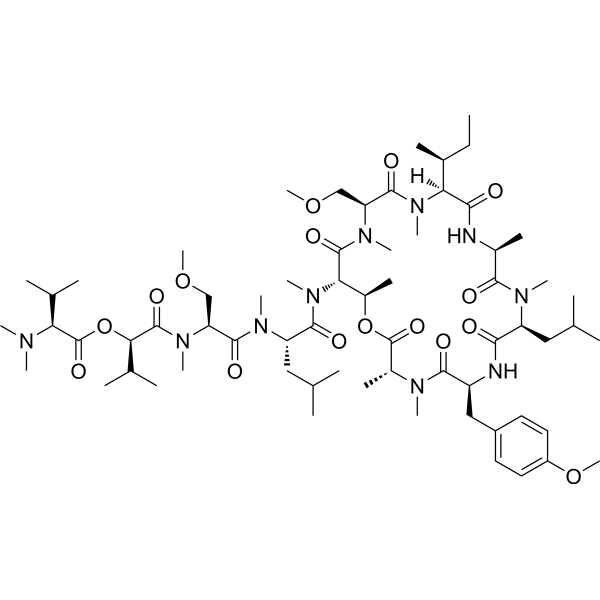
Coibamide A, an N-methyl-stabilized cytotoxic depsipeptide, shows potent antiproliferative activity. Coibamide A induces autophagosome accumulation via an mTOR-independent mechanism. Coibamide A induces apoptosis. Coibamide A inhibits VEGFA/VEGFR2 expression and suppresses tumor growth in glioblastoma xenografts .
loading...
    loading...
Cat. No.: HY-125863B
CAS No.: 9001-40-5
Synonyms: G6PD (yeast, recombinant)
Glucose 6-phosphate dehydrogenase (yeast, recombinant) (G6PD (yeast, recombinant)) is a recombinant enzyme requiring NADP + as a coenzyme. Glucose 6-phosphate dehydrogenase (yeast, recombinant) catalyzes the oxidative dehydrogenation of glucose-6-phosphate to form 6-phosphoglucono-δ-lactone, as well as the reduction of NADP + to NADPH. Glucose 6-phosphate dehydrogenase (yeast, recombinant) relies on the amino acid Arg-52 to bind NADP +. Glucose 6-phosphate dehydrogenase (yeast, recombinant) undergoes competitive inhibition by NADPH and strong inhibition by zinc ions (Zn 2+). Glucose 6-phosphate dehydrogenase (yeast, recombinant) is an enzyme in the pentose phosphate pathway, which is one of the glucose metabolic pathways. Glucose 6-phosphate dehydrogenase (yeast, recombinant) can be used for the quantitative detection of ATP, glucose and creatine kinase .
loading...
    loading...
Cat. No.: HY-125863A
CAS No.: 9001-40-5
Synonyms: G6PD (Leuconostoc sp., recombinant)
Research Areas:  

Metabolic Disease

Glucose-6-phosphate dehydrogenase (Leuconostoc sp., recombinant) (G6PD (Leuconostoc sp., recombinant)) (EC 1.1.1.49) is an NADP-dependent antioxidant metabolic enzyme. Glucose-6-phosphate dehydrogenase (Leuconostoc sp., recombinant) can be induced by sublethal doses of Menadione (HY-B0332) and increasing concentrations of NaCl. Glucose-6-phosphate dehydrogenase (Leuconostoc sp., recombinant) catalyzes the oxidation of glucose-6-phosphate (G6P) to 6-phosphoglucono-δ-lactone, while reducing NADP + to NADPH, providing reducing power for the antioxidant defense system and cellular redox balance of bacteria. Glucose-6-phosphate dehydrogenase (Leuconostoc sp., recombinant) is used in research related to diabetic complications .
loading...
    loading...
Cat. No.: HY-P1720
CAS No.: 19246-24-3
Target:  

Antibiotic Bacterial

Research Areas:  

Infection

Telomycin is a calcium-dependent antibiotic, which can be produced by Streptomyces. Telomycin inhibits gram-positive bacteria, including multidrug-resistant (MDR) pathogens .
loading...
    loading...
Cat. No.: HY-P1709
CAS No.: 141912-59-6
Protactin is a pentapeptide lactone produced by Streptomyces cucumeris strain L703-4 (ATCC 53784) with significant antioxidant properties. Protactin can be converted to actinomycin Zp by ferrocyanide oxidation. Actinomycin Zp exhibits potent antibacterial activity in vitro and has significant antitumor effects against P-388 leukemia in a mouse model .
loading...
    loading...
Cat. No.: HY-125863D
Synonyms: G6PD, Torula yeast
Research Areas:  

Metabolic Disease

Glucose-6-phosphate dehydrogenase, Torula yeast (G6PD, Torula yeast) (EC 1.1.1.49) is an NADP-dependent antioxidant metabolic enzyme. Glucose-6-phosphate dehydrogenase, Torula yeast can be induced by sublethal doses of Menadione (HY-B0332) and increasing concentrations of NaCl. Glucose-6-phosphate dehydrogenase, Torula yeast catalyzes the oxidation of glucose-6-phosphate (G6P) to 6-phosphoglucono-δ-lactone, while reducing NADP + to NADPH, providing reducing power for the antioxidant defense system and cellular redox balance of bacteria. Glucose-6-phosphate dehydrogenase, Torula yeast is used in research related to diabetic complications .
loading...
    loading...
Cat. No.: HY-P11022
CAS No.: 55599-68-3
Synonyms: A-3302-B
Research Areas:  

Infection Cancer

TL-119 (A-3302-B) is a polypeptide. TL-119 can be isolated from the bacteria Micromonospora sp. MAG 9-7 and Saccharomonospora sp. CNQ-490. TL-119 inhibits TRPV-1. TL-119 exhibits antiviral activity against HSV-2. TL-119 possesses anticancer activity against gastric cancer and colorectal cancer .
loading...
    loading...

