
6 Results for "

H9c2 rat cardiomyocytes

" in MedChemExpress (MCE) Product Catalog:
Products (6)

6 Results for "H9c2 rat cardiomyocytes" in MCE Product Catalog:

1
1 Cited Publications
Cat. No.: HY-W042301
CAS No.: 14293-44-8
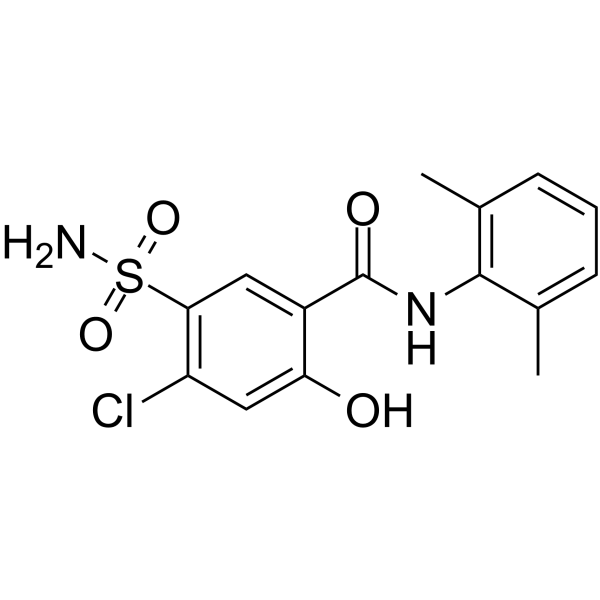
Xipamide is an orally active carbonic anhydrase (CA) inhibitor and Na +/Cl --potassium transporter inhibitor with diuretic and antihypertensive effects. Xipamide reduces NaCl reabsorption by inhibiting the Cl -/NaCO3 - anion exchanger, and increases calcium reabsorption while promoting potassium and magnesium excretion. Xipamide is mainly cleared via the renal pathway and causes a temporary decrease in glomerular filtration rate under specific conditions. Xipamide does not affect Ca 2+ signaling induced by endothelin-1 and other factors, nor does it inhibit various ion cotransport or pump activities in red blood cells. Xipamide can be used in researches related to cardiovascular diseases, hypertension (especially with left ventricular hypertrophy), advanced renal failure, and liver cirrhosis with ascites .
loading...
    loading...
1
1 Cited Publications
Cat. No.: HY-13101
CAS No.: 1108147-88-1
Purity:  99.98%
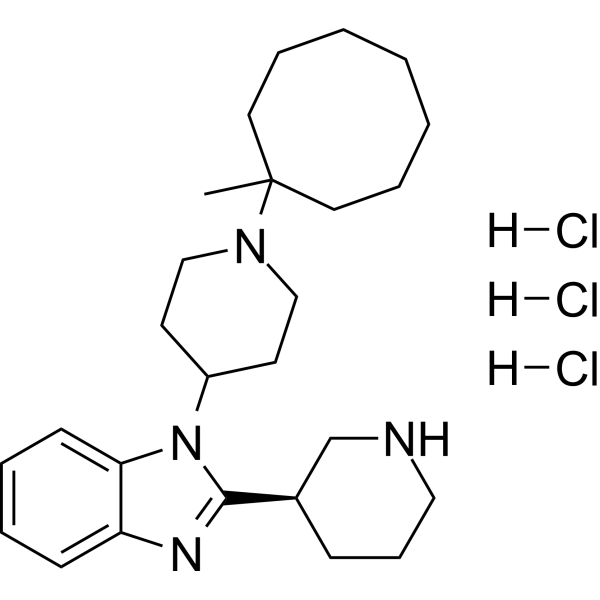
MCOPPB trihydrochloride is a NOP/ORL1 G protein-coupled receptor agonist and autophagy inhibitor that can cross the blood-brain barrier. MCOPPB trihydrochloride clears senescent cells, regulates locomotion, lipid storage and immune responses, and inhibits fibrosis and angiogenesis. MCOPPB trihydrochloride blocks autophagic flux, induces changes in locomotion and lipid storage, and activates the stress-responsive immune transcription network, thereby improving post-infarction cardiac function and exerting anxiolytic effects. MCOPPB trihydrochloride can be applied to research fields such as aging-related diseases and ischemic heart failure .
loading...
    loading...
Cat. No.: HY-P4890
CAS No.: 1158181-62-4
Relaxin H3 (human) is a relaxin peptide with anti-inflammatory, anti-apoptotic, anti-pyroptotic, anti-migratory, protective and anti-fibrotic activities. Relaxin H3 (human) acts on RXFP1 to generate cAMP and reduce the levels of ATP and ROS. Relaxin H3 (human) inhibits renal inflammatory pyroptosis (pyroptosis), NLRP3 inflammasome activation, caspase-1 activation, IL-1β/IL-18 secretion, collagen synthesis, TGF-β1 signaling pathway, Smad2 phosphorylation, myofibroblast differentiation, TIMP expression, and HRMEC migration. Relaxin H3 (human) activates AMPK, upregulates MFN2 expression, improves mitochondrial quality control and membrane potential, inhibits apoptosis (apoptosis) and pyroptosis, restores retinal ultrastructure, and reverses excessive left ventricular collagen expression. Relaxin H3 (human) can be used in studies related to kidney stones, nephrocalcinosis, diabetic cardiomyopathy, fibrotic cardiomyopathy, and diabetic retinopathy .
loading...
    loading...
Cat. No.: HY-184190
ERG-IN-7 is a Nav1.5, Cav1.2 and Kv11.1 inhibitor with IC50 values of 10.34 μM, 21.01 μM, and 16.385 μM for human Nav1.5, Cav1.2, and Kv11.1, respectively. ERG-IN-7 prolongs action potentials, reduces conduction velocity, and restores cardiac function. ERG-IN-7 can be used for the research of ventricular arrhythmia .
loading...
    loading...
Cat. No.: HY-W207224
CAS No.: 287177-12-2
Target:  

MAP4K

F1386-0303 is a highly selective MAP4K4 inhibitor with an IC50 of 34 nM against human targets. F1386-0303 exerts cardiomyocyte protective and function-preserving effects through mechanisms such as alleviating oxidative stress, inhibiting caspases, and maintaining mitochondrial membrane potential, while it does not interfere with the activity of Doxorubicin (HY-15142A) in cancer cells. F1386-0303 is rapidly cleared and has no bioavailability in mice, but it is well-suited as a tool compound for target validation. F1386-0303 can be applied to studies related to cardiac ischemia-reperfusion injury, Doxorubicin-induced cardiotoxicity, myocardial infarction and other related conditions .
loading...
    loading...
Cat. No.: HY-183370
Research Areas:  

Inflammation/Immunology

JAK2/STAT3-IN-2 is an orally active JAK2/STAT3 inhibitor. JAK2/STAT3-IN-2 inhibits the phosphorylation of tyrosine residues in JAK2 and STAT3, blocks downstream signal transduction, disrupts the dimerization and nuclear translocation of STAT3, and suppresses pro-inflammatory transcriptional activity. JAK2/STAT3-IN-2 inhibits the expression of IL-17A and IL-17F, reduces immune cell infiltration, and inhibits the production of NO simultaneously. JAK2/STAT3-IN-2 exerts a protective effect in a mouse model of ulcerative colitis induced by DSS (HY-116282C). JAK2/STAT3-IN-2 can be used for the research of ulcerative colitis .
loading...
    loading...

