10 Results for "

LUVs

" in MedChemExpress (MCE) Product Catalog:
Products (10)

10 Results for "LUVs" in MCE Product Catalog:

Art. -Nr.: HY-N16308
CAS. Nr.: 3091879-77-2
Category:  

Lipids

Target:  

Fluorescent Dye

ER-Laurdan is a derivative of the membrane-permeable fluorescent probe Laurdan (HY-D0080) that targets the endoplasmic reticulum (ER). As a membrane fluidity reporter, ER-Laurdan specifically localizes to the ER luminal membrane, and exhibits a prominent solvatochromic response to fluidity changes caused by membrane packing and exogenous saturated fatty acid stress. ER-Laurdan shows no overlapping localization with mitochondria, enables quantitative analysis of ER membrane fluidity via generalized polarization ratio measurement, and allows automatic signal masking with the help of ER markers. With high specificity and quantitative capability, ER-Laurdan serves as an important tool for investigating metabolic disorders and associated changes in the physical properties of cell membranes .
loading...
    loading...
Art. -Nr.: HY-112768
Reinheit:  ≥95.0%
Forschungsgebiete:  

Others

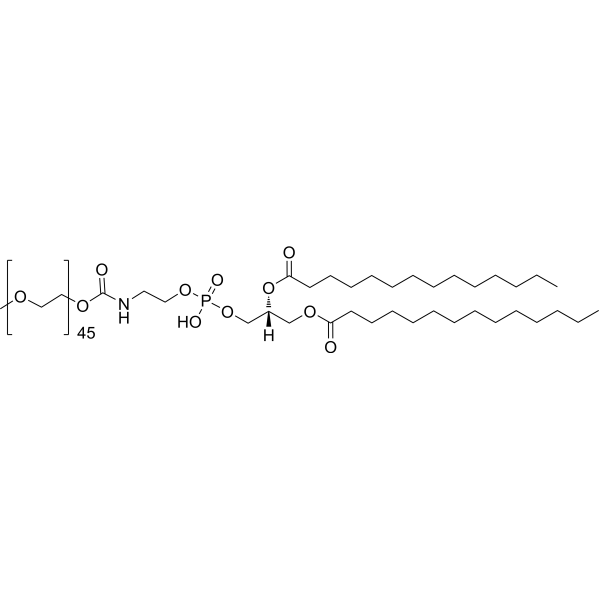
PEG2000-DMPE is a polyethylene glycol-lipid conjugate combined with phosphatidylethanolamine. PEG2000-DMPE undergoes a conformational transition from mushroom-like to brush-like at a concentration of 7 mol%, thereby exerting multiple functions such as inhibitor, stabilizer and surface defect modifier. PEG2000-DMPE can form a steric hindrance barrier on the vesicle surface to block calcium ion-induced liposome fusion, and dynamically regulate the fusion process through spontaneous transfer rate. PEG2000-DMPE can delay the thinning of foam thin liquid films and smoothly seal surface defects of solid support layers. PEG2000-DMPE can be used in the design and related research of stealth liposomes and micelles .
loading...
    loading...
Art. -Nr.: HY-D0142
CAS. Nr.: 59572-10-0
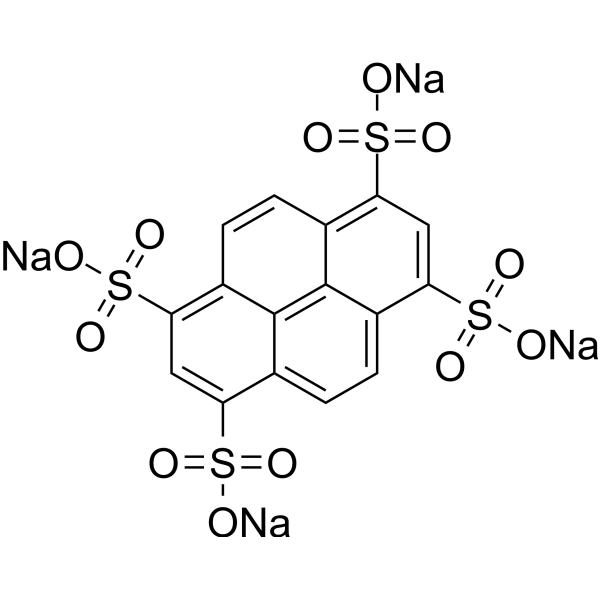
Pyrene-1,3,6,8-tetrasulfonic acid tetrasodium is a fluorescent dye and pH indicator, also as a ligand of multifunctional metal-organic framework. Pyrene-1,3,6,8-tetrasulfonic acid tetrasodium has been used to detect CO2 release. Pyrene-1,3,6,8-tetrasulfonic acid tetrasodium acts as a water-soluble fluorescent dye for fluorescence quenching assays monitoring gramicidin ion-channel activity . Ex/Em = 396/404 nm.
loading...
    loading...
Art. -Nr.: HY-121235
CAS. Nr.: 17737-65-4
Reinheit:  ≥98.0%
Synonyms: SCH-10304
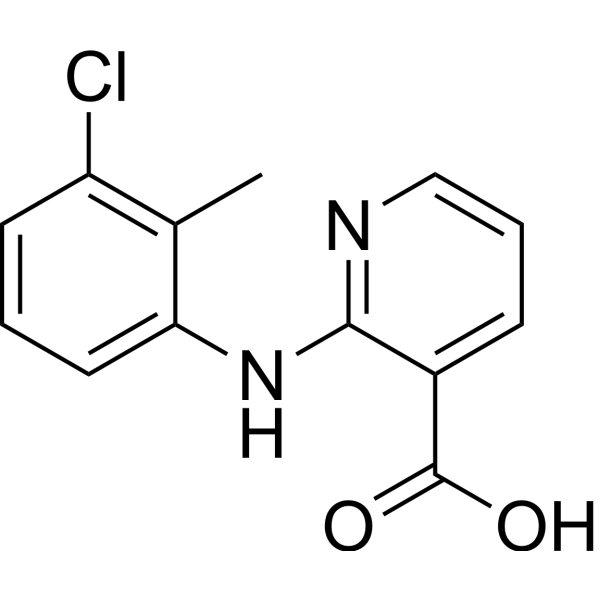
Clonixin (SCH-10304) is an orally active non-steroidal anti-inflammatory agent (NSAID) that inhibits COX synthesis. Clonixin acts as a voltage-gated L-type calcium channel blocker, exerts vasodilatory effects by antagonizing Ca 2+ in vascular smooth muscle. Clonixin inhibits TGF-β, reduces lung coefficient, immune cell infiltration level, oxidative stress response, airway resistance, hydroxyproline content and collagen deposition. Clonixin can be used in research related to inflammation such as idiopathic pulmonary fibrosis and moderate to severe pain .
loading...
    loading...
Art. -Nr.: HY-P4119
CAS. Nr.: 863608-35-9
Forschungsgebiete:  

Others

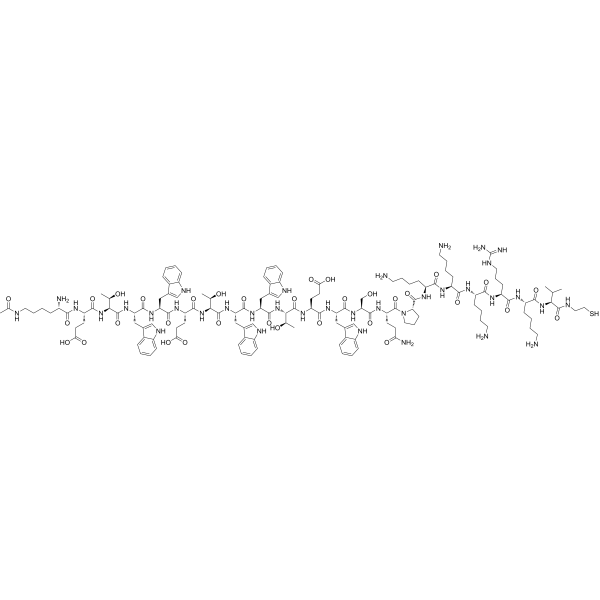
Pep-1-Cysteamine is an amphipathic chimeric cell-penetrating peptide. Pep-1-Cysteamine can penetrate biological membranes in an energy-independent manner without forming transmembrane pores, and efficiently deliver active proteins into cells, with its translocation dominated by electrostatic interactions and membrane perturbation .
loading...
    loading...
Art. -Nr.: HY-P11430
CAS. Nr.: 290360-66-6
Forschungsgebiete:  

Infection

UBI (31-38) is a Ubiquicidin-derived octapeptide and anti-bacterial agent. UBI (31-38) selectively interacts with anionic phospholipid membranes and restricts lipid lateral motion. UBI (31-38) induces anionic vesicle aggregation via electrostatic repulsion screening, and undergoes conformational changes in membrane-mimicking environments. UBI (31-38) can be used for the research of infection imaging probes .
loading...
    loading...
Art. -Nr.: HY-W800787
CAS. Nr.: 384847-49-8
Target:  

Liposome

Forschungsgebiete:  

Others

18:1 PE MCC is a reactive phospholipid containing a maleimide group. 18:1 PE MCC forms covalent bonds with thiol-modified chondroitin sulfate (CS) via thiol-maleimide reaction, and anchors CS to the surface of lipid membranes. 18:1 PE MCC is applicable to glycocalyx model construction and lipid membrane biophysics research .
loading...
    loading...
Art. -Nr.: HY-D3092
CAS. Nr.: 2757682-01-0
Target:  

Fluorescent Dye

Forschungsgebiete:  

Others

NRERf is an endoplasmic reticulum (ER)-targeted solvatochromic fluorescent probe based on Nile Red (HY-D0718). It possesses ER-targeting capability and can sense changes in local polarity and lipid order of biological membranes. NRERf undergoes excited-state charge transfer, with its emission color changing according to local polarity: the tightly packed, low-polarity liquid-ordered phase (Lo) induces a blue-shifted emission, while the high-polarity liquid-disordered phase (Ld) induces a red-shifted emission. The emission wavelength of NRERf varies with the environment. NRERf can be used to detect changes in lipid order and polarity induced in the ER by cholesterol extraction/enrichment, oxidative stress, and hyperosmotic shock .
loading...
    loading...
Art. -Nr.: HY-N16152
CAS. Nr.: 106918-69-8
Synonyms: C6-NBD-PE
Target:  

Fluorescent Dye

Forschungsgebiete:  

Others

16:0-06:0 NBD PE (C6-NBD-PE) is a commonly used fluorescent phospholipid analog and membrane-disrupting agent for investigating membrane lipid structure and dynamics. In aqueous buffers, the self-assembly of 16:0-06:0 NBD PE can be disrupted via binding to methylated α-, β-, and γ-cyclodextrins. 16:0-06:0 NBD PE can be selectively extracted from lipid vesicles upon the addition of methylated cyclodextrins, with an extraction efficiency lower than that of NBD-PC and NBD-SM analogs .
loading...
    loading...
Art. -Nr.: HY-180425
CAS. Nr.: 3611-72-1
Forschungsgebiete:  

Metabolic Disease

Cloridarol is a human islet amyloid peptide (hIAPP) inhibitor that prevents its abnormal misfolding and aggregation. Cloridarol can increase cell viability, inhibit apoptosis, and protect islet β-cells from hIAPP-induced cell toxicity. Cloridarol can be used for the research of type 2 diabetes (T2D) .
loading...
    loading...

