12 Results for "

Laser confocal microscope

" in MedChemExpress (MCE) Product Catalog:
Products (12)

12 Results for "Laser confocal microscope" in MCE Product Catalog:

Cat. No.: HY-D1422
CAS No.: 1445108-32-6
Synonyms: BDNCA-346
Target:  

Fluorescent Dye

Research Areas:  

Others

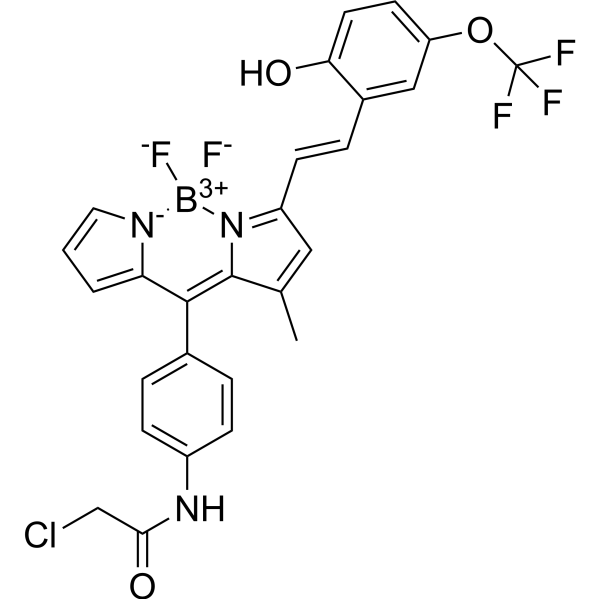
ER Tracker Yellow (BDNCA-346) is a Fluorescent probe for targeted visualization of temperature at the endoplasmic reticulum. Its detection mechanism depends on temperature, with fluorescence intensity decreasing at higher temperatures due to preferential non-radiative processes; this intensity reversibly returns to baseline when cooled, provided the probe does not precipitate or degrade. It localizes specifically to the endoplasmic reticulum, where it may covalently attach to biomacromolecules via a thiol-reactive moiety, and its fluorescence remains stable after cell fixation; its fluorescence intensity is unaffected by physiological pH ranges of 5.0–8.0 and free Ca²⁺ concentrations of 0–800 μM. Its excitation/emission wavelength is Ex/Em = 559/581 nm[1].
loading...
    loading...
Cat. No.: HY-D3108
CAS No.: 2569032-08-0
Target:  

Fluorescent Dye

Research Areas:  

Others

BV-1 is a fluorescent probe for viscosity detection and imaging in living cells. BV-1 can be used to detect changes in intracellular viscosity and mitochondrial viscosity in living cells. BV-1 responds to environmental viscosity via a molecular rotor mechanism. In a low-viscosity environment, the centrally located unsaturated structure induces a twisted intramolecular charge transfer (TICT) state and promotes non-radiative transitions, resulting in fluorescence quenching; when viscosity increases, molecular rotation is restricted, the TICT state is attenuated, and fluorescence is enhanced with a red shift. BV-1 can be used for real-time monitoring of changes in cytoplasmic viscosity and the viscosity increase during cell apoptosis. Ex/Em = 480/570 nm .
loading...
    loading...
Cat. No.: HY-D3096
Target:  

Fluorescent Dye

Research Areas:  

Others

TPh-PyBz-β-gal is a fluorescent probe used for the detection and imaging of β-galactosidase (β-gal) in living cells. The detection mechanism of TPh-PyBz-β-gal relies on β-gal, which cleaves the glycosidic bond linking the AIE-active fluorophore and the D-galactose residue unit of the probe. The emission wavelength of TPh-PyBz-β-gal after activation is 606 nm. TPh-PyBz-β-gal has low cytotoxicity and can be applied to β-gal imaging in living cells .
loading...
    loading...
Cat. No.: HY-D3126
CAS No.: 2420449-92-7
Target:  

Fluorescent Dye

Research Areas:  

Others

IOPBA is a fluorescent probe that can be used for the detection and bioimaging of trivalent iron ions Fe 3+ and fluoride ions F - in living cells. IOPBA emits blue fluorescence in its native state, but upon the introduction of Fe 3+, it forms a Fe 3+-IOPBA π-complex, where Fe 3+ ions coordinate with two phenyl groups of IOPBA, resulting in fluorescence quenching. IOPBA returns to its free state and recovers its original fluorescence after F - sequesters Fe 3+ to form the more stable [FeF6] 3- and dissociates the Fe 3+-IOPBA complex. The excitation wavelength of IOPBA is 342 nm, and its emission wavelength is 458 nm .
loading...
    loading...
Cat. No.: HY-D3094
CAS No.: 2687198-42-9
Target:  

Fluorescent Dye

Research Areas:  

Others

TPE-SQ5 is a ratiometric Fluorescent probe for hypochlorite (ClO -) detection with a limit of detection of 5.6 nM. TPE-SQ5 exhibits high selectivity and high sensitivity towards ClO -. TPE-SQ5 can be oxidized by ClO - to form an epoxide, which quenches its deep red fluorescence; subsequently, the epoxide decomposes into a hemicyanine and a sulfonic acid-substituted oxindole, producing blue-green fluorescence to achieve a ratiometric response. TPE-SQ5 can form nanoparticles with Pluronic F-127 via the nanoprecipitation method, and these nanoparticles possess cell permeability. TPE-SQ5 has unique Ex/Em spectra in different solvents and nanoparticle forms, with emission peaks at 643 nm (380 nm excitation, 95% H2O/THF), 631 nm (564 nm excitation, DMSO), 652 nm (536 nm excitation, THF) and 630 nm (524 nm excitation, nanoparticles); the Ex/Em settings used for cell imaging are 488/550-650 nm (red channel) and 405/450-550 nm (green channel) .
loading...
    loading...
Cat. No.: HY-D3068
CAS No.: 3077446-86-4
Target:  

Fluorescent Dye

Research Areas:  

Metabolic Disease

LDs-BCA is a BF2-chelated AIE fluorescent probe with a positive solvatochromic effect, which can specifically target intracellular lipid droplets (Ex/Em = 565/620-730 nm). LDs-BCA monitors the dynamic changes in the morphology, size and quantity of intracellular lipid droplets under oleic acid induction and starvation stress. LDs-BCA, after intraperitoneal injection, accumulates in the gastric fat of living obese mice, allowing continuous monitoring via its fluorescent signal. LDs-BCA is applicable to studies related to intracellular lipid droplet polarity imaging and in vivo gastric fat visualization .
loading...
    loading...
Cat. No.: HY-D3130
Target:  

Fluorescent Dye

Research Areas:  

Others

Mem-pH is a ratiometric fluorescent probe used for measuring vesicular pH. Mem-pH inserts into the plasma membrane bilayer and localizes to the vesicular lumen, switching between its basic and acidic forms via protonation during vesicular acidification to enable ratiometric pH readout. In aqueous media, Mem-pH forms non-emissive aggregates through aggregation-induced quenching, and then depolymerizes and recovers its fluorescent activity upon binding to the plasma membrane. The excitation/emission wavelengths of the basic form of Mem-pH are 405/450-550 nm, while those of the acidic form are 488/500-700 nm .
loading...
    loading...
Cat. No.: HY-D3160
Target:  

Fluorescent Dye

Research Areas:  

Others

Golgi-hNR is a cell membrane-permeable Golgi-targeted fluorescent probe containing a sulfonamide group. Golgi-hNR selectively accumulates in the Golgi apparatus of living cells, enabling real-time tracking and homeostasis assessment of reversible pH changes in the Golgi apparatus. Golgi-hNR exhibits a pH-dependent "off-on" fluorescence response mechanism within the pH 7.4-3.0 range, and its red fluorescence intensity decreases with increasing pH. The Ex/Em of Golgi-hNR is 560/664 nm and 580/664 nm, with the maximum emission peak located at 615 nm .
loading...
    loading...
Cat. No.: HY-D3121
CAS No.: 2763752-95-8
Target:  

Fluorescent Dye

Research Areas:  

Metabolic Disease

HOTPy is a mitochondria-targeted fluorescent viscosity probe with aggregation-induced emission properties, which responds to microenvironmental viscosity. HOTPy can recognize the abnormal increase in mitochondrial viscosity and capture dynamic viscosity changes in acute alcoholic liver injury models at both cellular and in vivo levels. The maximum absorption peak of HOTPy in PBS solution is at 379 nm; its maximum emission peak reaches 611 nm in a high-viscosity glycerol system. HOTPy can be used for the research of acute alcoholic liver injury .
loading...
    loading...
Cat. No.: HY-134096
CAS No.: 78323-98-5
Synonyms: DNS-M
Target:  

Fluorescent Dye

Research Areas:  

Others

Dansyl-morpholine (DNS-M) is a Fluorescent probe for lipid droplet imaging, cancer cell discrimination, and real-time tracking of lipid droplet dynamics. As a solvatochromic probe with a donor-π-acceptor structure, it relies on hydrophobic interaction for its mechanism of action: its good lipophilicity, confirmed by an oil-water partition coefficient LogP = 2.35, allows it to rapidly penetrate cell membranes, and it specifically localizes to the hydrophobic core of lipid droplets; its fluorescence is strongly enhanced in the nonpolar environment of lipid droplets, while it emits very weak fluorescence in polar environments like PBS buffer, and it exhibits a bathochromic shift in emission wavelength with increasing solvent polarity. It has negligible cytotoxicity, with cell viability remaining over 95% after 24-hour incubation with 100 μM of the probe, and it possesses excellent photostability, retaining over 97% of initial fluorescence intensity after 60 continuous laser scans. For cell imaging applications, its excitation/emission wavelengths for lipid droplet labeling are Ex/Em = 405/480−540 nm, and in a simulative lipid environment O/W emulsion, it has an excitation wavelength of ~346 nm and emission wavelength of ~500 nm, giving a Stokes shift of 154 nm[1].
loading...
    loading...
Cat. No.: HY-D3125
Target:  

Fluorescent Dye

Research Areas:  

Others

NtHzBtd is a fluorescent probe for detecting Fe 3+. NtHzBtd is applicable to the selective fluorescent detection of Fe 3+ ions and live cell imaging studies. NtHzBtd can selectively coordinate with Fe 3+ to form a 1:1 complex, triggering chelation enhanced quenching (CHEQ) and intramolecular charge transfer (ICT) processes, which result in fluorescence turn-off, thereby enabling sensitive detection of Fe 3+ and live cell fluorescence imaging. After binding to Fe 3+, NtHzBtd reduces fluorescence intensity, exhibits a rapid response property, with a limit of detection of 0.036 μM and a response time of approximately 55 s. The detection wavelengths are Ex/Em = 334/401 nm (solution system) .
loading...
    loading...
Cat. No.: HY-D3075
CAS No.: 2490504-23-7
Target:  

Fluorescent Dye

Research Areas:  

Others

TPE-2E N-oxide is a fluorescent probe used for hypoxia detection and tumor hypoxia imaging. Due to its active intramolecular motion, TPE-2E N-oxide shows no fluorescence in aqueous solution. In hypoxic environments, its N-oxide group undergoes two-electron reduction by CYP450 reductase and other heme protein reductases expressed under hypoxia, forming hydrophobic aggregates that trigger aggregation-induced emission through the restriction of intramolecular motion. TPE-2E N-oxide exhibits selective lipid droplet localization in cells. The absorption wavelength of TPE-2E N-oxide in dichloromethane is 313 nm; in a 99% hexane/dichloromethane mixed system, its excitation wavelength is 330 nm and emission wavelength is 460 nm. For in vitro cell imaging, excitation is performed at 405 nm, with an emission wavelength range of 430-560 nm .
loading...
    loading...
  • 1

