1. Search Result
Search Result
Results for "

Urea (Standard)

" in MedChemExpress (MCE) Product Catalog:

18

Inhibitors & Agonists

8

Natural
Products

Targets Recommended:
Cat. No. Product Name Target Research Areas Chemical Structure
  • HY-Y0271R

    Carbonyl diamide (Standard)

    Carbonic Anhydrase Reference Standards Endogenous Metabolite ERK Apoptosis Cardiovascular Disease Cancer
    Urea (Standard) is the analytical standard of Urea. This product is intended for research and analytical applications. Urea is a powerful protein denaturant via both direct and indirect mechanisms . A potent emollient and keratolytic agent . Used as a diuretic agent. Blood urea nitrogen (BUN) has been utilized to evaluate renal function . Widely used in fertilizers as a source of nitrogen and is an important raw material for the chemical industry.
    Urea (Standard)
  • HY-N0157R

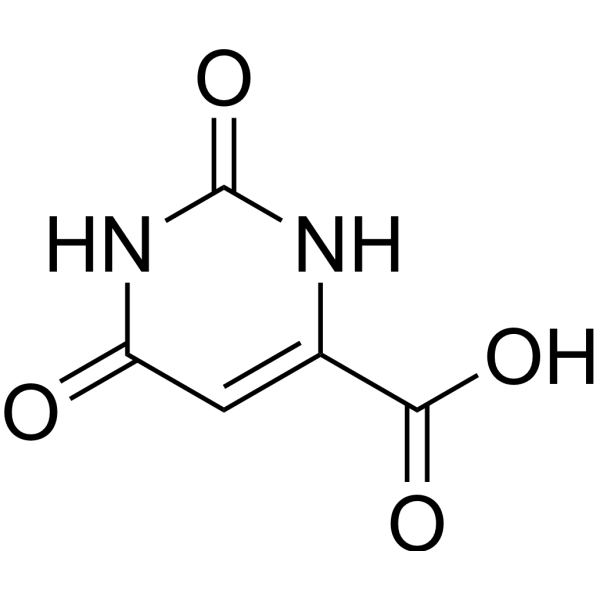
    6-Carboxyuracil (Standard); Vitamin B13 (Standard)

    Reference Standards Nucleoside Antimetabolite/Analog Endogenous Metabolite Metabolic Disease
    Orotic acid (Standard) is the analytical standard of Orotic acid. This product is intended for research and analytical applications. Orotic acid (6-Carboxyuracil), a precursor in biosynthesis of pyrimidine nucleotides and RNA, is released from the mitochondrial dihydroorotate dehydrogenase (DHODH) for conversion to UMP by the cytoplasmic UMP synthase enzyme. Orotic acid is a marker for measurement in routine newborn screening for urea cycle disorders. Orotic acid can induce hepatic steatosis and hepatomegaly in rats .
    Orotic acid (Standard)
  • HY-W010382R
    Oxaloacetic acid (Standard)
    2 Publications Verification

    2-Oxosuccinic acid (Standard)

    Reference Standards Endogenous Metabolite Reactive Oxygen Species (ROS) Metabolic Disease
    Oxaloacetic acid (Standard) is the analytical standard of Oxaloacetic acid. This product is intended for research and analytical applications. Oxaloacetic acid (2-Oxosuccinic acid) is a metabolic intermediate involved in several ways, such as citric acid cycle, gluconeogenesis, the urea cycle, the glyoxylate cycle, amino acid synthesis, and fatty acid synthesis, whereby Oxaloacetic acid facilitates the clearance of reactive oxygen species (ROS) and improves mitochondrial function .
    Oxaloacetic acid (Standard)
  • HY-W017018R

    Reference Standards Endogenous Metabolite Metabolic Disease
    L-Ornithine (hydrochloride) (Standard) is the analytical standard of L-Ornithine (hydrochloride). This product is intended for research and analytical applications. L-Ornithine hydrochloride is a non-proteinogenic amino acid, is mainly used in urea cycle removing excess nitrogen in vivo. L-Ornithine hydrochloride shows nephroprotective .
    L-Ornithine hydrochloride (Standard)
  • HY-W008150R

    α-Hydroxyisovaleric acid (Standard)

    Reference Standards Endogenous Metabolite Metabolic Disease
    2-Hydroxy-3-methylbutanoic acid (α-Hydroxyisovaleric acid) (Standard) is the analytical standard of 2-Hydroxy-3-methylbutanoic acid (HY-W008150). This product is intended for research and analytical applications. 2-Hydroxy-3-methylbutanoic acid is an α-hydroxy analogue of valine and a valine precursor that reduces urea excretion. 2-Hydroxy-3-methylbutanoic acid can promote the growth of chickens and rats, and is converted into valine in the body, participating in protein synthesis and maintaining nitrogen balance, thereby supporting animal growth and development. 2-Hydroxy-3-methylbutanoic acid has a more significant effect on the valine-deficient dietary model. 2-Hydroxy-3-methylbutanoic acid is mainly used in animal nutrition research to evaluate its potential application as a nitrogen source substitute in feed.
    2-Hydroxy-3-methylbutanoic acid (Standard)
  • HY-113289R

    Akt Androgen Receptor Bacterial Drug Metabolite HSV Reference Standards Infection Cardiovascular Disease Neurological Disease Cancer
    L-Ornithine (hydrochloride) (Standard) is the analytical standard of L-Ornithine (hydrochloride). This product is intended for research and analytical applications. L-Ornithine hydrochloride is a non-proteinogenic amino acid, is mainly used in urea cycle removing excess nitrogen in vivo. L-Ornithine hydrochloride shows nephroprotective .
    Brassicasterol (Standard)
  • HY-B1158R

    Reference Standards Bacterial Mas-related G-protein-coupled Receptor (MRGPR) Interleukin Related Infection
    Imidazolidinyl urea (Standard) is the analytical standard of Imidazolidinyl urea. This product is intended for research and analytical applications. Imidazolidinyl urea is a commonly used antibacterial preservative in cosmetics and pharmaceuticals that releases formaldehyde through decomposition. Imidazolidinyl urea can also be used in the preparation of multifunctional hydrogels for the care of infectious wounds. Imidazolidinyl urea has broad-spectrum antibacterial activity, which mainly inhibits the reproduction of gram-negative bacteria and gram-positive bacteria, and restricts the growth of yeast and mold to a certain extent. Imidazolidinyl urea can induce non-histaminergic allergy by MRGPRX2 activation of mast cells .
    Imidazolidinyl urea (Standard)
  • HY-131964R

    Reference Standards Drug Metabolite Others
    Sodium ethylparaben (Standard) is the analytical standard of Sodium ethylparaben. This product is intended for research and analytical applications. Sodium ethylparaben (Sodium ethyl 4-hydroxybenzoate) acts as a water soluble antiseptic usually employed as safe for cosmetics .
    Imidacloprid-urea (Standard)
  • HY-134098R

    Adipic acid diisopropyl ester (Standard)

    TRP Channel Reference Standards Others
    Oxaloacetic acid (Standard) is the analytical standard of Oxaloacetic acid. This product is intended for research and analytical applications. Oxaloacetic acid (2-Oxosuccinic acid) is a metabolic intermediate involved in several ways, such as citric acid cycle, gluconeogenesis, the urea cycle, the glyoxylate cycle, amino acid synthesis, and fatty acid synthesis, whereby Oxaloacetic acid facilitates the clearance of reactive oxygen species (ROS) and improves mitochondrial function .
    Diisopropyl adipate (Standard)
  • HY-Y0470R

    AminoUrea hydrochloride (Standard); Hydrazinecarboxamide hydrochloride (Standard)

    Antibiotic Reference Standards Inflammation/Immunology Cancer
    Semicarbazide (hydrochloride) (Standard) is the analytical standard of Semicarbazide (hydrochloride). This product is intended for research and analytical applications. Semicarbazide hydrochloride is an orally active urea derivative. Semicarbazide hydrochloride binds to copper or iron in cells. Semicarbazide hydrochloride inhibits the activity of soluble semicarbazide sensitive amine oxidase (SSAO). Semicarbazide hydrochloride damages cartilage, blood vessels, ovaries, testicles, and thyroid follicles .
    Semicarbazide hydrochloride (Standard)
  • HY-108379R

    Reference Standards ADC Linker Cancer
    Boc-C2-Urea-bis(Boc)-C4-Urea-4-phenylacetic acid (Standard) is the analytical standard of Boc-C2-Urea-bis(Boc)-C4-Urea-4-phenylacetic acid (HY-108379). This product is intended for research and analytical applications. Boc-C2-Urea-bis(Boc)-C4-Urea-4-phenylacetic acid is a cleavable ADC linker used in the synthesis of antibody-drug conjugates (ADCs) .
    Boc-C2-Urea-bis(Boc)-C4-Urea-4-phenylacetic acid (Standard)
  • HY-W087949R

    GuanylUrea sulfate (Standard)

    Reference Standards
    Urea, N-(aminoiminomethyl)-, sulfate (2:1) (Standard) is the analytical standard of Urea, N-(aminoiminomethyl)-, sulfate (2:1). This product is intended for research and analytical applications.
    Urea, N-(aminoiminomethyl)-, sulfate (2:1) (Standard)
  • HY-W105685R

    Reference Standards
    1,3-Bis(2-chloroethyl)urea (Standard) is the analytical standard of 1,3-Bis(2-chloroethyl)urea. This product is intended for research and analytical applications.
    1,3-Bis(2-chloroethyl)urea (Standard)
  • HY-Y0496R

    Reference Standards Insecticide Others
    1,4-Dichlorobenzene (Standard) is the analytical standard of 1,4-Dichlorobenzene. This product is intended for research and analytical applications. 1,4-Dichlorobenzene is a non-genotoxic, orally active mitogenic/tumor-promoting carcinogen that is also widely used as a dye, resin intermediate, and deodorant, moth repellent/insecticide. 1,4-Dichlorobenzene induces liver tumors in mice and promotes the growth of spontaneous precancerous lesions, but shows no liver tumor-inducing activity in F344 rats. 1,4-Dichlorobenzene increases the levels of white blood cell count, serum alanine aminotransferase and blood urea nitrogen in occupationally exposed populations. 1,4-Dichlorobenzene is metabolized to 2,5-dichlorophenol and excreted in urine, and this metabolite can serve as a biomarker for 1,4-Dichlorobenzene exposure. Due to its specific hepatotoxic characteristics, 1,4-Dichlorobenzene is applicable to liver cancer-related research .
    1,4-Dichlorobenzene (Standard)
  • HY-107199R

    NBPT (Standard)

    Reference Standards Urease Others
    N-Butylthiophosphoric triamide (Standard) (NBPT (Standard)) is the analytical standard of N-Butylthiophosphoric triamide (HY-107199). This product is intended for research and analytical applications. N-Butylthiophosphoric triamide (NBPT) is a potent urease inhibitor. Butylthiophosphoric triamide inhibits nitrification and reduces the conversion of urea to NH3 gas .
    N-Butylthiophosphoric triamide (Standard)
  • HY-101867R

    Reference Standards Bacterial Infection Cancer
    AU1235 (Standard) is the analytical standard of AU1235 (HY-101867). This product is intended for research and analytical applications. AU1235, an adamantyl urea, is a potent MmpL3 inhibitor. The Mycobacterium tuberculosis protein MmpL3 performs an essential role in cell wall synthesis, since it effects the transport of trehalose monomycolates across the inner membrane .
    AU1235 (Standard)
  • HY-N0157AR

    6-Carboxyuracil zinc (Standard); Vitamin B13 zinc (Standard)

    Nucleoside Antimetabolite/Analog Endogenous Metabolite Reference Standards Metabolic Disease
    Orotic acid (zinc) (Standard) is the analytical standard of Orotic acid (zinc). This product is intended for research and analytical applications. Orotic acid (zinc), a precursor in biosynthesis of pyrimidine nucleotides and RNA, is released from the mitochondrial dihydroorotate dehydrogenase (DHODH) for conversion to UMP by the cytoplasmic UMP synthase enzyme. Orotic acid (zinc) is a marker for measurement in routine newborn screening for urea cycle disorders. Orotic acid (zinc) can induce hepatic steatosis and hepatomegaly in rats .
    Orotic acid zinc (Standard)
  • HY-122940R

    Ageratochromene (Standard)

    Others Reference Standards Metabolic Disease
    Precocene II (Standard) is the analytical standard of Precocene II (HY-122940). This product is intended for research and analytical applications. Precocene II (Ageratochromene) is a plant larva hormone antagonists that inhibits the biosynthesis of juvenile hormone. Precocene II inhibits corpora allata function and downregulates juvenile hormone levels, while exerting multiple effects including inducing precocious metamorphosis, forming macropterous morphs, inhibiting ovarian growth, producing cytotoxicity, disrupting insect development, and causing sterility and kidney damage. Precocene II blocks normal nymphal development, causes renal tubular damage and increases blood urea nitrogen levels, and also blocks juvenile hormone biosynthesis in vitro. Precocene II undergoes oxidative metabolism catalyzed by NADPH-dependent monooxygenase to generate a variety of metabolites. Precocene II can be applied in studies related to insect growth regulation and nephrotoxicity .
    Precocene II (Standard)

Inquiry Online

Your information is safe with us. * Required Fields.

Salutation


Country or Region *

Applicant Name *


Organization Name *

Department *


Email Address *


Product Name *

Cat. No.


Requested quantity *

Phone Number *


Remarks

Inquiry Online

Inquiry Information

Product Name:
Cat. No.:
Quantity:
MCE Japan Authorized Agent:

