14 Results for "

carboxymethyl cellulose

" in MedChemExpress (MCE) Product Catalog:
Products (14)

14 Results for "carboxymethyl cellulose" in MCE Product Catalog:

53
53 Publications Verification
Cat. No.: HY-Y0703
CAS No.: 9004-32-4
Synonyms: CMC-Na (Viscosity:800-1200 mPa.s)
Sodium carboxymethyl cellulose (Viscosity:800-1200 mPa.s) is the sodium salt of cellulose arboxymethyl and frequently used as viscous agent, paste and barrier agent.
loading...
    loading...
12
12 Cited Publications
Cat. No.: HY-Y1889A
CAS No.: 9004-32-4
Synonyms: CMC-Na (MW 250000); CMC-Na (Viscosity:1500-3100 mPa.s)
Sodium carboxymethyl cellulose (CMC-Na) (MW 250000) is a sodium salt of carboxymethyl cellulose. Sodium carboxymethyl cellulose has adsorption and corrosion inhibition on low-carbon steel in an acidic medium. Sodium carboxymethyl cellulose can be used as a thickener, paste and barrier agent .
loading...
    loading...
Cat. No.: HY-Y0703C
CAS No.: 9004-32-4
Synonyms: CMC-Na (Viscosity:300-800mpa.s)
Sodium carboxymethyl cellulose (Viscosity:300-800mpa.s) is the sodium salt of cellulose arboxymethyl and frequently used as viscous agent, paste and barrier agent.
loading...
    loading...
Cat. No.: HY-Y0703A
CAS No.: 9004-32-4
Synonyms: CMC-Na (Viscosity:1200-1400 mPa.s)
Sodium carboxymethyl cellulose (Viscosity:1200-1400 mPa.s) is the sodium salt of cellulose arboxymethyl and frequently used as viscous agent, paste and barrier agent.
loading...
    loading...
Cat. No.: HY-Y1889
CAS No.: 9004-32-4
Synonyms: CMC-Na (Viscosity:5000-15000 mPa.s)
Sodium carboxymethyl cellulose (Viscosity:5000-15000 mPa.s) is the sodium salt of cellulose arboxymethyl and frequently used as viscous agent, paste and barrier agent.
loading...
    loading...
Cat. No.: HY-Y0703D
CAS No.: 9004-32-4
Synonyms: CMC-Na (average Mw 90000, DS=0.7, Viscosity:50-200 mPa.s)
Sodium carboxymethyl cellulose (average Mw 90000, DS=0.7, Viscosity:50-200 mPa.s) is the sodium salt of cellulose arboxymethyl and frequently used as viscous agent, paste and barrier agent .
loading...
    loading...
Cat. No.: HY-B2221C
CAS No.: 9000-11-7
Synonyms: carboxymethyl cellulose CM-32; CM-32
CM Cellulose CM-32 (Carboxymethyl cellulose) is a cellulose derivative. CM Cellulose CM-32 has a wide range of applications in the biomedical field, including tissue engineering, wound dressing, absorbent nonwovens, fabrication of 3D-scaffolds for biocompatible implants, artificial organs or mimics of extracellular polymeric matrix and diagnosis of various diseases. CM Cellulose CM-32 can decrease osteoclasts formation. CM Cellulose CM-32 can be used as a biological material or organic compound for life science related research .
loading...
    loading...
Cat. No.: HY-D0980
CAS No.: 138529-46-1
Synonyms: Biotinyl-3,6-dioxaoctanediamine; EZ-Link Amine-PEO2-Biotin
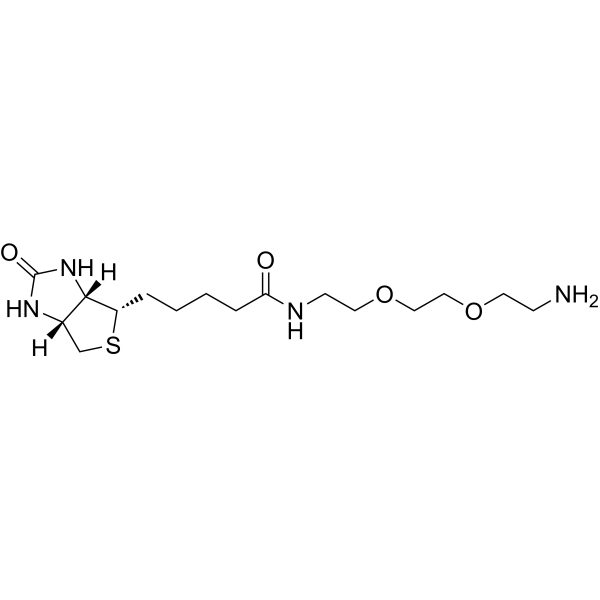
Biotin-DADOO (Biotinyl-3,6-dioxaoctanediamine; EZ-Link Amine-PEO2-Biotin) is a biotin-containing amine compound and a biotinylation reagent. As an amino component, Biotin-DADOO participates in the nucleophilic ring-opening reaction of epoxidized ω-double bonds during the synthesis of biotinylated inhibitor derivatives. Biotin-DADOO can be conjugated with carboxymethyl cellulose derivatives. Biotin-DADOO is involved in the synthesis of biotin-estradiol conjugates for enzyme immunoassays. Biotin-DADOO can be used in the research of influenza A .
loading...
    loading...
Cat. No.: HY-Y0703E
CAS No.: 9004-32-4
Sodium carboxymethyl cellulose (Viscosity:2500-6000mpa.s) is the sodium salt of cellulose arboxymethyl and frequently used as viscous agent, paste and barrier agent .
loading...
    loading...
Cat. No.: HY-B2220B
CAS No.: 9012-54-8
Research Areas:  

Others

Thermostable cellulase recombinant is a cellulose hydrolase present in hyperthermophiles, which catalyzes the hydrolysis of β-1,4 glycosidic bonds in cellulose. Thermostable cellulase recombinant targets carboxymethyl cellulose (CMC) as its primary substrate, and retains high residual activity even after incubation at high temperatures. The activity of Thermostable cellulase recombinant is inhibited by ionic and non-ionic detergents, and can be enhanced by cobalt ions. Thermostable cellulase recombinant can be applied in the paper industry .
loading...
    loading...
Cat. No.: HY-154704
CAS No.: 9050-04-8
Purity:  99.6%
Research Areas:  

Others

Calcium carboxymethyl cellulose can be used as an excipient. Pharmaceutical excipients, or pharmaceutical auxiliaries, refer to other chemical substances used in the pharmaceutical process other than pharmaceutical ingredients. Pharmaceutical excipients generally refer to inactive ingredients in pharmaceutical preparations, which can improve the stability, solubility and processability of pharmaceutical preparations. Pharmaceutical excipients also affect the absorption, distribution, metabolism, and elimination (ADME) processes of co-administered drugs .
loading...
    loading...
Cat. No.: HY-P2859A
Research Areas:  

Metabolic Disease

Chitosanase, Streptomyces griseus (EC 3.2.1.132) catalyzes the endohydrolysis of β (1,4) linkages between N-acetyl-D-glucosamine and D-glucosamine residues in partially deacetylated chitosan. Chitosanase, Streptomyces griseus (EC 3.2.1.132) is capable of hydrolyzing both chitosan and carboxymethyl cellulose.
loading...
    loading...
Cat. No.: HY-E71366
Research Areas:  

Metabolic Disease

Endo-1,4-β-D-glucanase is a glycoside hydrolase that cleaves internal β-1,4-glycosidic bonds in cellulose and related β-D-glucans (β-D-Glucan) (HY-139413). Endo-1,4-β-D-glucanase randomly cuts long, insoluble cellulose polymer chains into shorter, soluble fragments such as oligosaccharides, thereby paving the way for further digestion into glucose .
loading...
    loading...
Cat. No.: HY-135721
CAS No.: 13304-62-6
Synonyms: Benzyl acrylamide
Research Areas:  

Others

N-Benzylacrylamide (Benzyl acrylamide) is a hydrophobic monomer. N-Benzylacrylamide can form hydrophobic microdomains that act as physical cross-linking sites to connect polymer chains to each other into a three-dimensional network; dynamically reversible hydrophobic interactions enable the spontaneous reformation of physical cross-linking sites after contact of fractured surfaces, thereby achieving autonomous self-healing. N-Benzylacrylamide can promote the synthesis of carboxymethyl cellulose-modified amphiphilic copolymers, and enhance the intermolecular association, viscoelasticity, thermal stability, as well as fire resistance/fire extinguishing performance of the resulting hydrogels .
loading...
    loading...
  • 1

