1. Search Result
Search Result
Pathways Recommended: PI3K/Akt/mTOR
Results for "

cardiac K currents

" in MedChemExpress (MCE) Product Catalog:
Cat. No. Product Name Target Research Areas Chemical Structure
  • HY-108592

    Potassium Channel Cardiovascular Disease Neurological Disease
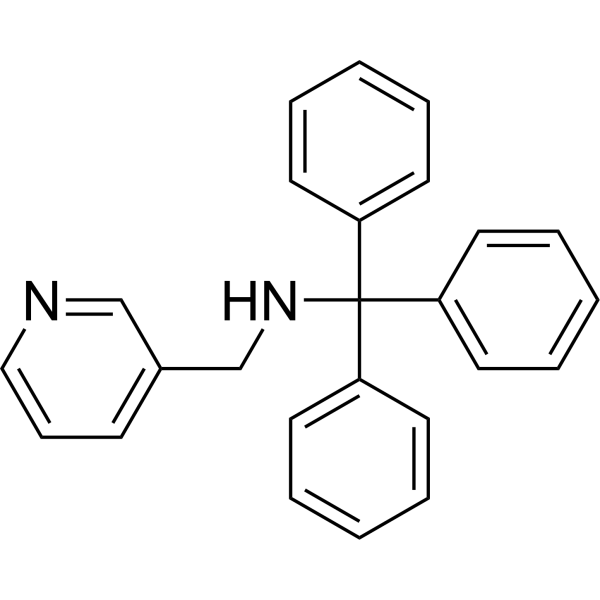
    UCL 2077 is a potassium channel and slow afterhyperpolarization (sAHP) inhibitor. UCL 2077 selectively blocks sAHP channels without affecting L-type Ca 2+ currents. UCL 2077 blocks KCNQ1- and KCNQ2-containing K + channels, decreases erg current amplitude, increases erg deactivation rate. UCL 2077 can be used for the research of hippocampus-dependent memory retrieval deficit and cardiac arrhythmias .
    UCL 2077
  • HY-126704

    KC-8857

    Potassium Channel Cardiovascular Disease
    Tedisamil (KC-8857) is an antiarrhythmic compound with important biological activities. Tedisamil exhibits a significant slowing effect on heart rate, which is achieved by inhibiting the transient outward potassium current (I(to)) in the atrium. Tedisamil inhibits multiple potassium currents, including IK, K(ATP), and PKA-activated chloride channels, thereby prolonging the cardiac action potential and QT interval, and increasing cardiac reentry. Tedisamil has antiarrhythmic effects on ventricular arrhythmias and atrial flutter in animal models .
    Tedisamil
  • HY-118148

    Potassium Channel Cardiovascular Disease
    UK-66914, is a class III antiarrhythmic agent that specifically acts on the delayed rectifier potassium current (I_K). UK-66914 is designed to prolong action potential duration (APD) and increase cardiac refractory period, thereby potentially terminating the reentry mechanism in arrhythmias without affecting the serious side effects of antiarrhythmic drugs associated with other ion channels such as Na+ and Ca2+ currents .
    UK-66914
  • HY-126704A

    KC-8857 dihydrochloride

    Potassium Channel Cardiovascular Disease
    Tedisamil (KC-8857) dihydrochloride is an antiarrhythmic compound with important biological activities. Tedisamil dihydrochloride exhibits a significant slowing effect on heart rate, which is achieved by inhibiting the transient outward potassium current (I(to)) in the atrium. Tedisamil dihydrochloride inhibits multiple potassium currents, including IK, K(ATP), and PKA-activated chloride channels, thereby prolonging the cardiac action potential and QT interval, and increasing cardiac reentry. Tedisamil dihydrochloride has antiarrhythmic effects on ventricular arrhythmias and atrial flutter in animal models .
    Tedisamil dihydrochloride
  • HY-182599

    Calcium Channel mAChR Neurological Disease
    RCC-36 hydrochloride is an L-type calcium channel inhibitor and competitive muscarinic receptor antagonist. RCC-36 hydrochloride inhibits L-type calcium currents in voltage- and concentration-dependent fashion with no effect on cardiac K + currents. RCC-36 hydrochloride suppresses maximum acetylcholine-induced contractile responses, inhibits detrusor muscle contractions induced by potassium chloride, calcium chloride, and electric field stimulation, including atropine-resistant contractions. RCC-36 hydrochloride can be used for the research of urinary frequency, urinary incontinence, and bladder overactivity .
    RCC-36 hydrochloride

Inquiry Online

Your information is safe with us. * Required Fields.

Salutation


Country or Region *

Applicant Name *


Organization Name *

Department *


Email Address *


Product Name *

Cat. No.


Requested quantity *

Phone Number *


Remarks

Inquiry Online

Inquiry Information

Product Name:
Cat. No.:
Quantity:
MCE Japan Authorized Agent:

