11 Results for "

chorioallantoic membrane model

" in MedChemExpress (MCE) Product Catalog:
Products (11)

11 Results for "chorioallantoic membrane model" in MCE Product Catalog:

Cat. No.: HY-W008956
CAS No.: 267402-71-1
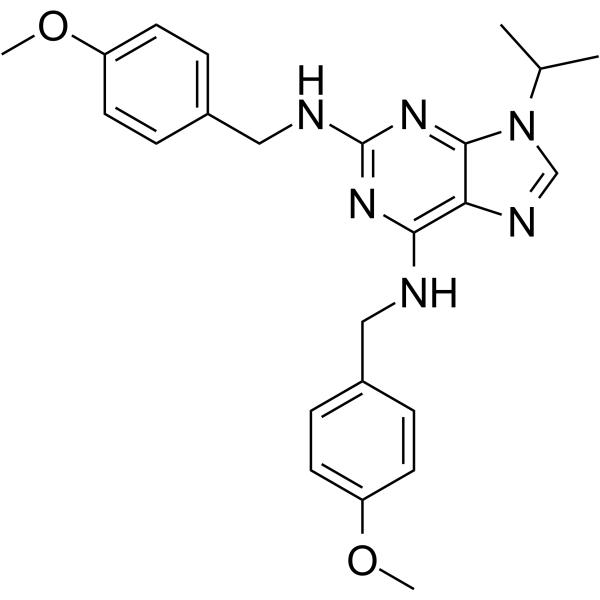
Myoseverin is a microtubule-binding molecule and angiogenesis inhibitor. Myoseverin can induce the reversible fission of multinucleated myotubes into mononucleated fragments. In addition, Myoseverin exerts anti-angiogenic effects by inhibiting endothelial cell function and endothelial progenitor cell differentiation .
loading...
    loading...
Cat. No.: HY-175857
Target:  

HDAC Apoptosis

Research Areas:  

Cancer

HDAC-IN-92 is a pan-HDAC inhibitor with an IC50 of 12.58 µM in A2780 cells. HDAC-IN-92 demonstrates broad-spectrum, notable cytotoxic activity against a range of human cancer cell lines, including ovarian, liver, and breast carcinomas. HDAC-IN-92 causes apoptosis and demonstrates a notable decrease in tumor cell colony formation. HDAC-IN-92 inhibits the formation of blood vessels in the chick chorioallantoic membrane (CAM). HDAC-IN-92 exhibits anti-tumor effect in a 4T1 tumor-bearing mouse model. HDAC-IN-92 can be used for research targeting solid tumor .
loading...
    loading...
Cat. No.: HY-163841
Target:  

Drug Derivative

Research Areas:  

Cancer

Antitumor agent-181 (HJ1) is an anticancer agent. Antitumor agent-181 inhibits tumor cell growth in vivo and in vitro .
loading...
    loading...
Cat. No.: HY-170591
CAS No.: 2922588-44-9
Target:  

MDM-2/p53 Apoptosis

Research Areas:  

Cancer

p53 Activator 14 (Compound 7A) is a derivative of Neratinib (HY-32721), that induces DNA damage, activates p53, and inhibits the proliferation of multi cancer cells (IC50=7.21 μM for HCT116 cell). p53 Activator 14 inhibits the adhesion, migration and invasion of HCT116, arrests the cell cycle, and induces apoptosis. p53 Activator 14 inhibits angiogenesis and exhibits antitumor efficacy in chick chorioallantoic membrane (CAM) model .
loading...
    loading...
Cat. No.: HY-178921
CAS No.: 1313741-00-2
Research Areas:  

Cancer

HJ-4 is a Piperine (HY-N0144) derivative. HJ-4 potently inhibits the proliferation of CRC cells by dose-dependently reducing colony formation and DNA synthesis. HJ-4 markedly suppresses the adhesion, migration, invasion and induces apoptosis of CRC cells. HJ-4 demonstrates anti-tumor efficacy in chicken embryo chorioallantoic membrane (CAM) model implanted with HCT116/SW480 tumor spheroids. HJ-4 can be used for the study of colorectal cancer (CRC) .
loading...
    loading...
Cat. No.: HY-B0530A
CAS No.: 1798-50-1
Synonyms: γ-pipradol hydrochloride
Research Areas:  

Cancer

Azacyclonol (γ-pipradol) hydrochloride is a compound with promising anticancer activity, showing effectiveness in inhibiting NOX-derived ROS in A549 human lung cancer cells. Azacyclonol hydrochloride exhibits enhanced proliferation inhibition against androgen-refractory cancer cell lines, specifically DU145 and PC-3. Azacyclonol hydrochloride demonstrates antitumor activity in DU145-xenografted chorioallantoic membrane tumor models. Azacyclonol hydrochloride also acts as a ligand for the M3 muscarinic acetylcholine receptor, which is overexpressed in ARPC. Azacyclonol hydrochloride effectively blocks carbachol-induced proliferation and NOX activity in DU145 cells. Azacyclonol hydrochloride can also be utilized for the treatment of chronic schizophrenia.
loading...
    loading...
Cat. No.: HY-175018
VEGFR-2-IN-71 is a dual VEGFR2/tubulin inhibitor. VEGFR-2-IN-71 inhibits tumor cell proliferation and induces apoptosis and cell cycle arrest. VEGFR-2-IN-71 inhibits angiogenesis in the chick chorioallantoic membrane (CAM) model. VEGFR-2-IN-71 inhibits tumor growth in the HGC-27 xenograft model by inhibiting VEGFR2 and tubulin. VEGFR-2-IN-71 has low oral bioavailability in rats. VEGFR-2-IN-71 can be used in cancer research .
loading...
    loading...
Cat. No.: HY-181009
CAS No.: 3124773-51-6
Target:  

HDAC Apoptosis Autophagy

Research Areas:  

Cancer

HDAC-IN-98 is a HDAC1, HDAC2, HDAC3 inhibitor (one of the most selective class I HDAC inhibitors) with human IC50 values of 41.2 nM, 52.5 nM, and 74.3 nM respectively. HDAC-IN-98 induces H3K9 acetylation, p21 upregulation, G2/M arrest, cell apoptosis, has strong antiproliferative effects in colorectal cancer cells, low toxicity in healthy colon epithelium, modulates short-term in vitro effects via autophagy, and shows strong antitumor efficacy in vivo in the chorioallantoic membrane model (CAM) assay. HDAC-IN-98 can be used for the research of colorectal cancer .
loading...
    loading...
Cat. No.: HY-180814
Research Areas:  

Cancer

SKF-83566-PEG1-pomalidomide is an anti-tumor agent and is formed by the covalent connection of SKF-83566 (HY-103430A) (dopamine D1 receptor antagonist) and Pomalidomide (HY-10984) (immunomodulatory agent). SKF-83566-PEG1-pomalidomide can inhibit cancer cells invasion, migration and colony formation. SKF-83566-PEG1-pomalidomide can inhibit tumor growth and angiogenesis in MDA-MB-231 cell chicken embryo chorioallantoic membrane (CAM) xenograft model. SKF-83566-PEG1-pomalidomide can be used for research of breast cancer .
loading...
    loading...
Cat. No.: HY-116068
CAS No.: 1267949-42-7
Research Areas:  

Cancer

DW532 is a dual inhibitor of tubulin and tyrosine kinase, with IC50 values of 4.9 μM and 5.5 μM against EGFR and VEGFR2, respectively, and a KD of 3.6 μM for tubulin. DW532 induces cell cycle arrest at the G2/M phase, triggers cell apoptosis via caspase-related pathways, and inhibits angiogenesis. DW532 can be used for research related to cancers (e.g., breast cancer) .
loading...
    loading...
Cat. No.: HY-187120
CAS No.: 1422528-30-0
Target:  

Cytochrome P450

Research Areas:  

Cancer

PAIB-SOs-12 is a CYP1A1-activated antimitotic prodrug with affinity for human CYP1A1, with a Ki value of 1.2 μM. PAIB-SOs-12 exhibits nanomolar antiproliferative activity in cancer cells expressing CYP1A1, with a selectivity ratio of over 100 against cancer cells that do not express CYP1A1. PAIB-SOs-12 undergoes CYP1A1-mediated N-dealkylation to form the active metabolite PIB-SO, which induces G2/M cell cycle arrest and microtubule disruption, and shows significantly improved stability in rodent liver microsomes compared to its n-butyl analog. PAIB-SOs-12 can be used in breast cancer-related research .
loading...
    loading...
  • 1

