


28 Results for "

choroidal neovascularization

" in MedChemExpress (MCE) Product Catalog:
Products (28)

28 Results for "choroidal neovascularization" in MCE Product Catalog:

11
11 Publications Verification
Cat. No.: HY-13535
CAS No.: 262438-43-7
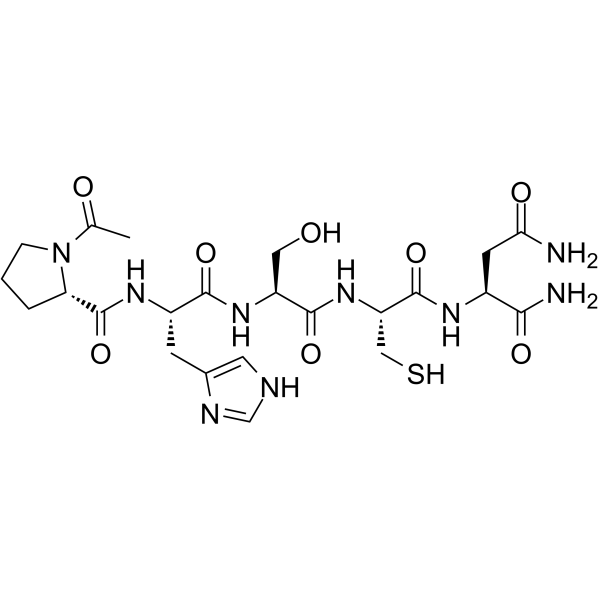
ATN-161 is an antagonist of α5β1 integrin and αvβ3 integrin, as well as an inhibitor of fibrosis, an inhibitor of oxidative stress, a tight junction stabilizer, a mitochondrial integrity protector, an angiogenesis inhibitor and an antiviral agent. ATN-161 inhibits NLRP3, MAPK, and ROS. ATN-161 protects mice from SARS-CoV-2 infection . ATN-161 reduces infarct volume, alleviates edema, decreases immune cell infiltration, reduces the area of choroidal neovascularization lesions, lowers tumor microvessel density and viral load. ATN-161 can be used in research related to ischemic stroke, choroidal neovascularization, breast cancer, coronavirus disease 2019 (COVID-19), and liver metastasis of colorectal cancer .
loading...
    loading...
2
2 Cited Publications
Cat. No.: HY-166648
Target:  

Liposome

Research Areas:  

Cancer

DSPE-PEG2000-Maleimide sodium (purity>98%) is a functional lipid component and a thiol-reactive crosslinker. DSPE-PEG2000-Maleimide sodium (purity>98%) undergoes Michael addition with the thiol groups of thiolated or cyclic RGD peptides to form stable thioether bonds and DSPE-PEG2000-RGD. DSPE-PEG2000-Maleimide sodium (purity>98%) is applicable to research on drug delivery .
loading...
    loading...
2
2 Cited Publications
Cat. No.: HY-118530
CAS No.: 65002-17-7
Purity:  98.87%
Synonyms: SA96; Thiobutarit
Target:  

VEGFR

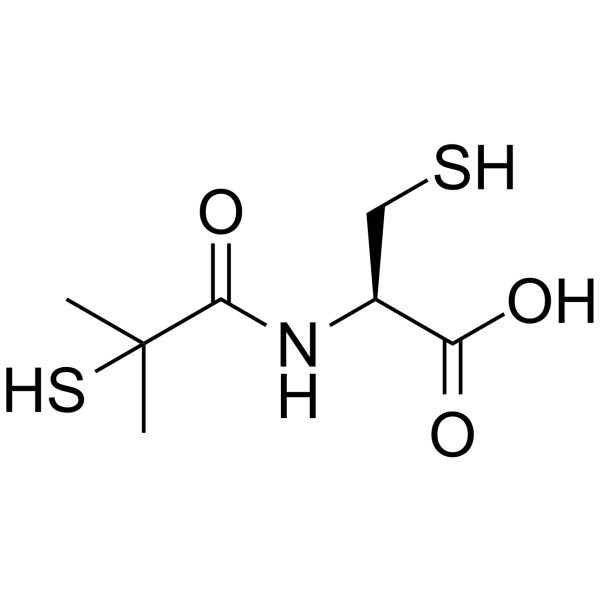
Bucillamine (SA96) is an orally active and potent sulfhydryl donor and antioxidant. Bucillamine is also an antirheumatic agent with antiangiogenic properties. Bucillamine can protect against Ischemia/reperfusion (I/R) injury in high-risk organ transplants. Bucillamine inhibits the production of VEGF. Bucillamine can be used for the research of choroidal neovascularization (CNV) and rheumatoid arthritis (RA) .
loading...
    loading...
2
2 Cited Publications
Cat. No.: HY-166648A
Target:  

Liposome

Research Areas:  

Others

DSPE-PEG-Maleimide ammonium (MW 2000) is a functional lipid component and a thiol-reactive crosslinker. DSPE-PEG-Maleimide ammonium (MW 2000) undergoes Michael addition with the thiol groups of thiolated or cyclic RGD peptides to form stable thioether bonds and DSPE-PEG (2000)-RGD. DSPE-PEG-Maleimide ammonium (MW 2000) is applicable to research on drug delivery .
loading...
    loading...
1
1 Cited Publications
Cat. No.: HY-15492
CAS No.: 319460-94-1
Purity:  99.71%
Synonyms: AG-013958
Target:  

VEGFR

Research Areas:  

Cardiovascular Disease

AG-13958 (AG-013958), a potent VEGFR tyrosine kinase inhibitor, is used for treatment of choroidal neovascularization associated with age-related macular degeneration (AMD) .
loading...
    loading...
Cat. No.: HY-P99830
CAS No.: 1227158-72-6
Synonyms: KH902
Conbercept (KH902) is a recombinant fusion protein composed of VEGFR-1 (second domain) and VEGFR-2 (third and fourth domains) regions fused to human IgG1 Fc. Conbercept is a VEGF inhibitor (IC50 = 8.8 pM) and is a soluble receptor decoy that blocks all isoforms of VEGF-A (Kd = 0.5 pM), VEGF-B (Kd = 8 pM), VEGF-C, and PlGF (Kd = 5 pM). Conbercept has anti-inflammatory effects, can lower the levels of VEGF, TNF-α and IL-6, and reduce the infiltration of inflammatory cells. Conbercept decreases tumor growth in several oncology studies. Conbercept can be used for various eye diseases such as polypoidal choroidal vasculopathy (PCV), diabetic macular edema (DME) and pathologic myopia choroidal neovascularization (pmCNV) .
loading...
    loading...
Cat. No.: HY-153484A
CAS No.: 849758-52-7
Research Areas:  

Others

Bevasiranib sodium is a siRNA designed to silence the genes that produce vascular endothelial growth factor (VEGF). It is widely accepted that vascular endothelial growth factor (VEGF) is a key component in the pathogenesis of choroidal neo-vascularization (CNV), which is a precursor to wet age-related macular degeneration (wet AMD).
loading...
    loading...
Cat. No.: HY-W1048555A
Mal-PEG2000-SCM is a heterobifunctional PEG crosslinker bearing maleimide and succinimidyl carboxymethyl ester functional groups. MMal-PEG2000-SCM conjugates the F3 peptide to nanoparticles: the SCM group reacts with amino groups on the nanoparticle surface to form amide groups, while the MAL group reacts with thiol groups of the F3 peptide to form carbon-sulfur bonds. Mal-PEG-SCM enables unidirectional addition of linkers, ensuring that appropriate functional groups are available for RGD incorporation. Mal-PEG2000-SCM can be used in the development of nanoparticles targeting specific tumor cells .
loading...
    loading...
Cat. No.: HY-132126
CAS No.: 848057-98-7
Purity:  99.87%
Target:  

SRPK

Research Areas:  

Others

SPHINX is a selective SRPK1 inhibitor with an IC50 value of 0.58 μM. SPHINX effectively reduces Choroidal Neovascularization (CNV) in vivo. SPHINX can be used for the research of (age-related macular degenaration) AMD .
loading...
    loading...
Cat. No.: HY-116312
CAS No.: 510774-50-2
Synonyms: 8-CPT-2'-O-Me-cAMP
Target:  

Ras

Research Areas:  

Cardiovascular Disease

8-pCPT-2′-O-Me-cAMP (8-CPT-2'-O-Me-cAMP), an analog of cAMP, is an activator of exchange proteins activated by cAMP (Epac). 8-pCPT-2′-O-Me-cAMP activates Epac1 (EC50 = 2.2 μM), but not PKA (EC50 >10 μM). 8-pCPT-2′-O-Me-cAMP stimulates Epac-mediated Ca 2+ release in pancreatic β-cells in vitro. 8-pCPT-2′-O-Me-cAMP is a Rap1 activator. 8-pCPT-2′-O-Me-cAMP enhances the retinal pigment epithelium barrier against the pathological choroidal endothelial cell invasion that occurs in macular degeneration .
loading...
    loading...
Cat. No.: HY-101990
CAS No.: 1031206-36-6
Purity:  99.81%
Target:  

VEGFR

Research Areas:  

Others

IMS2186 is an anti-choroidal neovascularization (CNV) agent that inhibits angiogenesis upstream of VEGF. IMS2186 can arrest cancer cell cycle in G2/M phase, thus exerting anti-proliferation and anti-angiogenesis effects. IMS2186 has no intraocular toxicity and reduces the amount of eye leakage and diseased cells .
loading...
    loading...
Cat. No.: HY-145604
CAS No.: 1433361-02-4
Purity:  98.37%
Synonyms: RG7774
Vicasinabin (RG7774) is an orally active, selective, and full CB2R agonist, with EC50 values of 2.81 nM and 2.60 nM for human CB2R and mouse CB2R, respectively. Vicasinabin inhibits inflammation, reduces leukocyte adhesion and decreases vascular permeability by selectively activating CB2R. Vicasinabin can be used in the researches for diabetic retinopathy, uveitis and laser-induced choroidal neovascularization .
loading...
    loading...
Cat. No.: HY-158821A
Target:  

TGF-beta/Smad

Research Areas:  

Neurological Disease

ISTH0036 sodium is a phosphorothioate LNA-modified antisense oligonucleotide gapmer that selectively targets and downregulates TGF-β2 mRNA. ISTH0036 sodium suppresses TGF-β2 expression, reduces choroidal neovascularization and vascular leakage, inhibits fibrosis, blocks epithelial-to-mesenchymal transition, and inhibits angiogenesis while promoting bleb survival. ISTH0036 sodium exhibits long-lasting, dose-dependent ocular tissue distribution and target engagement in rabbit and non-human primate eyes. ISTH0036 sodium can be used for the study of various ocular disorders, such as glaucoma and neovascular retinal diseases .
loading...
    loading...
Cat. No.: HY-158821
CAS No.: 2179222-27-4
Target:  

TGF-beta/Smad

Research Areas:  

Neurological Disease

ISTH0036 is a phosphorothioate LNA-modified antisense oligonucleotide gapmer that selectively targets and downregulates TGF-β2 mRNA. ISTH0036 suppresses TGF-β2 expression, reduces choroidal neovascularization and vascular leakage, inhibits fibrosis, blocks epithelial-to-mesenchymal transition, and inhibits angiogenesis while promoting bleb survival. ISTH0036 exhibits long-lasting, dose-dependent ocular tissue distribution and target engagement in rabbit and non-human primate eyes. ISTH0036 can be used for the study of various ocular disorders, such as glaucoma and neovascular retinal diseases .
loading...
    loading...
Cat. No.: HY-153484
CAS No.: 959961-96-7
Research Areas:  

Others

Bevasiranib is a siRNA designed to silence the genes that produce vascular endothelial growth factor (VEGF). It is widely accepted that vascular endothelial growth factor (VEGF) is a key component in the pathogenesis of choroidal neo-vascularization (CNV), which is a precursor to wet age-related macular degeneration (wet AMD).
loading...
    loading...
Cat. No.: HY-118530R
CAS No.: 65002-17-7
Synonyms: SA96 (Standard); Thiobutarit (Standard)
Bucillamine (Standard) is the analytical standard of Bucillamine. This product is intended for research and analytical applications. Bucillamine (SA96) is an orally active and potent sulfhydryl donor and antioxidant. Bucillamine is also an antirheumatic agent with antiangiogenic properties. Bucillamine can protect against Ischemia/reperfusion (I/R) injury in high-risk organ transplants. Bucillamine inhibits the production of VEGF. Bucillamine can be used for the research of choroidal neovascularization (CNV) and rheumatoid arthritis (RA) .
loading...
    loading...
Cat. No.: HY-184141
CAS No.: 3037217-70-9
Target:  

VEGFR

Research Areas:  

Neurological Disease

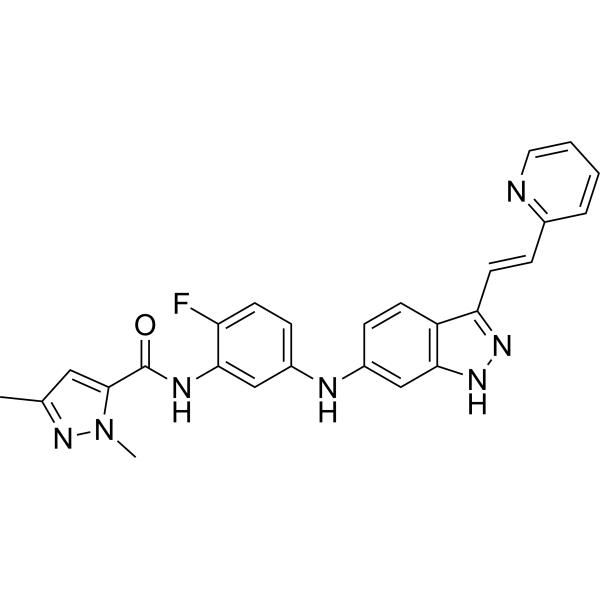
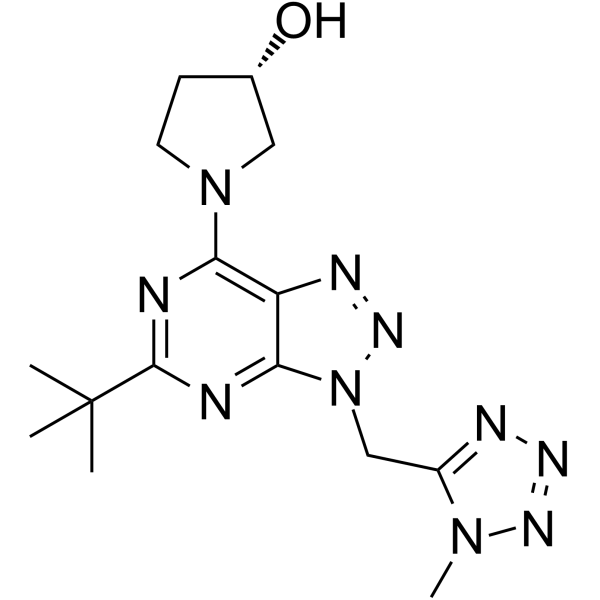
EYE1090 is an orally active VEGFR2 inhibitor with an IC50 of 3 nM. EYE1090 inhibits angiogenesis, endothelial migration, VEGFR2-induced retinal leakage, and reduces choroidal neovascularization lesion size in mice. EYE1090 can be used for the research of age-related macular degeneration, diabetic retinopathy, choroidal neovascularization .
loading...
    loading...
Cat. No.: HY-182372
CAS No.: 1638153-78-2
Target:  

Epoxide Hydrolase

Research Areas:  

Neurological Disease

SH-11037 is a potent inhibitor of soluble epoxide hydrolase (sEH) and docks to the substrate binding cleft in the sEH hydrolase domain. SH-11037 dose-dependently suppresses angiogenesis in the choroidal sprouting assay ex vivo and inhibited ocular developmental angiogenesis in zebrafish larvae. SH-11037 reduces choroidal neovascularisation lesion volume in the laser-induced CNV mouse model. SH-11037 synergises with anti-VEGF treatments in vitro and in vivo. SH-11037 induces G2/M phase blockade and retains retinal endothelial cell viability at active concentrations without overt toxicity. SH-11037 can be used for the research of retinal neovascularization and ocular neovascularization .
loading...
    loading...
Cat. No.: HY-P992151
Synonyms: LT1002
Sphingomab (LT1002) is a mouse-derived IgG1 κ monoclonal antibody and also an inhibitor targeting S1P, with high affinity for S1P and a Kd value of 0.03 ± 0.002 nM. Sphingomab blocks S1P-mediated IL-8 release in ovarian cancer cells. Sphingomab exhibits anti-angiogenic activity in a mouse model of choroidal neovascularization. Sphingomab reduces peripheral blood lymphocyte counts. Sphingomab can be used in the research of ovarian cancer and age-related macular degeneration .
loading...
    loading...
Cat. No.: HY-183377
CAS No.: 1260071-76-8
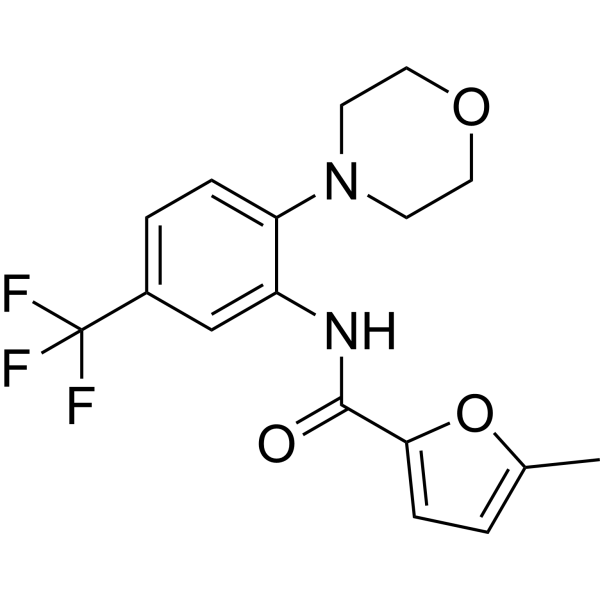
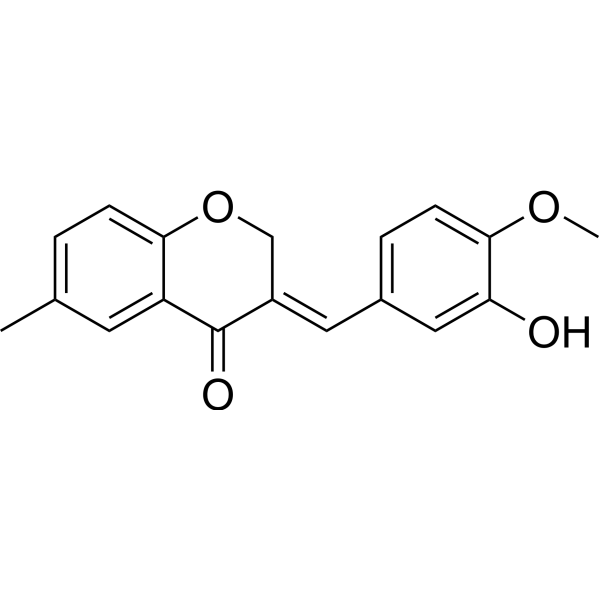
DMBT is an orally effective anti-tumor metastasis and anti-angiogenesis agent. DMBT downregulates key molecules such as EGFR/p-Akt/HIF-1α/VEGF/MMP-9, inhibits the HIF-1α/VE-cadherin (cadherin)/MMPs and Nrf2/HO-1 signaling pathways, and reduces hypoxia-induced ROS levels as well as the secretion and activity of MMP-9. DMBT inhibits hypoxia-induced vasculogenic mimicry, cancer cell migration, invasion and metastasis, and exhibits no obvious cytotoxicity to normal cells. DMBT reduces the area of laser-induced choroidal neovascularization lesions. DMBT can be used in studies related to breast cancer, melanoma and macular degeneration .
loading...
    loading...

