8 Results for "

contact allergen

" in MedChemExpress (MCE) Product Catalog:
Products (8)

8 Results for "contact allergen" in MCE Product Catalog:

2
2 Cited Publications
Cat. No.: HY-N0508
CAS No.: 85026-55-7
Rosin is a natural resin extracted from coniferous trees such as pine trees. Rosin is a frequent contact allergen which induces allergic contact dermatitis. Rosin can be used as emulsifiers, adhesives, and other chemical applications .
loading...
    loading...
Cat. No.: HY-B1419
CAS No.: 90-01-7
Synonyms: 2-Hydroxybenzyl alcohol; Saligenin
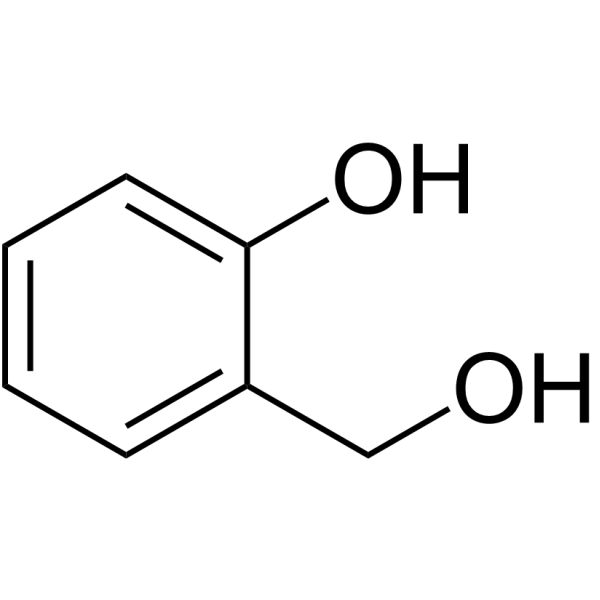
Salicyl alcohol (2-Hydroxybenzyl alcohol; Saligenin) is a phenolic alcohol-type topical anesthetic and strong sensitizer with antiseptic, antibacterial and antipyretic activities. Salicyl alcohol serves as a precursor for salicin synthesis. Salicyl alcohol induces contact dermatitis and eczematous skin reactions, and is a well-known allergen identified in phenolic resins. Salicyl alcohol is isolated from the barks of European aspen (Populus tremula), rowan (Sorbus aucuparia) and willow (Salix spp.). Salicyl alcohol is used in studies related to allergic contact dermatitis .
loading...
    loading...
Cat. No.: HY-W184893
CAS No.: 526-37-4
Target:  

Others

Atranol is a strong contact allergen found in oak moss absolute (OMA). Atranol causes contact dermatitis by inducing immune system allergic reactions. Atranol is promising for research of etiology of contact dermatitis and cosmetic allergens .
loading...
    loading...
Cat. No.: HY-N0508R
CAS No.: 85026-55-7
Rosin (Standard) is the analytical standard of Rosin. This product is intended for research and analytical applications. Rosin is a natural resin extracted from coniferous trees such as pine trees. Rosin is a frequent contact allergen which induces allergic contact dermatitis. Rosin can be used as emulsifiers, adhesives, and other chemical applications .
loading...
    loading...
Cat. No.: HY-186038
CAS No.: 10264-38-7
Research Areas:  

Inflammation/Immunology

Cyanoethyl dimethyldithiocarbamate, a dithiocarbamate-related substance, is a contact allergen. Cyanoethyl dimethyldithiocarbamate can be found in accelerator-free and conventional nitrile gloves. Cyanoethyl dimethyldithiocarbamate can be used for the research of allergic contact dermatitis .
loading...
    loading...
Cat. No.: HY-184853
CAS No.: 99-84-3
Target:  

Drug Intermediate

Research Areas:  

Inflammation/Immunology

β-Terpinene is a naturally occurring monoterpene, prohapten/metabolic substrate, and contact allergen inducer, with moderate potency as a sensitizer .β-Terpinene undergoes metabolic activation to epoxides that conjugate with glutathione .β-Terpinene induces contact allergy via reactive allylic epoxide metabolites .β-Terpinene does not significantly reduce growth of Erwinia amylovora at concentrations up to 1500 mg/l .β-Terpinene can be used for the research of Aspergillus flavus infection.
loading...
    loading...
Cat. No.: HY-W040536
CAS No.: 6440-58-0
Synonyms: Dimethyloldimethyl hydantoin
Research Areas:  

Infection

DMDM hydantoin (Glydant) is an allergen and formaldehyde-releasing preservative. DMDM hydantoin releases formaldehyde under regulation by multiple factors and with enhanced release in alkaline environments. DMDM hydantoin induces allergic contact dermatitis via type-IV delayed hypersensitivity, either directly or through released formaldehyde. DMDM hydantoin is a broad-spectrum preservative that is effective against fungi, yeast, and gram-positive and gram-negative bacteria. DMDM hydantoin can be used in cosmetics industry production research (e.g., shampoos, hairsprays, and skincare products) and can be used for research on allergic contact dermatitis .
loading...
    loading...
Cat. No.: HY-W761985
CAS No.: 65907-30-4
Target:  

Insecticide

Research Areas:  

Inflammation/Immunology

Furathiocarb is a carbamate pro-insecticide and a contact allergen. Furathiocarb is commonly used in studies related to contact allergy. Furathiocarb induces significant proliferation of MHC II-positive B cells in auricular lymph node cells and induces the production of Th1 cytokines (such as IL-2, TNF-γ and IFN-γ). However, Furathiocarb does not induce respiratory allergy in mice. After absorption through the abdominal skin of isolated rats, Furathiocarb is completely metabolized into carbofuran, and its permeation amount increases with time and dosage. The skin permeation rates of both emulsifiable concentrate (EC) and wettable powder (WP) formulations of Furathiocarb are higher than that of Furathiocarb itself, with no significant difference between the two formulations .
loading...
    loading...

