


13 Results for "

costimulatory receptor

" in MedChemExpress (MCE) Product Catalog:
Products (13)

13 Results for "costimulatory receptor" in MCE Product Catalog:

Cat. No.: HY-P99570
CAS No.: 2126777-87-3
Synonyms: GBR-830

Target:  

Inhibitory Antibodies

Research Areas:  

Inflammation/Immunology

Telazorlimab (GBR-830) is a humanized monoclonal antibody against OX40 costimulatory receptor on activated T cells. Telazorlimab can be used for the research of autoimmune diseases .
loading...
    loading...
Cat. No.: HY-P99315
CAS No.: 220651-94-5
Synonyms: BG 9588; Anti-Human CD40L Recombinant Antibody; Hu5c8

Target:  

TNF Receptor

Research Areas:  

Inflammation/Immunology

Ruplizumab (BG 9588) is a humanized anti-CD40L IgG1κ monoclonal antibody. By binding to CD40L, Ruplizumab blocks its interaction with the CD40 receptor, inhibits T-B cell costimulatory signals, and mediates the depletion of activated T cells via the Fc segment. Ruplizumab has immunosuppressive effects. Ruplizumab can be used in the study of systemic lupus erythematosus, organ transplant rejection, and autoimmune diseases. Recommend Isotype Controls: Human IgG1 kappa, Isotype Control (HY-P99001) .
loading...
    loading...
Cat. No.: HY-P99431
CAS No.: 2489390-15-8
Synonyms: Alomfilimab; SAR 445256

Target:  

CD28

Research Areas:  

Inflammation/Immunology Cancer

KY-1044 (Alomfilimab; SAR 445256) is a fully human IgG1 antibody targeting inducible costimulatory receptor (ICOS). KY-1044 depletes ICOS high cells via antibody-dependent cellular cytotoxicity (ADCC) through the engagement of FcgRIIIa. KY-1044 act as a costimulatory molecule on cells expressing lower ICOS levels, such as CD8 + TEff cells (through FcgR-dependent clustering). KY-1044 exploit the differential expression of ICOS on T-cell subtypes to improve the intratumoral immune contexture and restore an antitumor immune response .
loading...
    loading...
Cat. No.: HY-144002
CAS No.: 216014-46-9
Synonyms: RC-529
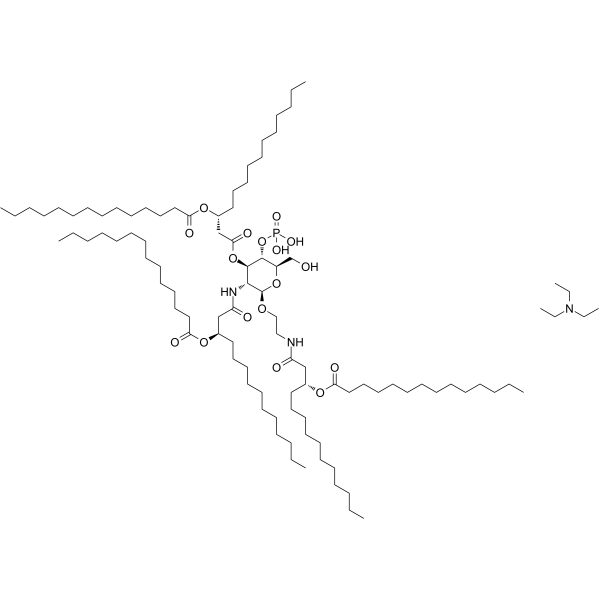
RIBI-529 (RC-529) is a fully synthetic, low-toxicity TLR4 agonist vaccine adjuvant. RIBI-529 upregulates cell surface co-stimulatory molecules, receptors, cytokines and chemokines, and activates the innate immune system. RIBI-529 enhances short-term CD4 + T cell clonal expansion, division, and ex vivo survival under growth factor withdrawal conditions. RIBI-529 enhances humoral and cell-mediated adaptive immune responses, induces non-specific resistance against viral and bacterial pathogens, and skews responses toward a Th1 type, accompanied by Th2 responses .
loading...
    loading...
Cat. No.: HY-151506
CAS No.: 2274812-94-9
Target:  

Liposome

Research Areas:  

Cancer

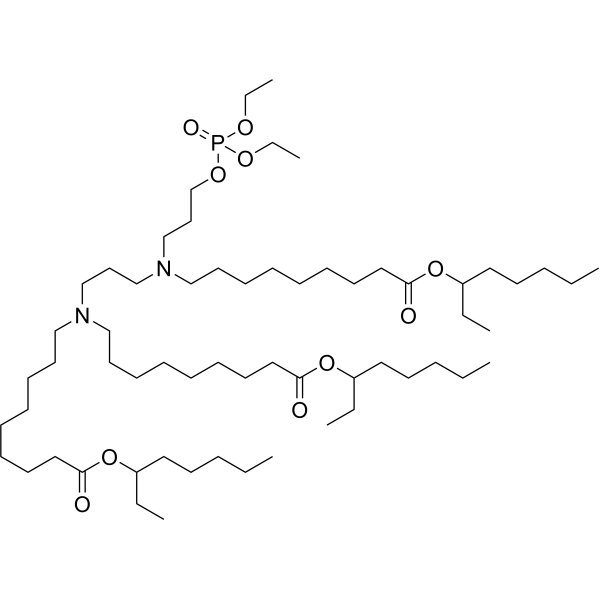
Phospholipid PL1 is a phospholipid-derived nanoparticle, can deliver costimulatory receptor mRNA (CD137 or OX40) to T cells. Phospholipid PL1 could induce the activation of various immune cells, including T cells and dendritic cells (DCs) in order to boost antitumor immunity .
loading...
    loading...
Cat. No.: HY-P991529

Target:  

TNF Receptor

Research Areas:  

Inflammation/Immunology Cancer

AGEN-2373 is a conditionally active agonist antibody targeting the co-stimulatory receptor CD137. GEN-2373 binds to CD137 without disruption of ligand binding. AGEN-2373 stimulates CD137 under receptor clustering conditions. AGEN-2373 can enhance T cell activity when combined with other checkpoint modulators (e.g. PD-1 antagonist and OX40 agonist). AGEN-2373 can be studied in research for human malignancies .
loading...
    loading...
Cat. No.: HY-159753
Research Areas:  

Inflammation/Immunology

HS105 is a vaccine adjuvant and a key component in vaccines. Adjuvants can be divided into immunostimulants and delivery systems. Adjuvants can not only enhance the intensity and durability of immune responses, but also affect the type of immune responses. On the one hand, immunostimulants promote the production of antigen signals and co-stimulatory signals by targeting Toll-like receptors (TLRs) and other pattern recognition receptors (PRRs), leading to the maturation and activation of antigen presenting cells (APCs), thereby enhancing adaptive immune responses; on the other hand, delivery systems are carrier materials that promote antigen delivery by prolonging the bioavailability of loaded antigens and targeting antigens to lymph nodes or APCs. Several common adjuvants include: saponins, TLRs agonists, polysaccharides, nanoparticles, cytokines, and mucosal adjuvants .
loading...
    loading...
Cat. No.: HY-168384
CAS No.: 875158-73-9
M04 is an agonist of STING. It induces the expression of the IFN reporter gene in HEK293T cells expressing wild-type human STING, but does not induce this expression in HEK293T cells expressing the R71H-G230A-R293Q (HAQ) STING variant or in mouse RAW 264.7 cells, indicating that its activity is dependent on allelic and species variations. M04 induces the production of TNF-α, IL-10, IL-1β, and IL-12p70 in human peripheral blood mononuclear cells (PBMCs). At a concentration of 50 µM, M04 stimulates dendritic cells isolated from PBMCs to express the MHC class II cell surface receptor HLA-DR and co-stimulatory molecules CD40, CD80, and CD86, and also enhances their ability to activate T cells in an ex vivo assay. M04 can be used in research on inflammatory immune diseases .
loading...
    loading...
Cat. No.: HY-P992044
Synonyms: NOV1801
EU101 (NOV1801) is a humanized agonistic monoclonal antibody targeting the costimulatory receptor CD137, with potential immunostimulatory and antineoplastic activities .
loading...
    loading...
Cat. No.: HY-159751
Research Areas:  

Inflammation/Immunology

HS101 is a vaccine adjuvant and a key component in vaccines. Adjuvants can be divided into immunostimulants and delivery systems. Adjuvants can not only enhance the intensity and durability of immune responses, but also affect the type of immune responses. On the one hand, immunostimulants promote the production of antigen signals and co-stimulatory signals by targeting Toll-like receptors (TLRs) and other pattern recognition receptors (PRRs), leading to the maturation and activation of antigen presenting cells (APCs), thereby enhancing adaptive immune responses; on the other hand, delivery systems are carrier materials that promote antigen delivery by prolonging the bioavailability of loaded antigens and targeting antigens to lymph nodes or APCs. Several common adjuvants include: saponins, TLRs agonists, polysaccharides, nanoparticles, cytokines, and mucosal adjuvants .
loading...
    loading...
Cat. No.: HY-P81184
Synonyms: Activation B7-1 antigen; B lymphocyte activation antigen B7; B7; B7-1; B7-1 antigen; BB1; CD28 antigen ligand 1; CD28LG; CD28LG1; CD80; CD80 antigen (CD28 antigen ligand 1, B7-1 antigen); CD80 antigen; CD80 molecule; CD80_HUMAN; costimulatory factor CD80; costimulatory molecule variant IgV-CD80; CTLA-4 counter-receptor B7.1; LAB7; T-lymphocyte activation antigen CD80; CD80_RAT.

Host:  

Mouse

Application:  

WB, ICC/IF, FC

Reactivity:  

Human, Mouse

loading...
    loading...
Cat. No.: HY-P86682
Synonyms: CD28LG2; FUN1; LAB72; Activation B7 2 antigen; Activation B7-2 antigen 3; CD86_HUMAN; Activation B7-2 antigen; Activation B72 antigen; B lymphocyte activation antigen B7 2; B lymphocyte activation antigen B72; B-lymphocyte activation antigen B7-2 2; B-lymphocyte activation antigen B7-2; B7 2; B7 2 antigen; B7; B7-2; B7.2; B70; B72 antigen; BU63; CD 86; CD28 antigen ligand 2 2; CD28 antigen ligand 2; Cd28l2; CD28LG2; CD86 antigen(CD28 antigen ligand 2, B7-2 antigen) 1, 2; CD86 antigen; CD86 molecule; CLS1; CTLA 4 counter receptor B7 2; CTLA 4 counter receptor B7.2; CTLA-4 counter-receptor B7.2 2, 3; CTLA4 counter receptor B72; Early T-cell costimulatory molecule 1; ETC-1; FUN 1; LAB72; Ly-58; Ly58; MB7; MB7-2; Membrane glycoprotein; MGC34413; T lymphocyte activation antigen CD86; T-lymphocyte activation antigen CD86; TS/A-2.

Host:  

Rabbit

Application:  

ICC/IF, FC

Reactivity:  

Human

loading...
    loading...
Cat. No.: HY-P86682A
Synonyms: CD28LG2; FUN1; LAB72; Activation B7 2 antigen; Activation B7-2 antigen 3; CD86_HUMAN; Activation B7-2 antigen; Activation B72 antigen; B lymphocyte activation antigen B7 2; B lymphocyte activation antigen B72; B-lymphocyte activation antigen B7-2 2; B-lymphocyte activation antigen B7-2; B7 2; B7 2 antigen; B7; B7-2; B7.2; B70; B72 antigen; BU63; CD 86; CD28 antigen ligand 2 2; CD28 antigen ligand 2; Cd28l2; CD28LG2; CD86 antigen(CD28 antigen ligand 2, B7-2 antigen) 1, 2; CD86 antigen; CD86 molecule; CLS1; CTLA 4 counter receptor B7 2; CTLA 4 counter receptor B7.2; CTLA-4 counter-receptor B7.2 2, 3; CTLA4 counter receptor B72; Early T-cell costimulatory molecule 1; ETC-1; FUN 1; LAB72; Ly-58; Ly58; MB7; MB7-2; Membrane glycoprotein; MGC34413; T lymphocyte activation antigen CD86; T-lymphocyte activation antigen CD86; TS/A-2.

Host:  

Rabbit

Application:  

ICC/IF, FC

Reactivity:  

Human

loading...
    loading...
  • 1

