7 Results for "

dopamine prodrug

" in MedChemExpress (MCE) Product Catalog:
Products (7)

7 Results for "dopamine prodrug" in MCE Product Catalog:

Cat. No.: HY-W011963
CAS No.: 1421-65-4
Synonyms: Levodopa methylester hydrochloride
Melevodopa (Levodopa methylester) hydrochloride is an orally active methylated prodrug of Levodopa (HY-N0304), a dopamine precursor. When used in combination with Carbidopa (HY-B0311) in an effervescent tablet formulation, Melevodopa hydrochloride inhibits motor fluctuations in Parkinson's disease. Melevodopa hydrochloride suppresses subcutaneous tumor growth, pulmonary metastasis proliferation, and primary mass invasiveness of melanoma. Melevodopa hydrochloride induces lipid peroxidation by increasing malondialdehyde levels in melanoma and improves the survival rate of melanoma-bearing mice. Melevodopa hydrochloride can be used in research related to Parkinson's disease (with motor fluctuations) and melanoma .
loading...
    loading...
Cat. No.: HY-118956
CAS No.: 166591-11-3
Purity:  98.01%
Synonyms: ABT-431 hydrochloride; DAS-431 hydrochloride
Target:  

Dopamine Receptor

Research Areas:  

Neurological Disease

Adrogolide hydrochloride (ABT-431 hydrochloride) is a chemically stable prodrug that can convert to the dopamine D1 receptor agonist A-86929. Adrogolide hydrochloride ameliorates the MPTP (HY-15608)-induced Parkinson's Disease in marmoset model, reduces the dyskinesias tendency. Adrogolide hydrochloride reverses Risperidone (HY-11018)-induced cognitive deficits in monkey .
loading...
    loading...
Cat. No.: HY-117702
CAS No.: 135949-60-9
RB 101 is a blood-brain barrier-crossing prodrug as well as aminopeptidase N and neutral endopeptidase-24.11 inhibitor. RB 101 blocks enkephalin breakdown, elevates extracellular enkephalin levels and activate δ-opioid receptor and dopamine D1 receptor. RB 101 can be used for the research of pain, depressive syndromes, and diabetic neuropathy .
loading...
    loading...
Cat. No.: HY-14408
CAS No.: 913842-25-8
Target:  

Adenosine Receptor

Research Areas:  

Neurological Disease

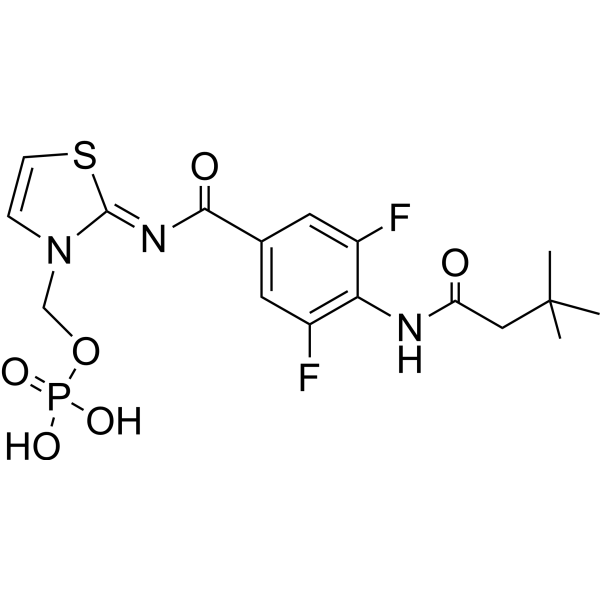
Lu AA47070 is a phosphonooxymethylene prodrug of a potent and selective Adenosine A2A receptor antagonist. Lu AA47070 reverses the motor and motivational effects produced by dopamine D2 receptor blockade .
loading...
    loading...
Cat. No.: HY-W752502
CAS No.: 74639-40-0
Docarpamine is an orally active dopamine prodrug that can be hydroxylated in the small intestine and liver to form active dopamine. Docarpamine mainly activates D1-like receptors in peripheral blood vessels to lower blood pressure and heart rate in a state of spontaneous hypertension. Docarpamine exerts a pressor and tachycardic effect by activating D1-like receptors, vasopressin V1 receptors, and α-adrenergic receptors in normal blood pressure conditions. Docarpamine can be used for research on renal vascular dilation and diuresis .
loading...
    loading...
Cat. No.: HY-160718
CAS No.: 171752-56-0
Synonyms: ABT-431; DAS-431
Target:  

Dopamine Receptor

Research Areas:  

Neurological Disease

Adrogolide is an A-86929 (HY-171472) prodrug and dopamine D1 receptor agonist. Adrogolide is converted rapidly in plasma to A-86929. Adrogolide improves behavioral disability and locomotor activity scores. Adrogolide can also attenuate the ability of Cocaine to induce Cocaine-seeking behavior. Adrogolide can be used in the research of Parkinson's disease .
loading...
    loading...
Cat. No.: HY-122278
CAS No.: 7101-51-1
Synonyms: Levodopa methylester
Melevodopa (Levodopa methylester) is an orally active methylated prodrug of Levodopa (HY-N0304), a dopamine precursor. When used in combination with Carbidopa (HY-B0311) in an effervescent tablet formulation, Melevodopa inhibits motor fluctuations in Parkinson's disease. Melevodopa suppresses subcutaneous tumor growth, pulmonary metastasis proliferation, and primary mass invasiveness of melanoma. Melevodopa induces lipid peroxidation by increasing malondialdehyde levels in melanoma and improves the survival rate of melanoma-bearing mice. Melevodopa can be used in research related to Parkinson's disease (with motor fluctuations) and melanoma .
loading...
    loading...

