9 Results for "

electrophysiological responses

" in MedChemExpress (MCE) Product Catalog:
Products (9)

9 Results for "electrophysiological responses" in MCE Product Catalog:

Cat. No.: HY-128454
CAS No.: 3658-80-8
Purity:  ≥98.0%
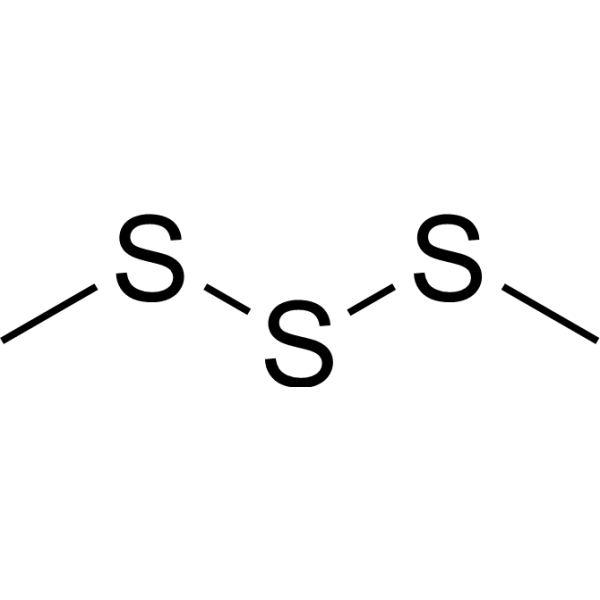
Dimethyl trisulfide is a cyanide scavenger. Dimethyl trisulfide can be isolated from garlic, onions, broccoli and similar plants. Dimethyl trisulfide converts cyanide into thiocyanate. Dimethyl trisulfide is used by saprophagous insects to locate breeding sites (decaying organic matter), and is also used by deceptive flowers in brood sites to attract such insects. Dimethyl trisulfide induces electrophysiological responses in houseflies .
loading...
    loading...
Cat. No.: HY-W073501
CAS No.: 628-48-8
Synonyms: trans-2-Pentenedioic acid
trans-Glutaconic acid (trans-2-Pentenedioic acid) is the trans isomer of Glutaconic acid (HY-W073501A). trans-Glutaconic acid is a neurotoxic metabolite. trans-Glutaconic acid induces weak neurotoxicity in cultured cerebral neocortical neurons. trans-Glutaconic acid elicits significant electrophysiological responses in rat neocortical wedge preparations at high concentrations. trans-Glutaconic acid can be used in studies related to glutaric acidemia type 1 .
loading...
    loading...
Cat. No.: HY-110168
CAS No.: 913830-15-6
Purity:  98.36%
Target:  

nAChR

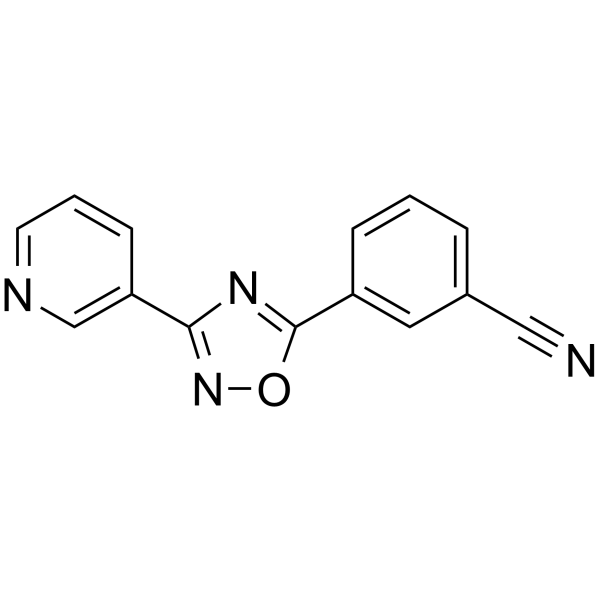
NS 9283 (A-969933) is a α4β2 nicotinic acetylcholine receptor (α4β2 nAChR) positive allosteric modulator that preferentially targets the (α4)3 (β2)2 stoichiometric conformation. NS 9283 increases the potency of ACh-induced currents without enhancing the maximal effect of ACh. NS 9283 also enhances prefrontal glutamate release, modulates attention-related electrophysiological responses, and potentiates the antinociceptive effects associated with α4β2 nAChR agonists. NS 9283 can be used in research related to inflammatory pain, postoperative pain, osteoarthritis pain, and Parkinson's disease .
loading...
    loading...
Cat. No.: HY-110168R
CAS No.: 913830-15-6
NS 9283 (Standard) is the analytical standard of NS 9283 (HY-110168). This product is intended for research and analytical applications. NS 9283 (A-969933) is a α4β2 nicotinic acetylcholine receptor (α4β2 nAChR) positive allosteric modulator that preferentially targets the (α4)3 (β2)2 stoichiometric conformation. NS 9283 increases the potency of ACh-induced currents without enhancing the maximal effect of ACh. NS 9283 also enhances prefrontal glutamate release, modulates attention-related electrophysiological responses, and potentiates the antinociceptive effects associated with α4β2 nAChR agonists. NS 9283 can be used in research related to inflammatory pain, postoperative pain, osteoarthritis pain, and Parkinson's disease .
loading...
    loading...
Cat. No.: HY-W004287
CAS No.: 1731-88-0
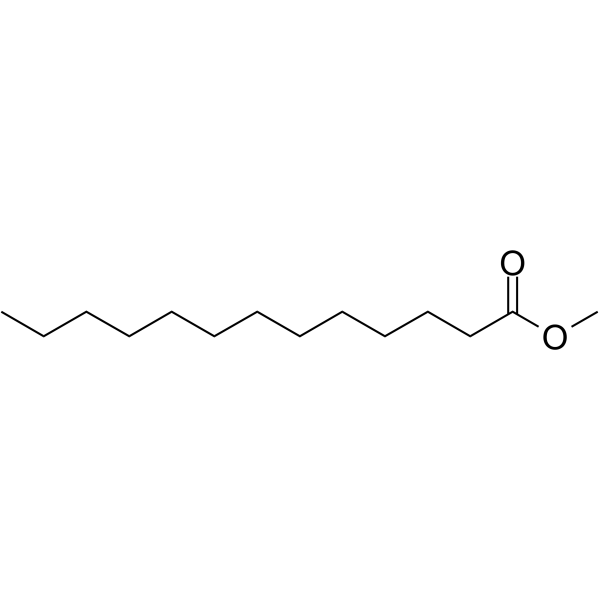
Methyl tridecanoate is a fatty acid methyl ester. Methyl tridecanoate exhibits an IC50 of 3.26 μM and a Ki of 2.30 μM against AsOBP21f in Anopheles sinensis. Methyl tridecanoate induces electroantennographic responses in female Anopheles sinensis. Methyl tridecanoate shows a dose-dependent attractive effect on Anopheles sinensis. Methyl tridecanoate weakly inhibits β-amyloid aggregation and AChE activity. Methyl tridecanoate can be used in the research of malaria and Alzheimer's disease .
loading...
    loading...
Cat. No.: HY-W017141
CAS No.: 24683-00-9
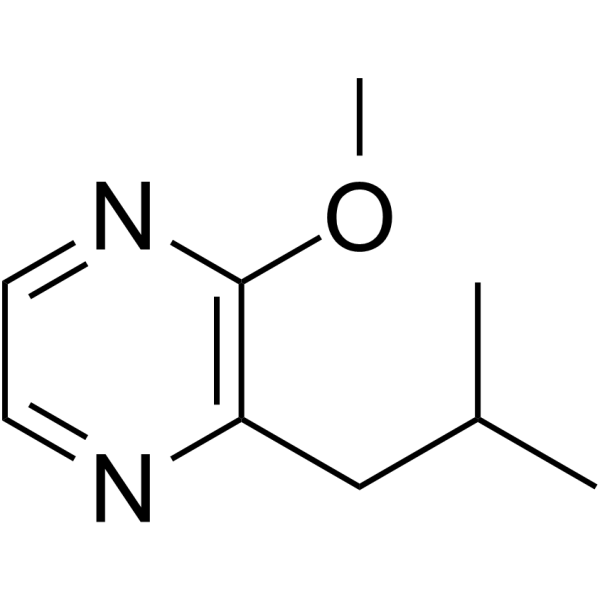
2-Isobutyl-3-methoxypyrazine is a male-specific aggregation pheromone released by the Portuguese leaf beetle Labidostomis lusitanica. 2-Isobutyl-3-methoxypyrazine induces dose-dependent electroantennographic responses in the antennae of both male and female Labidostomis lusitanica, with the overall response intensity of females being higher than that of males. 2-Isobutyl-3-methoxypyrazine induces positive chemotactic behavior, and exerts a repellent effect on male Labidostomis lusitanica at high doses. 2-Isobutyl-3-methoxypyrazine can be used in insect ecology research .
loading...
    loading...
Cat. No.: HY-W108424
CAS No.: 20711-10-8
Target:  

Insecticide

Research Areas:  

Infection

(Z)-11-Tetradecenyl acetate is a sex pheromone component and male attractant. (Z)-11-Tetradecenyl acetate triggers strong and stable electrophysiological responses in the antennal sensilla of male Euhyponomeutoides albithoracellus. (Z)-11-Tetradecenyl acetate, when used in combination with (E)-11-tetradecenyl acetate (HY-W1067200), attracts male Euhyponomeutoides albithoracellus. (Z)-11-Tetradecenyl acetate contributes to the development of sustainable pest control strategies including monitoring and mating disruption .
loading...
    loading...
Cat. No.: HY-110168S
NS 9283-d4 is the deuterated-labeled NS 9283 (HY-110168). NS 9283 (A-969933) is a α4β2 nicotinic acetylcholine receptor (α4β2 nAChR) positive allosteric modulator that preferentially targets the (α4)3 (β2)2 stoichiometric conformation. NS 9283 increases the potency of ACh-induced currents without enhancing the maximal effect of ACh. NS 9283 also enhances prefrontal glutamate release, modulates attention-related electrophysiological responses, and potentiates the antinociceptive effects associated with α4β2 nAChR agonists. NS 9283 can be used in research related to inflammatory pain, postoperative pain, osteoarthritis pain, and Parkinson's disease .
loading...
    loading...
Cat. No.: HY-W673672
CAS No.: 4144-54-1
Synonyms: 4-Ketocapric acid; 4-ODA
Target:  

Sex Pheromone

Research Areas:  

Infection

4-Oxodecanoic acid (4-Ketocapric acid) is a Sex pheromone component. 4-Oxodecanoic acid can be isolated from the sternal glands on the sixth abdominal segment of unmated female Vespa velutina. When mixed with 4-oxooctanoic acid at the natural secretion ratio of 0.78 in female wasps, 4-Oxodecanoic acid exhibits an attractive effect on male Vespa velutina. 4-Oxodecanoic acid can be used in population monitoring and control research on the invasive species Vespa velutina .
loading...
    loading...

