



NS 9283

Based on 1 Customer Validation
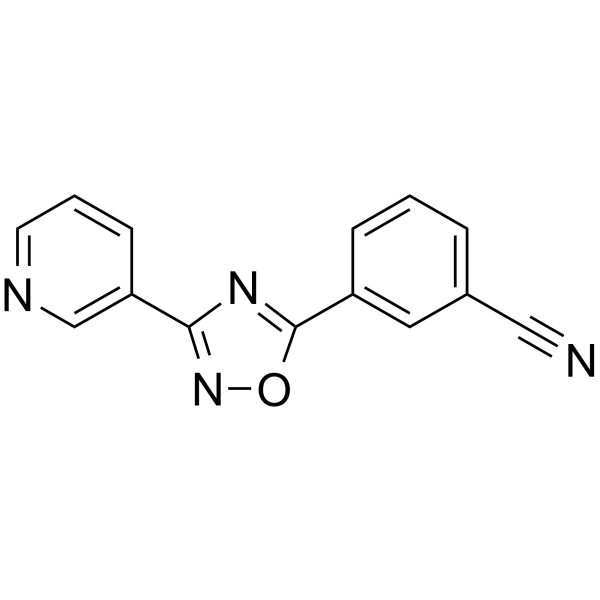
NS 9283 (A-969933) is a α4β2 nicotinic acetylcholine receptor (α4β2 nAChR) positive allosteric modulator that preferentially targets the (α4)3 (β2)2 stoichiometric conformation. NS 9283 increases the potency of ACh-induced currents without enhancing the maximal effect of ACh. NS 9283 also enhances prefrontal glutamate release, modulates attention-related electrophysiological responses, and potentiates the antinociceptive effects associated with α4β2 nAChR agonists. NS 9283 can be used in research related to inflammatory pain, postoperative pain, osteoarthritis pain, and Parkinson's disease.
For research use only. We do not sell to patients.
- Purity : 98.15%
- CAS No.: 913830-15-6
- Formula: C14H8N4O
- Molecular Weight:248.24
-
Storage:
4°C, protect from light
* In solvent : -80°C, 6 months; -20°C, 1 month (protect from light)

To place orders, for customer services and technical support, please contact: MedChemExpress USA
Tel: 609-228-6898 E-mail: [email protected] [email protected]


-
 Biological Activity
-
Chemical Information
-
Solvent & Solubility
- Protocols
- Purity & Documentation
- References
-
 Help & FAQs





Biological Activity
Description
IC50 & Target
[4]|
α4β2 nAChR |
In Vitro
NS 9283 (10 μM) moderately reduces the desensitization recovery rate of stably expressed human (α4)3 (β2)2 nAChR in HEK293 cells[4].
NS 9283 (10 μM) significantly slows the deactivation kinetics of stably expressed human (α4)3 (β2)2 nAChR in HEK293 cells, increasing the deactivation time constant to 65 ms[4].
NS 9283 (pre-incubated with ACh for approximately 40 s at a concentration of 10 μM prior to co-administration) enhances the inward current signal of human α4β2 nicotinic acetylcholine receptors expressed in HEK293 cells. In the experiment, a physiologically relevant concentration of 1 μM ACh is used, yielding an average peak current of 78 pA[1].
NS 9283 (30 μM) does not enhance (-)-nicotine-induced dopamine release in rat striatal slices, indicating that functional striatal α4β2 nAChRs belong to the high-sensitivity subtype[3].
MedChemExpress (MCE) has not independently confirmed the accuracy of these methods. They are for reference only.
In Vivo
NS 9283 (0.3-3.0 mg/kg; p.o.; single administration) enhances the amplitude of P3-like event-related potentials (ERP) in the mediodorsal thalamic nucleus (MD) (0.3 mg/kg) and auditory cortex (AC) (3.0 mg/kg) of rats, increases the amplitude of the pre-attentive N1 peak in the mediodorsal thalamic nucleus (0.3 mg/kg), and prolongs the latency of P3-like event-related potentials in the medial prefrontal cortex (mPFC) (3.0 mg/kg), without improving overall task performance[2].
NS 9283 (1-30 mg/kg; p.o.; single administration) alone has no effect on rotational behavior in 6-OHDA-lesioned rats, but co-administration with NS3956 (HY-183666) inhibits rotational behavior[3].
NS 9283 (3-30 mg/kg; p.o.; single administration; 30 min before formalin injection) exerts no analgesic effect when used alone in the rat formalin pain model, but potentiates the antinociceptive effect of NS3956 by 100-fold across all test phases[3].
Co-administration of NS 9283 (3.5 μmol/kg; i.p.; single dose) potentiates the reversal effect of ABT-594 (HY-14316A) on carrageenan-induced hyperalgesia in rats by 6-fold, whereas NS 9283 alone shows no analgesic activity even at a dose as high as 35 μmol/kg[5].
Combination of NS 9283 (3.5 or 35 μmol/kg; p.o.) with 30 nmol/kg ABT-594 potentiates ABT-594-induced brain functional activity, producing approximately a 5-fold enhancement, whereas 35 μmol/kg NS 9283 alone does not significantly alter brain function signals[5].
NS 9283 (intraperitoneal injection; single pre-treatment, dose 0.35-3.5 mg/kg) dose-dependently attenuates nicotine self-administration behavior in male Sprague Dawley rats under the FR5 schedule, while no such effect is observed at the dose of 0.35 mg/kg[6].
NS 9283 (3.5 mg/kg; i.p.; single pretreatment) reduces the reinforcing effect of nicotine, as evidenced by decreases in breakpoints, active lever responses, and nicotine infusions in male Sprague Dawley rats under a progressive ratio (PR) schedule when nicotine is administered at doses of 0.03 mg/kg and 0.06 mg/kg[6].
NS 9283 (0.35-3.5 mg/kg; i.p.; single pretreatment) dose-dependently attenuates cue- and nicotine-induced reinstatement of nicotine-seeking behavior in male Sprague Dawley rats, while no such effect is observed at the dose of 0.35 mg/kg[6].
NS 9283 (400-800 pmol; local pressure ejection into mPFC) induces glutamate release in the medial prefrontal cortex (mPFC) of intact-side rats[1].
NS 9283 (3 mg/kg; i.p.; single administration) enhances submaximal dose nicotine-induced glutamate release in the medial prefrontal cortex (mPFC) of rats by 48%[1].
MedChemExpress (MCE) has not independently confirmed the accuracy of these methods. They are for reference only.
-
Animal Model:Sprague-Dawley (CD-IGS) (male, arrival weight 280-299 g, maintained at 85-90% of free-feeding weight, trained in nicotine discrimination two-lever operant paradigm)[7]
-
Dosage:0.075-7.5 mg/kg
-
Administration:i.p.; 20 min before session
-
Result:Did not significantly generalize to nicotine alone; combination with 0.025 mg/kg nicotine produced full generalization at 7.5 mg/kg and a reported discrimination ED50 of 0.95 mg/kg.
-
Animal Model:Wistar rats (male adult, 300-450 g, urethane-anesthetized with intact cholinergic projections to medial prefrontal cortex)[1]
-
Dosage:400 pmol; 800 pmol
-
Administration:local pressure ejection into mPFC
-
Result:Evoked glutamate release in the mPFC with an average peak amplitude of 4.9 μM and a t80 decay rate of 2.1 s.
Evoked glutamate release in intact left hemispheres of rats with unilaterally lesioned right mPFC with an average peak amplitude of 3.3 μM at 400 pmol.
Evoked glutamate release in intact left hemispheres of rats with unilaterally lesioned right mPFC with an average peak amplitude of 5.8 μM at 800 pmol.
-
Animal Model:Wistar rats (male adult, 300-450 g, urethane-anesthetized)[1]
-
Dosage:3 mg/kg
-
Administration:i.p.; 30 min before measurement
-
Result:Potentiated the peak amplitude of glutamate release evoked by 40 pmol nicotine in the mPFC by 48%.
Increased peak amplitude from a baseline of 3.1 μM to 4.5 μM post-administration.
-
Animal Model:Sprague Dawley (male, ~15 weeks old, ~400-500 g at surgery)[2]
-
Dosage:0.3 mg/kg; 3.0 mg/kg
-
Administration:Oral administration (p.o.); 30 min before task
-
Result:Increased P3-like ERP amplitude in MD thalamus at 0.3 mg/kg and auditory cortex at 3.0 mg/kg; 0.3 mg/kg also increased MD thalamic N1 amplitude.
-
Animal Model:Sprague Dawley (adult female; 6-OHDA-induced unilateral nigrostriatal pathway lesion)[3]
-
Dosage:Up to 30 mg/kg
-
Administration:p.o.; single dose; p.o. (30 minutes prior to NS3956 co-administration)
-
Result:Did not induce rotational behavior alone; 30 mg/kg potentiated low-dose NS3956/nicotine-associated suppression of rotational behavior.
-
Animal Model:Sprague Dawley (adult male; formalin-induced hindpaw acute pain)[3]
-
Dosage:3-30 mg/kg
-
Administration:p.o.; single dose; 30 minutes prior to formalin
-
Result:Had no antinociceptive effect alone.
30 mg/kg strongly potentiated associated responses, with a reported 100-fold increase in interphase antinociceptive potency.
-
Animal Model:Sprague Dawley (adult male, 200-250 g, carrageenan-induced thermal hyperalgesia)[5]
-
Dosage:3.5 μmol/kg (co-administered with ABT-594); 3 μmol/kg, 10 μmol/kg, 30 μmol/kg, 35 μmol/kg (administered alone)
-
Administration:i.p.; single dose
-
Result:Produced no significant change in paw withdrawal latency compared to vehicle when administered alone at doses up to 35 μmol/kg.
Induced a 6-fold leftward shift in the ABT-594 dose-response curve for reversal of thermal hyperalgesia when co-administered at 3.5 μmol/kg with ABT-594.
-
Animal Model:Sprague Dawley (adult male, 200-250 g, monoiodoacetate-induced knee joint pain)[5]
-
Dosage:3.5 μmol/kg (co-administered with ABT-594); 1 μmol/kg, 3 μmol/kg, 10 μmol/kg (administered alone)
-
Administration:i.p.; single dose
-
Result:Induced a 50% return of grip force to normalcy when administered alone at 10 μmol/kg; doses of 1 μmol/kg and 3 μmol/kg showed no effect.
Induced a 5-fold leftward shift in the ABT-594 dose-response curve for return of grip force to normalcy when co-administered at 3.5 μmol/kg with ABT-594.
-
Animal Model:Sprague Dawley (adult male, 200-250 g, nicotine-induced locomotor sensitization)[5]
-
Dosage:3.5 μmol/kg, 10 μmol/kg (administered alone); 3.5 μmol/kg (co-administered with 10 nmol/kg ABT-594)
-
Administration:i.p.; single acute challenge dose
-
Result:Did not alter locomotor activity in nicotine-sensitized rats compared to vehicle challenge when administered alone at 3.5 μmol/kg or 10 μmol/kg.
Did not alter locomotor activity in nicotine-sensitized rats compared to vehicle challenge when co-administered at 3.5 μmol/kg with 10 nmol/kg ABT-594.
-
Animal Model:Sprague Dawley (male, 225-250 g, trained to self-administer nicotine intravenously on fixed-ratio 5 schedule)[6]
-
Dosage:0.35 mg/kg; 3.5 mg/kg
-
Administration:i.p.; single pretreatment
-
Result:Reduced total active lever responses and total nicotine infusions at 3.5 mg/kg compared to vehicle pretreatment.
Did not produce a significant reduction in total active lever responses or total nicotine infusions at 0.35 mg/kg.
Had no effect on inactive lever responses.
-
Animal Model:Sprague Dawley (male, 225-250 g, trained to self-administer nicotine intravenously on progressive ratio schedule)[6]
-
Dosage:3.5 mg/kg
-
Administration:i.p.; single pretreatment
-
Result:Reduced total active lever responses, total nicotine infusions, and breakpoints in rats self-administering 0.03 mg/kg nicotine on PR schedule.
Reduced total active lever responses, total nicotine infusions, and breakpoints in rats self-administering 0.06 mg/kg nicotine on PR schedule.
Had no effect on inactive lever responses.
-
Animal Model:Sprague Dawley (male, 225-250 g, trained to self-administer nicotine intravenously then extinguished prior to reinstatement testing)[6]
-
Dosage:0.35 mg/kg; 3.5 mg/kg
-
Administration:i.p.; single pretreatment
-
Result:Reduced total active lever responses during nicotine reinstatement compared to vehicle and 0.35 mg/kg pretreatment at 3.5 mg/kg.
Had no effect on inactive lever responses.
-
Animal Model:Sprague Dawley (male, 225-250 g, trained to self-administer nicotine intravenously on fixed-ratio 5 schedule)[6]
-
Dosage:0.125 μg/kg/infusion; 1.25 μg/kg/infusion; 2.5 μg/kg/infusion
-
Administration:i.v.; self-administered; 5 consecutive days
-
Result:Failed to support self-administration behavior at all tested doses; total active lever responses and infusions were equivalent to vehicle-treated rats.
Had total active lever responses and infusions significantly lower than the nicotine control group at all tested doses.
Had no effect on inactive lever responses.
-
Animal Model:Sprague Dawley (male, 225-250 g, trained to self-administer nicotine intravenously on fixed-ratio 5 schedule)[6]
-
Dosage:0.35 mg/kg; 3.5 mg/kg
-
Administration:i.p.; daily; 10 consecutive days
-
Result:Reduced total active lever responses and total nicotine infusions compared to vehicle and 0.35 mg/kg pretreatment for all 10 days at 3.5 mg/kg.
Did not produce a significant reduction in total active lever responses or total nicotine infusions at 0.35 mg/kg.
Lowered inactive lever responses on days 8 and 9 compared to vehicle and 0.35 mg/kg groups at 3.5 mg/kg.
-
Animal Model:Sprague Dawley (male, 225-250 g, trained to self-administer sucrose pellets on fixed-ratio 5 schedule)[6]
-
Dosage:3.5 mg/kg
-
Administration:i.p.; single pretreatment (acute testing); daily; 10 consecutive days (repeated testing)
-
Result:Had no effect on total active lever responses for sucrose self-administration with acute pretreatment.
Had no effect on total active lever responses for sucrose self-administration with repeated pretreatment.
-
Animal Model:Sprague Dawley (male, 225-250 g, trained to self-administer sucrose pellets then extinguished prior to reinstatement testing)[6]
-
Dosage:3.5 mg/kg
-
Administration:i.p.; single pretreatment
-
Result:Had no effect on total active lever responses during sucrose reinstatement.


Chemical Information
-
CAS No. 913830-15-6
-
Appearance Solid
-
Molecular Weight 248.24
-
Formula C14H8N4O
-
Color White to off-white
-
SMILES
N#CC1=CC=CC(C2=NC(C3=CN=CC=C3)=NO2)=C1
-
Shipping
Room temperature in continental US; may vary elsewhere.
-
Storage
4°C, protect from light
* In solvent : -80°C, 6 months; -20°C, 1 month (protect from light)


Solvent & Solubility
In Vitro:
DMSO : 16.67 mg/mL (67.15 mM; ultrasonic and warming and heat to 60°C; Hygroscopic DMSO has a significant impact on the solubility of product, please use newly opened DMSO)
Please refer to the solubility information to select the appropriate solvent. Once prepared, please aliquot and store the solution to prevent product inactivation from repeated freeze-thaw cycles.
Storage method and period of stock solution: -80°C, 6 months; -20°C, 1 month (protect from light). When stored at -80°C, please use it within 6 months. When stored at -20°C, please use it within 1 month.
Please refer to the solubility information to select the appropriate solvent. Once prepared, please aliquot and store the solution to prevent product inactivation from repeated freeze-thaw cycles.
Storage method and period of stock solution: -80°C, 6 months; -20°C, 1 month (protect from light). When stored at -80°C, please use it within 6 months. When stored at -20°C, please use it within 1 month.
Concentration (start) × Volume (start) = Concentration (final) × Volume (final)


Purity & Documentation
-
Data Sheet (302 KB)
-
SDS (393 KB)
- English - EN (393 KB)
- Français - FR (393 KB)
- Deutsch - DE (393 KB)
- Norwegian - NO (393 KB)
- Español - ES (393 KB)
- Swedish - SV (393 KB)
- Italian - IT (393 KB)
- Korean - KR (393 KB)
- Portuguese - PT (393 KB)
-
Handling Instructions (2659 KB)
References
[3]. Rode F, et al. Positive allosteric modulation of α4β2 nAChR agonist induced behaviour. Brain research. 2012 Jun 06;1458:67-75. [Content Brief]
[4]. Grupe M, et al. Unravelling the mechanism of action of NS9283, a positive allosteric modulator of (α4)3(β2)2 nicotinic ACh receptors. British Journal of Pharmacology. 2013;168:2000-2010. [Content Brief]


Complete Stock Solution Preparation Table
Please refer to the solubility information to select the appropriate solvent. Once prepared, please aliquot and store the solution to prevent product inactivation from repeated freeze-thaw cycles.
Storage method and period of stock solution: -80°C, 6 months; -20°C, 1 month (protect from light). When stored at -80°C, please use it within 6 months. When stored at -20°C, please use it within 1 month.
| Optional Solvent | Concentration Solvent Mass | 1 mg | 5 mg | 10 mg | 25 mg |
|---|---|---|---|---|---|
| DMSO | 1 mM | 4.0284 mL | 20.1418 mL | 40.2836 mL | 100.7090 mL |
| 5 mM | 0.8057 mL | 4.0284 mL | 8.0567 mL | 20.1418 mL | |
| 10 mM | 0.4028 mL | 2.0142 mL | 4.0284 mL | 10.0709 mL | |
| 15 mM | 0.2686 mL | 1.3428 mL | 2.6856 mL | 6.7139 mL | |
| 20 mM | 0.2014 mL | 1.0071 mL | 2.0142 mL | 5.0354 mL | |
| 25 mM | 0.1611 mL | 0.8057 mL | 1.6113 mL | 4.0284 mL | |
| 30 mM | 0.1343 mL | 0.6714 mL | 1.3428 mL | 3.3570 mL | |
| 40 mM | 0.1007 mL | 0.5035 mL | 1.0071 mL | 2.5177 mL | |
| 50 mM | 0.0806 mL | 0.4028 mL | 0.8057 mL | 2.0142 mL | |
| 60 mM | 0.0671 mL | 0.3357 mL | 0.6714 mL | 1.6785 mL |


NS 9283 Related Classifications
HY-110168 Related Classifications
 Powered by Bioz