1. Search Result
Search Result
Results for "

honeybee colonies

" in MedChemExpress (MCE) Product Catalog:

5

Inhibitors & Agonists

1

Natural
Products

1

Isotope-Labeled Compounds

Cat. No. 상품명 Target 연구분야 Chemical Structure
  • HY-139338
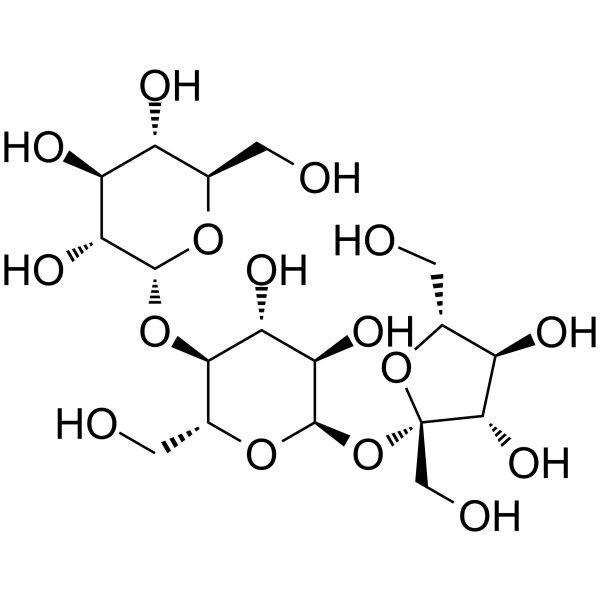
    Erlose
    1 Publications Verification

    Glycosidase Others
    Erlose is a trisaccharide sucrose derivative and low-calorie sweetener synthesized from glucose and sucrose via an α-glucosidase-mediated transglycosylation reaction. Erlose is often used as a marker to identify whether honey is adulterated with artificial sucrose. Erlose has approximately half the sweetness of sucrose but a similar taste, and it effectively inhibits crystal formation and browning reactions during food heat treatment .
    Erlose
  • HY-B1953
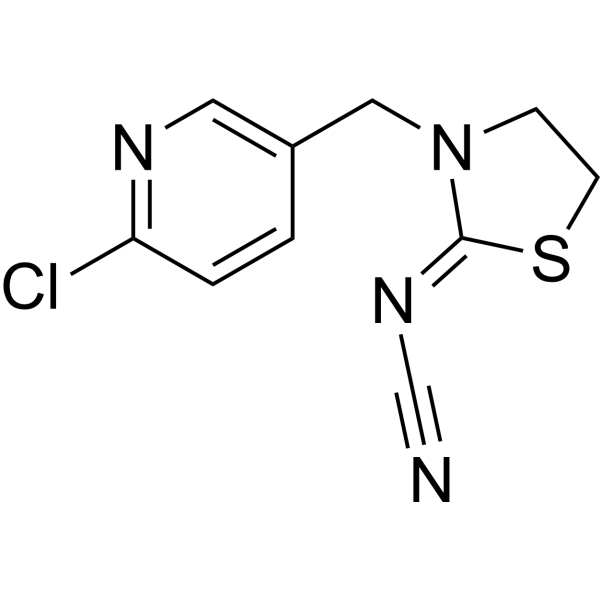
    Thiacloprid
    1 Publications Verification

    Environmental Pollutants Insecticide nAChR Infection
    Thiacloprid is an orally active neurotoxic insecticide and also a nAChR agonist. Thiacloprid reduces the viability of healthy cells, depletes reduced glutathione, and increases MDA levels, thereby inducing cytotoxicity and oxidative stress damage. In practical applications, Thiacloprid has lower acute toxicity to honeybees than other compounds of the same class such as Imidacloprid (HY-B0838), but it still significantly impairs the learning and memory function, immune capacity and survival status of honeybees. Thiacloprid induces intestinal microbial dysbiosis and reduces survival rate in middle-aged honeybees, increases the risk of premature collapse in bumblebee colonies, and significantly decreases the final colony weight and reproductive output. Thiacloprid is used in broad-spectrum agricultural pest control, often alone or in combination with Deltamethrin (HY-B1971), and meets the pest management needs of various crops including potatoes, cabbages, various fruits and vegetables, and nuts .
    Thiacloprid
  • HY-B2021

    Insecticide Neurological Disease
    τ-Fluvalinate is an insecticide and in-hive miticide, with its mechanism involving interfering with nervous systems. τ-Fluvalinate binds to the open state of Varroa destructor (VdNaV1) and Apis mellifera (AmNaV1) voltage-dependent sodium channels, with EC50 values of 160 nM and 60 nM respectively. τ-Fluvalinate has higher affinity for AmNaV1, which causes sublethal toxicity to honeybees. τ-Fluvalinate can be applied for research on Varroa destructor infestation in honeybee colonies .
    τ-Fluvalinate
  • HY-B1953R

    Reference Standards nAChR Insecticide Infection
    Thiacloprid (Standard) is the analytical standard of Thiacloprid. This product is intended for research and analytical applications. Thiacloprid is an orally active neurotoxic insecticide and also a nAChR agonist. Thiacloprid reduces the viability of healthy cells, depletes reduced glutathione, and increases MDA levels, thereby inducing cytotoxicity and oxidative stress damage. In practical applications, Thiacloprid has lower acute toxicity to honeybees than other compounds of the same class such as Imidacloprid (HY-B0838), but it still significantly impairs the learning and memory function, immune capacity and survival status of honeybees. Thiacloprid induces intestinal microbial dysbiosis and reduces survival rate in middle-aged honeybees, increases the risk of premature collapse in bumblebee colonies, and significantly decreases the final colony weight and reproductive output. Thiacloprid is used in broad-spectrum agricultural pest control, often alone or in combination with Deltamethrin (HY-B1971), and meets the pest management needs of various crops including potatoes, cabbages, various fruits and vegetables, and nuts .
    Thiacloprid (Standard)
  • HY-B1953S

    nAChR Insecticide Infection
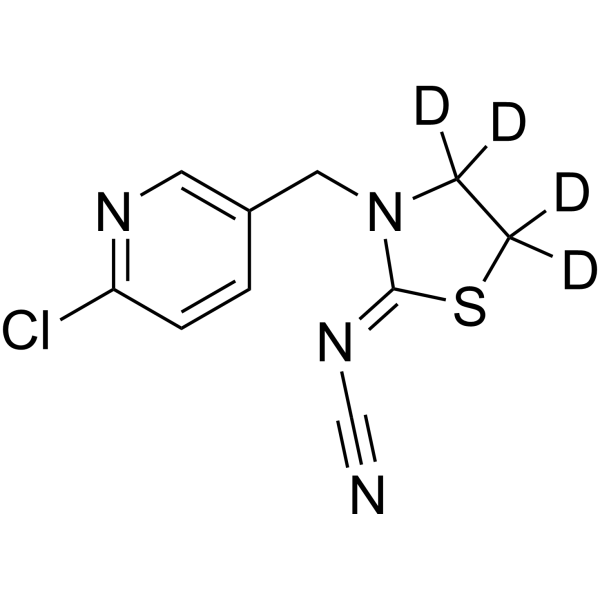
    Thiacloprid-d4 is the deuterium labeled Thiacloprid. Thiacloprid is an orally active neurotoxic insecticide and also a nAChR agonist. Thiacloprid reduces the viability of healthy cells, depletes reduced glutathione, and increases MDA levels, thereby inducing cytotoxicity and oxidative stress damage. In practical applications, Thiacloprid has lower acute toxicity to honeybees than other compounds of the same class such as Imidacloprid (HY-B0838), but it still significantly impairs the learning and memory function, immune capacity and survival status of honeybees. Thiacloprid induces intestinal microbial dysbiosis and reduces survival rate in middle-aged honeybees, increases the risk of premature collapse in bumblebee colonies, and significantly decreases the final colony weight and reproductive output. Thiacloprid is used in broad-spectrum agricultural pest control, often alone or in combination with Deltamethrin (HY-B1971), and meets the pest management needs of various crops including potatoes, cabbages, various fruits and vegetables, and nuts .
    Thiacloprid-d4

온라인 문의

Your information is safe with us. * Required Fields.

호칭


Country or Region *

고객명 *


회사명 *

Department *


메일주소 *


상품명 *

Cat. No.


Requested quantity *

전화번호 *


비고

온라인 문의

Inquiry Information

상품명:
Cat. No.:
수량:
MCE Japan Authorized Agent:

