



Erlose
Based on 1 publication(s) in Google Scholar
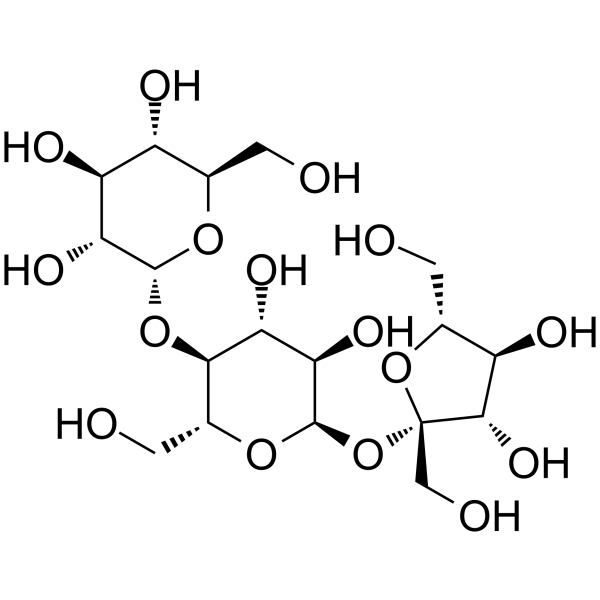
Erlose is a trisaccharide sucrose derivative and low-calorie sweetener synthesized from glucose and sucrose via an α-glucosidase-mediated transglycosylation reaction. Erlose is often used as a marker to identify whether honey is adulterated with artificial sucrose. Erlose has approximately half the sweetness of sucrose but a similar taste, and it effectively inhibits crystal formation and browning reactions during food heat treatment.
For research use only. We do not sell to patients.
- Purity : 99.57%
- CAS No.: 13101-54-7
- Formula: C18H32O16
- Molecular Weight:504.44
-
Storage:
4°C, protect from light
* In solvent : -80°C, 6 months; -20°C, 1 month (protect from light)

To place orders, for customer services and technical support, please contact: MedChemExpress USA
Tel: 609-228-6898 E-mail: [email protected] [email protected]


-
 Biological Activity
-
Chemical Information
-
Solvent & Solubility
- Purity & Documentation
- References
-
 Help & FAQs


Publications Citing Use of MedChemExpress (MCE) Erlose
More

Biological Activity
Description
IC50 & Target
|
α‑glucosidase |
In Vitro
Erlose (25% (w/w) unlabeled sucrose + 25% (w/w) 13C-labeled sucrose; 5 days) forms via an α-glucosidase-mediated glycosyl transferase reaction where sucrose acts as a glucosyl donor, with glucose binding to sucrose to produce erlose, as confirmed by the 1:3:3:1 intensity ratio of 13C-labeled erlose species[2].
Erlose has species-specific contents in natural monofloral honeys, ranging from an average of 0.08 g/100g in rape honey to 1.19 g/100g in jujube honey, with some jujube honey samples containing over 2.0 g/100g erlose[2].
MedChemExpress (MCE) has not independently confirmed the accuracy of these methods. They are for reference only. .


Chemical Information
-
CAS No. 13101-54-7
-
Appearance Liquid to low melt solid
-
Molecular Weight 504.44
-
Formula C18H32O16
-
Color White to off-white
-
SMILES
OC[C@]1(O[C@@H]([C@H]([C@@H]1O)O)CO)O[C@H]2O[C@@H]([C@H]([C@@H]([C@H]2O)O)O[C@H]3O[C@@H]([C@H]([C@@H]([C@H]3O)O)O)CO)CO
-
Structure Classification
-
Initial Source
honeydews of the citrus mealy bug
-
Shipping
Room temperature in continental US; may vary elsewhere.
-
Storage
4°C, protect from light
* In solvent : -80°C, 6 months; -20°C, 1 month (protect from light)


Publications (1)
-
Journal Impact Factor
-
Most Recent
-
J Chromatogr B Analyt Technol Biomed Life Sci
Distinguishing native trisaccharides having differential monosaccharide composition and linkage using PGC-LC MS/MS. [Abstract]2026 Jan 15:1269:124849. PMID: 41270636


Solvent & Solubility
In Vitro:
H2O : ≥ 50 mg/mL (99.12 mM)
* "≥" means soluble, but saturation unknown.
Please refer to the solubility information to select the appropriate solvent. Once prepared, please aliquot and store the solution to prevent product inactivation from repeated freeze-thaw cycles.
Storage method and period of stock solution: -80°C, 6 months; -20°C, 1 month (protect from light). When stored at -80°C, please use it within 6 months. When stored at -20°C, please use it within 1 month.
* Note: If you choose water as the stock solution, please dilute it to the working solution, then filter and sterilize it with a 0.22 μm filter before use.
Please refer to the solubility information to select the appropriate solvent. Once prepared, please aliquot and store the solution to prevent product inactivation from repeated freeze-thaw cycles.
Storage method and period of stock solution: -80°C, 6 months; -20°C, 1 month (protect from light). When stored at -80°C, please use it within 6 months. When stored at -20°C, please use it within 1 month.
* Note: If you choose water as the stock solution, please dilute it to the working solution, then filter and sterilize it with a 0.22 μm filter before use.
Concentration (start) × Volume (start) = Concentration (final) × Volume (final)


Purity & Documentation
-
Data Sheet (297 KB)
-
SDS (252 KB)
- English - EN (252 KB)
- Français - FR (252 KB)
- Deutsch - DE (252 KB)
- Norwegian - NO (252 KB)
- Español - ES (252 KB)
- Swedish - SV (252 KB)
- Italian - IT (252 KB)
- Korean - KR (252 KB)
- Portuguese - PT (252 KB)
-
Handling Instructions (2659 KB)
References
[1]. Vergès A, et al. Novel product specificity toward erlose and panose exhibited by multisite engineered mutants of amylosucrase. Protein Sci. 2017;26(3):566-577. [Content Brief]
[2]. Yan S, et al. Turanose and erlose as characteristic oligosaccharides in honey: Their formation mechanism and potential application for detecting honey adulteration. Food Chem. 2025;487:144784. [Content Brief]


Complete Stock Solution Preparation Table
Please refer to the solubility information to select the appropriate solvent. Once prepared, please aliquot and store the solution to prevent product inactivation from repeated freeze-thaw cycles.
Storage method and period of stock solution: -80°C, 6 months; -20°C, 1 month (protect from light). When stored at -80°C, please use it within 6 months. When stored at -20°C, please use it within 1 month.
| Optional Solvent | Concentration Solvent Mass | 1 mg | 5 mg | 10 mg | 25 mg |
|---|---|---|---|---|---|
| H2O | 1 mM | 1.9824 mL | 9.9120 mL | 19.8240 mL | 49.5599 mL |
| 5 mM | 0.3965 mL | 1.9824 mL | 3.9648 mL | 9.9120 mL | |
| 10 mM | 0.1982 mL | 0.9912 mL | 1.9824 mL | 4.9560 mL | |
| 15 mM | 0.1322 mL | 0.6608 mL | 1.3216 mL | 3.3040 mL | |
| 20 mM | 0.0991 mL | 0.4956 mL | 0.9912 mL | 2.4780 mL | |
| 25 mM | 0.0793 mL | 0.3965 mL | 0.7930 mL | 1.9824 mL | |
| 30 mM | 0.0661 mL | 0.3304 mL | 0.6608 mL | 1.6520 mL | |
| 40 mM | 0.0496 mL | 0.2478 mL | 0.4956 mL | 1.2390 mL | |
| 50 mM | 0.0396 mL | 0.1982 mL | 0.3965 mL | 0.9912 mL | |
| 60 mM | 0.0330 mL | 0.1652 mL | 0.3304 mL | 0.8260 mL | |
| 80 mM | 0.0248 mL | 0.1239 mL | 0.2478 mL | 0.6195 mL |
* Note: If you choose water as the stock solution, please dilute it to the working solution, then filter and sterilize it with a 0.22 μm filter before use.


Erlose Related Classifications
HY-139338 Related Classifications
 Powered by Bioz