9 Results for "

human Aβ42

" in MedChemExpress (MCE) Product Catalog:
Products (9)

9 Results for "human Aβ42" in MCE Product Catalog:

27
27 Publications Verification
Cat. No.: HY-P1363
Synonyms: Amyloid β-peptide (1-42) (human) TFA
Target:  

Amyloid-β

Research Areas:  

Neurological Disease

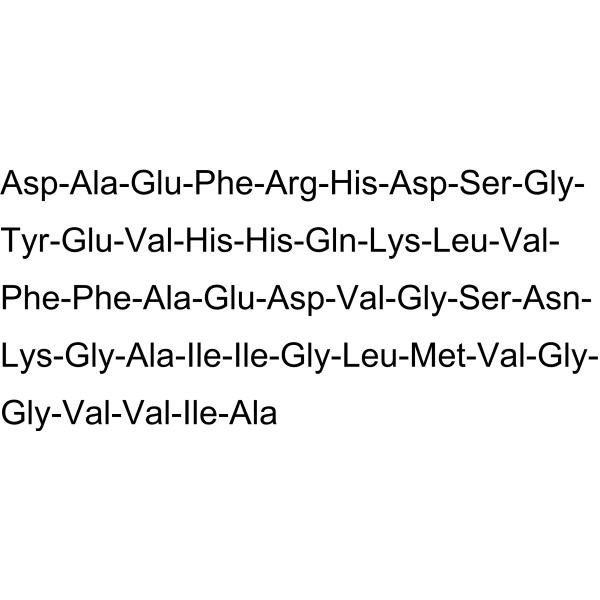
β-Amyloid (1-42) (Amyloid β-peptide (1-42), human TFA, a 42-amino acid peptide that has not been treated with HFIP, is a brain-penetrant amyloid protein fragment, which can be used in research on Alzheimer's disease and Down’s syndrome. β-Amyloid (1-42), human TFA remaining as a monomer exhibits antioxidant and neuroprotective effects. β-Amyloid (1-42), human TFA, after being monomericized by HFIP and dissolved in DMSO to form the stock solution, on the one hand, can form soluble oligomers (AβOs) when incubated at 4 °C, which have synaptic toxicity and neurotoxicity; on the other hand, it can be incubated at 37 °C to form insoluble fibrils, with lower neurotoxicity, and participating in the oxidative damage process. Aβ42 oligomers bind to various neuronal surface receptors (such as PrPc, mGluR5, NMDA receptors, etc.), triggering oxidative stress, calcium homeostasis imbalance, and synaptic toxicity via activating downstream signaling pathways, leading to neuronal dysfunction and death .
loading...
    loading...
27
27 Publications Verification
Cat. No.: HY-P1363A
CAS No.: 107761-42-2
Synonyms: Amyloid β-peptide (1-42) (human)
Target:  

Amyloid-β

Research Areas:  

Neurological Disease

β-Amyloid (1-42) (Amyloid β-peptide (1-42)), human, a 42-amino acid peptide that has not been treated with HFIP, is a brain-penetrant amyloid protein fragment, which can be used in research on Alzheimer's disease and Down’s syndrome. β-Amyloid (1-42), human remaining as a monomer exhibits antioxidant and neuroprotective effects. β-Amyloid (1-42), human, after being monomericized by HFIP and dissolved in DMSO to form the stock solution, on the one hand, can form soluble oligomers (AβOs) when incubated at 4 °C, which have synaptic toxicity and neurotoxicity; on the other hand, it can be incubated at 37 °C to form insoluble fibrils, with lower neurotoxicity, and participating in the oxidative damage process. Aβ42 oligomers bind to various neuronal surface receptors (such as PrPc, mGluR5, NMDA receptors, etc.), triggering oxidative stress, calcium homeostasis imbalance, and synaptic toxicity via activating downstream signaling pathways, leading to neuronal dysfunction and death .
loading...
    loading...
27
27 Publications Verification
Cat. No.: HY-P1363B
CAS No.: 107761-42-2
Target:  

Amyloid-β

Research Areas:  

Neurological Disease

β-Amyloid (1-42), human, HFIP-treated, a 42-amino acid peptide that has been treated with HFIP from β-Amyloid (1-42), human (HY-P1363A), is a brain-penetrant amyloid protein fragment, which can be used in research on Alzheimer's disease and Down’s syndrome. β-Amyloid (1-42), human, HFIP-treated remaining as a monomer exhibits antioxidant and neuroprotective effects. β-Amyloid (1-42), human, HFIP-treated, after being dissolved in DMSO to form the stock solution, on the one hand, can form soluble oligomers (AβOs) when incubated at 4°C, which have synaptic toxicity and neurotoxicity; on the other hand, it can be incubated at 37°C to form insoluble fibrils, with lower neurotoxicity, and participating in the oxidative damage process. Aβ42 oligomers bind to various neuronal surface receptors (such as PrPc, mGluR5, NMDA receptors, etc.), triggering oxidative stress, calcium homeostasis imbalance, and synaptic toxicity via activating downstream signaling pathways, leading to neuronal dysfunction and death .
loading...
    loading...
Cat. No.: HY-P990301

Target:  

Amyloid-β

Research Areas:  

Neurological Disease

Anti-Human/Mouse/Rat Amyloid-beta Antibody (MOAB-2) is a mouse-derived IgG2b λ type antibody inhibitor, targeting to Amyloid-beta. Anti-Human/Mouse/Rat Amyloid-beta Antibody (MOAB-2) recognizes unaggregated, oligomeric or fibrillar forms of Aβ42 and unaggregated Aβ40. Anti-Human/Mouse/Rat Amyloid-beta Antibody (MOAB-2) is selective for human Aβ42 over Aβ40, but not amyloid precursor protein (APP). Anti-Human/Mouse/Rat Amyloid-beta Antibody (MOAB-2) can immunostain human or rat and mouse tissue. Anti-Human/Mouse/Rat Amyloid-beta Antibody (MOAB-2) can be used for detections of western blot, immunohistochemistry, immunofluorescence, immunoprecipitation and ELISA .
loading...
    loading...
Cat. No.: HY-P5905
Synonyms: Citrullinated Aβ (1-42); Citrullinated Aβ42
Target:  

Amyloid-β

Research Areas:  

Neurological Disease

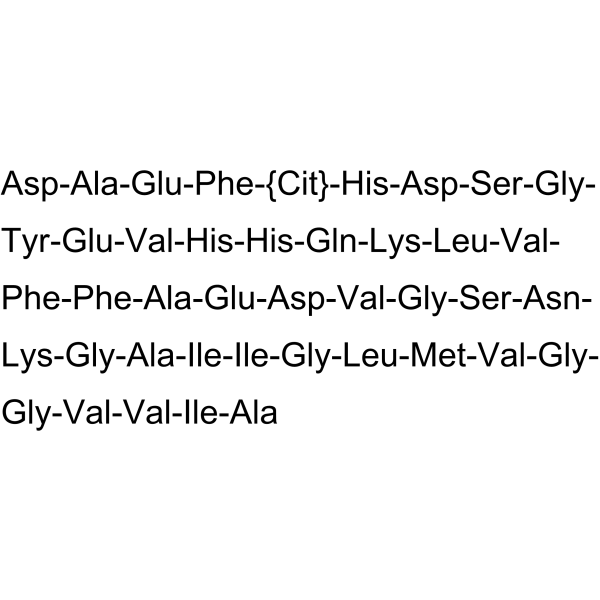
Citrullinated amyloid-β (1-42) peptide (human) (Citrullinated Aβ (1-42)) is a modified form of β-Amyloid (1-42) (HY-P1363) with a citrullination at the Arg5 site. Compared to the unmodified β-Amyloid (1-42), its formation of soluble low-molecular-weight oligomers is enhanced, the rate of fibril formation is reduced, and like unmodified Aβ42, it forms protofibrils comprised of parallel β-sheets .
loading...
    loading...
Cat. No.: HY-P1363S1
β-Amyloid (1-42), human, Ala( 13C3, 15N) TFA is the 13C and 15N-labeled β-Amyloid (1-42), human (HY-P1363A). β-Amyloid (1-42) (Amyloid β-peptide (1-42)), human, a 42-amino acid peptide that has not been treated with HFIP, is a brain-penetrant amyloid protein fragment, which can be used in research on Alzheimer's disease and Down’s syndrome. β-Amyloid (1-42), human remaining as a monomer exhibits antioxidant and neuroprotective effects. β-Amyloid (1-42), human, after being monomericized by HFIP and dissolved in DMSO to form the stock solution, on the one hand, can form soluble oligomers (AβOs) when incubated at 4 °C, which have synaptic toxicity and neurotoxicity; on the other hand, it can be incubated at 37 °C to form insoluble fibrils, with lower neurotoxicity, and participating in the oxidative damage process. Aβ42 oligomers bind to various neuronal surface receptors (such as PrPc, mGluR5, NMDA receptors, etc.), triggering oxidative stress, calcium homeostasis imbalance, and synaptic toxicity via activating downstream signaling pathways, leading to neuronal dysfunction and death .
loading...
    loading...
Cat. No.: HY-128581
CAS No.: 1420200-82-3
Purity:  99.47%
Target:  

γ-secretase

Research Areas:  

Neurological Disease

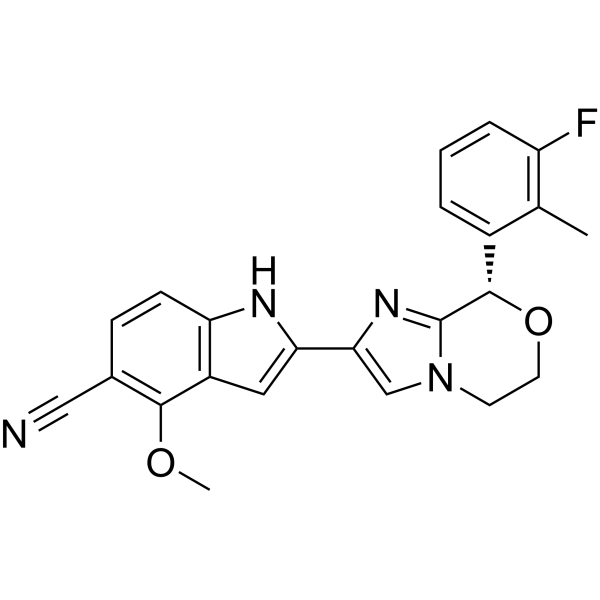
γ-Secretase modulator 4 is a potent γ-secretase modulator, reduces the Aβ42 level with IC50s of 0.014 μM and 0.017 μM in human and mouse, respectively .
loading...
    loading...
Cat. No.: HY-P991073

Target:  

Amyloid-β

Research Areas:  

Neurological Disease

MEDI-1814 is a fully human IgG1 antibody that targets the C terminus of Aβ42. MEDI-1814 binds to and sweeps away the circulated Aβ peptides, hence, restricting them from aggregating into toxic oligomers. MEDI-1814 can be used for the study of Alzheimer's diseases. The isotype control for MEDI-1814 can refer to Human IgG1 kappa, Isotype Control (HY-P99001) .
loading...
    loading...
Cat. No.: HY-175755
Target:  

Amyloid-β

Research Areas:  

Neurological Disease

Ac-BIM-acid bromide is a derivative of Acridine. Ac-BIM-acid bromide significantly inhibits amyloid fibrillation. Ac-BIM-acid bromide modulates the structure of N-terminal region of Saccharomyces cerevisiae Stm1 protein (Stm1_N 1-113) and the amyloid morphology of human Aβ42 protein, inhibiting theirs growth. Ac-BIM-acid bromide can be used for Alzheimer’s disease research .
loading...
    loading...

