11 Results for "

locomotor depression

" in MedChemExpress (MCE) Product Catalog:
Products (11)

11 Results for "locomotor depression" in MCE Product Catalog:

Cat. No.: HY-171844
CAS No.: 1086377-48-1
Target:  

iGluR

CX1739 is an orally active, blood-brain barrier permeable, low-efficacy AMPA-glutamate receptor (AMPAR) potentiator. CX1739 enhances excitatory neurotransmission by potentiating glutamate-induced excitatory currents and promoting in vivo long-term potentiation. CX1739 eliminates amphetamine-induced locomotor activity, reverses opioid-, pentobarbital- and ethanol-induced respiratory depression, and exerts pro-cognitive effects in animals. CX1739 impairs motor function recovery and increases the risk of post-injury complications. CX1739 can be used in research related to attention-deficit/hyperactivity disorder, dementia, respiratory depression and spinal cord injury .
loading...
    loading...
Cat. No.: HY-P10405A
Target:  

Dopamine Receptor

Research Areas:  

Neurological Disease

TAT-D1 peptide acetate is a dopamine D1-D2 receptor heterodimer inhibitor. TAT-D1 peptide acetate disrupts the function of dopamine D1-D2 receptor heteromers, enhances subchronic amphetamine-induced locomotor activity, and exacerbates the expression of amphetamine-induced locomotor sensitization. TAT-D1 peptide acetate produces rapid anxiolytic and antidepressant-like effects in rat models of depression and anxiety, and inhibits c-fos expression in the nucleus accumbens of rats. TAT-D1 peptide acetate can be used in the research of psychostimulant addiction, depression and anxiety disorders .
loading...
    loading...
Cat. No.: HY-125784A
CAS No.: 56287-63-9
Target:  

5-HT Receptor

Research Areas:  

Neurological Disease

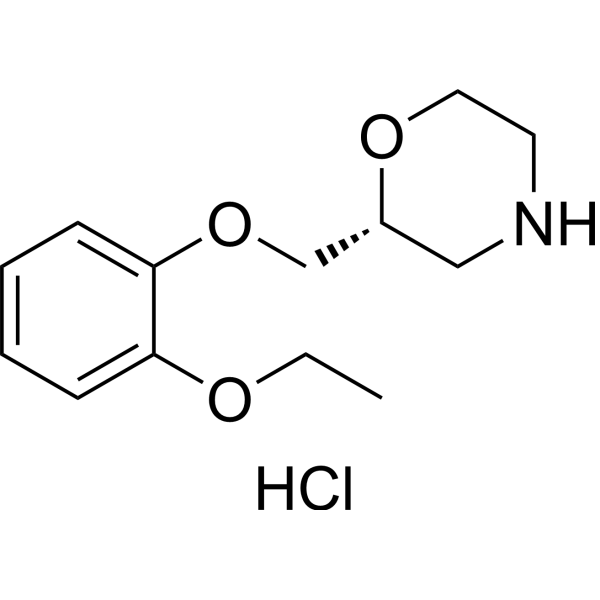
(R)-Viloxazine hydrochloride is the less active R-isomer of Viloxazine hydrochloride (HY-125784). (R)-Viloxazine hydrochloride can be used in the research of depression .
loading...
    loading...
Cat. No.: HY-P10405
Target:  

Dopamine Receptor

Research Areas:  

Neurological Disease

TAT-D1 peptide is a dopamine D1-D2 receptor heterodimer inhibitor. TAT-D1 peptide disrupts the function of dopamine D1-D2 receptor heteromers, enhances subchronic amphetamine-induced locomotor activity, and exacerbates the expression of amphetamine-induced locomotor sensitization. TAT-D1 peptide produces rapid anxiolytic and antidepressant-like effects in rat models of depression and anxiety, and inhibits c-fos expression in the nucleus accumbens of rats. TAT-D1 peptide can be used in the research of psychostimulant addiction, depression and anxiety disorders .
loading...
    loading...
Cat. No.: HY-118461
CAS No.: 108351-91-3
Target:  

Dopamine Receptor

Research Areas:  

Neurological Disease

PD 120697 is an orally active dopamine (DA) agonist. PD 120697 inhibits striatal DA synthesis, DA neuronal firing, spontaneous locomotor activity, and reverses Reserpine (HY-N0480)-induced depression .
loading...
    loading...
Cat. No.: HY-125784AS
CAS No.: 1246815-04-2
Synonyms: (R)-Viloxazin-d5 hydrochloride; (R)-Emovit-d5 hydrochloride
(R)-Viloxazine-d5 hydrochloride ((R)-Viloxazin-d5 hydrochloride; (R)-Emovit-d5 hydrochloride) is the deuterated-labeled (R)-Viloxazine hydrochloride (HY-125784A). (R)-Viloxazine hydrochloride is the less active R-isomer of Viloxazine hydrochloride (HY-125784). (R)-Viloxazine hydrochloride can be used in the research of depression .
loading...
    loading...
Cat. No.: HY-142110
CAS No.: 39226-94-3
Synonyms: DCMB
LY 78335 (DCMB) is a brain-penetrant phenylethanolamine-N-methyltransferase (PNMT) inhibitor with a Ki of 0.09 μM. LY 78335 acts as an α₂-adrenoceptor inhibitor with an IC50 of 10 μM. LY 78335 increases spontaneous locomotor activity in rats. LY 78335 increases extracellular concentration of 3-methoxy-4-hydroxyphenylglycol (MHPG) in rat hypothalamus. LY 78335 prevents growth hormone (GH) secretion in rats. LY 78335 can be used for the research of depression .
loading...
    loading...
Cat. No.: HY-182687
CAS No.: 2257428-48-9
Target:  

Adenosine Receptor

Research Areas:  

Neurological Disease

MRS7469 is a highly selective A1 adenosine receptor (A1AR) agonist with over 2000-fold selectivity over other adenosine receptor subtypes. MRS7469 stably binds to the orthosteric binding site of A1AR, and exhibits extremely high affinity for both humans and mice (e.g., human pKi is 8.67, mouse pKi is 9.43). By activating central A1AR, MRS7469 significantly induces hypothermia, motor inhibition and psychomotor dysfunction, and can be widely used in research related to depression and other relevant fields .
loading...
    loading...
Cat. No.: HY-177797
CAS No.: 30439-19-1
Research Areas:  

Neurological Disease

5-Methoxytryptoline acts as a modulator of the Serotonin transporter complex, as well as a ligand for the 5-HT2A and 5-HT2C receptors, with Ki values of 130 nM and 140 nM for the 5-HT2A and 5-HT2C receptors, respectively. 5-Methoxytryptoline inhibits the active uptake of Serotonin (HY-B1473A) and Tryptamine (HY-B2132) in platelets. 5-Methoxytryptoline induces behavioral excitation, cortical electroencephalographic desynchronization, and dose-dependent elevation of plasma prolactin, followed by behavioral sedation and partial recovery of cortical electroencephalographic voltage. 5-Methoxytryptoline antagonizes Reserpine (HY-N0480)-induced sedation, reduced locomotor activity, and hypothermia. 5-Methoxytryptoline exerts dose-dependent effects on behavior and cortical electroencephalographic activity in freely moving rats. 5-Methoxytryptoline can be used in depression-related research .
loading...
    loading...
Cat. No.: HY-105857
CAS No.: 5845-26-1
Target:  

GABA Receptor

Research Areas:  

Neurological Disease

Thiazesim is a CNS-penetrant GABAA receptor inhibitor, exerting anticonvulsant and antidepressant effects. Thiazesim depresses amygdala output, disrupts conditioned avoidance response in rats. Thiazesim can be used for the research of depression and epilepsy .
loading...
    loading...
Cat. No.: HY-105857A
CAS No.: 3122-01-8
Target:  

GABA Receptor

Research Areas:  

Neurological Disease

Thiazesim hydrochloride is a CNS-penetrant GABAA receptor inhibitor, exerting anticonvulsant and antidepressant effects. Thiazesim hydrochloride depresses amygdala output, disrupts conditioned avoidance response in rats. Thiazesim hydrochloride can be used for the research of depression and epilepsy .
loading...
    loading...
  • 1

