7 Results for "

marine animals

" in MedChemExpress (MCE) Product Catalog:
Products (7)

7 Results for "marine animals" in MCE Product Catalog:

Cat. No.: HY-W750676
CAS No.: 7542-45-2
Synonyms: AstaREAL; AstaXin; BioAstin
Target:  

Endogenous Metabolite

Research Areas:  

Metabolic Disease

rac-Astaxanthin is a carotenoid pigment found primarily in marine animals including shrimp and salmon. It is a potent lipid-soluble antioxidant.
loading...
    loading...
Cat. No.: HY-W750676R
CAS No.: 7542-45-2
Synonyms: AstaREAL (Standard); AstaXin (Standard); BioAstin (Standard)
(rac./meso)-Astaxanthin (Standard) is the analytical standard of (rac./meso)-Astaxanthin. This product is intended for research and analytical applications. rac-Astaxanthin is a carotenoid pigment found primarily in marine animals including shrimp and salmon. It is a potent lipid-soluble antioxidant.
loading...
    loading...
Cat. No.: HY-137990
CAS No.: 3774-64-9
Purity:  97.75%
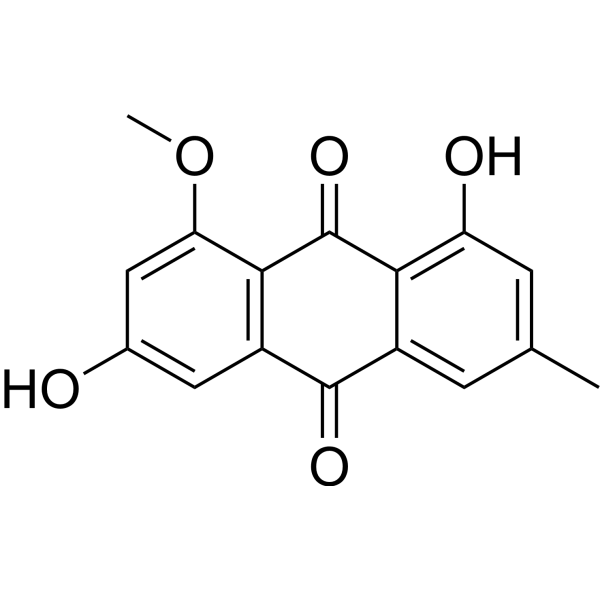
Questin is an anthraquinone compound and antibacterial agent. Questin can be isolated from marine-derived fungi and plants. Questin inhibits Cdc25B phosphatase. Questin exhibits antibacterial activity against V. harveyi, V. anguillarum, V. cholerae, and V. parahemolyticus with MIC values of 31.25 µg/mL, 62.5 µg/mL, 62.5 µg/mL, and 125 µg/mL. Questin displays antiprotozoal activity against the animal protozoan pathogen Tritrichomonas foetus, with a MIC of 12.5 µg/mL. Questin has anticancer activity against lung and colon cancer .
loading...
    loading...
Cat. No.: HY-W795031
CAS No.: 64436-13-1
Target:  

Bacterial

Research Areas:  

Infection

Arsenobetaine is an organoarsenical and a compatible solute that has been found in various marine animals, such as lobsters and crabs, as well as terrestrial organisms, including earthworms and lichens. Arsenobetaine is protective against B. subtilis cell death induced by high osmolarity or extreme temperatures when used at a concentration of 1 mM .
loading...
    loading...
Cat. No.: HY-113621B
CAS No.: 2757574-06-2
Target:  

Fluorescent Dye MMP

Research Areas:  

Cancer

Ageladine A dihydrochloride is an inhibitor of matrix metalloproteinase (MMP) isolated from the marine sponge Agelas nakamurai, possessing anti-angiogenic activity. Ageladine A dihydrochloride not only inhibits MMP-2 but also MMP-1, MMP-8, MMP-9, MMP-12, and MMP-13, with IC50 values of 4.65 μM, 2.79 μM, 907.12 nM, 1.83 μM, 767.57 nM, and 1.09 μM, respectively. Additionally, Ageladine A dihydrochloride is a pH-sensitive membrane-permeable dye that emits fluorescence in the blue-green range upon UV excitation, featuring a maximum absorption peak at 370 nm. Furthermore, Ageladine A dihydrochloride serves as a reliable and stable fluorescent pH sensor for detecting changes in intracellular pH values .
loading...
    loading...
Cat. No.: HY-W270079
CAS No.: 94089-22-2
Target:  

Others

Research Areas:  

Others

2-Methyl-3-isopropoxypyrazine is a pyrazine compound and a component of an odor modulator for modulating odors of asphalt, sludge, sewage, ginkgo, compost, marine animals, vegetables, food waste, or paint .
loading...
    loading...
Cat. No.: HY-L107
2,020 compounds

With features of enormous scaffold diversity and structural complexity, natural products (NPs) are the main sources of lead compounds and new drugs and play a highly significant role in the drug discovery and development process, especially for cancer and infectious diseases. A large number of natural products have been proven to have potential anti-tumor effects, mainly from plants, animals, Marine organisms and microorganisms. At present, derived than 60% of anti-tumor drugs come from natural sources, and they are widely used in breast, prostate and colon cancers.

MCE offers a unique collection of 2,020 natural products with validated anti-cancer activity. MCE anti-cancer natural product library is a useful tool for anti-tumor drugs screening and other related research.

