6 Results for "

mitochondrial respiratory chain Complexes IV

" in MedChemExpress (MCE) Product Catalog:
Products (6)

6 Results for "mitochondrial respiratory chain Complexes IV" in MCE Product Catalog:

Cat. No.: HY-114220
CAS No.: 873546-31-7
Purity:  98.41%
Research Areas:  

Infection

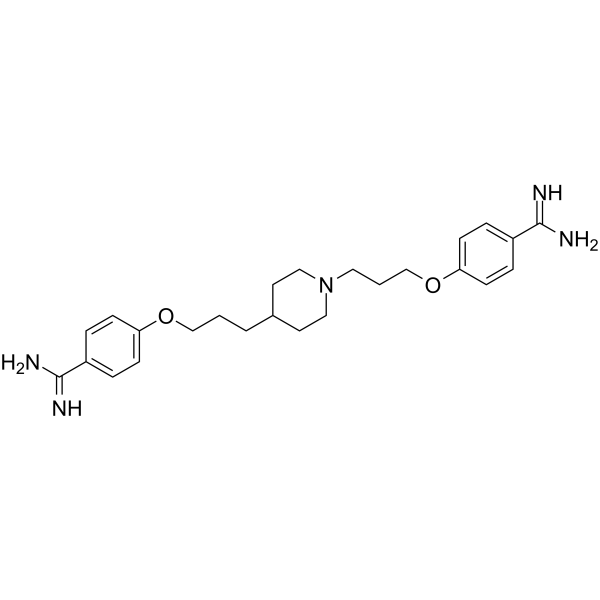
T-2307 is an antifungal agent with blood-brain barrier penetration. T-2307 exhibits broad-spectrum antifungal activity against Candida species, including echinocandin-resistant strains, Cryptococcus neoformans, Cryptococcus gattii, and some Aspergillus species. T-2307 selectively targets fungal mitochondrial respiratory chain complexes III and IV, causing collapse of the fungal mitochondrial membrane potential and exerting fungicidal or fungistatic effects. T-2307 can be used in research related to fungal infections such as invasive candidiasis, cryptococcosis, and aspergillosis .
loading...
    loading...
Cat. No.: HY-Y1366
CAS No.: 116-09-6
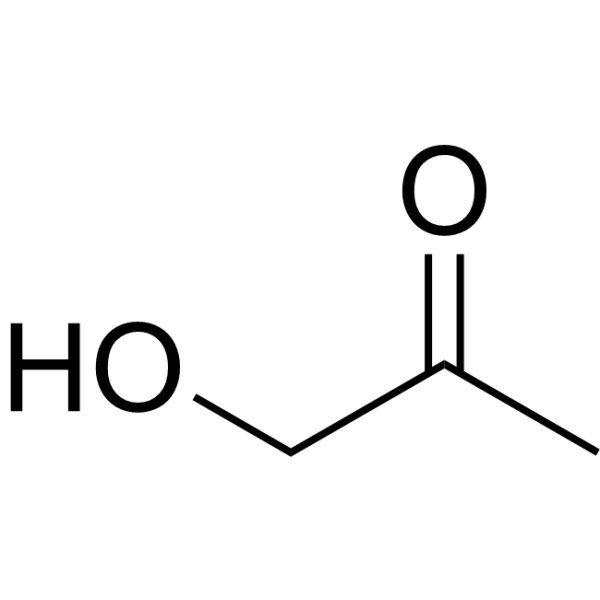
Hydroxyacetone is a toxic compound. Hydroxyacetone can be isolated from e-cigarette aerosols. Hydroxyacetone reduces the activity of cellular Mitochondrial reductase (with an IC50 of 5.53 mg/mL for mitochondrial reductase in BEAS-2B cells) and increases ROS levels. Hydroxyacetone induces mitochondrial stress and oxidative damage. Hydroxyacetone induces destabilization of F-actin. At high concentrations, Hydroxyacetone promotes cell rounding and Apoptotic body formation. Hydroxyacetone exerts toxic effects on cells including airway epithelial cells and possesses respiratory toxicity potential .\n


loading...
    loading...
Cat. No.: HY-125857B
CAS No.: 9007-43-6
Cytochrome C (Saccharomyces cerevisiae) is a type C cytochrome located in the intermembrane space of the mitochondria. As an electron carrier, Cytochrome C (Saccharomyces cerevisiae) transfers electrons between complex III (cytochrome c reductase) and complex IV (cytochrome c oxidase, CIV) of the respiratory chain. Cytochrome C (Saccharomyces cerevisiae) can play a crucial role in triggering apoptosis by being released from the mitochondria into the cytosol .
loading...
    loading...
Cat. No.: HY-132178B
Research Areas:  

Metabolic Disease

Cytochrome C oxidase (complex IV) (EC 7.1.1.9) is the unique terminal oxidase of the mitochondrial respiratory chain (RC) in mammals. Cytochrome C oxidase is made up of thirteen subunits that catalyze the transfer of electrons from ferro-cytochrome c to molecular oxygen .
loading...
    loading...
Cat. No.: HY-131453
CAS No.: 1352002-58-4
Mitochondrial respiration-IN-1 is a mitochondrial respiratory inhibitor. Mitochondrial respiration-IN-1 reduces platelet aggregation, adhesion, and platelet-induced coagulation responses. Mitochondrial respiration-IN-1 induces adaptive glycolysis, decreases mitochondrial membrane potential, selectively reduces ATP production derived from oxidative phosphorylation, and exerts bidirectional regulatory effects on cell proliferation. Mitochondrial respiration-IN-1 activates UPRmt and upregulates the expression of SDHA-1 and MT-CO1. Mitochondrial respiration-IN-1 restores metabolic homeostasis in type 2 diabetic mice. Mitochondrial respiration-IN-1 can be used to investigate diseases mediated by inappropriate platelet activation/aggregation and type 2 diabetes .
loading...
    loading...
Cat. No.: HY-116032
CAS No.: 256348-71-7
Target:  

TrxR

Research Areas:  

Cancer

PAO-PDT is an organoarsenic inhibitor of thioredoxin reductase (TrxR), with an IC50 of 33 nM. PAO-PDT can bind to the C-terminal selenocysteine/cysteine pair of TrxR and convert the enzyme into an NADPH oxidase, which increases reactive oxygen species levels and impairs mitochondrial respiratory function, thereby inducing apoptosis in leukemia cells. PAO-PDT can be used for leukemia research .
loading...
    loading...

