



T-2307

Based on 1 Customer Validation
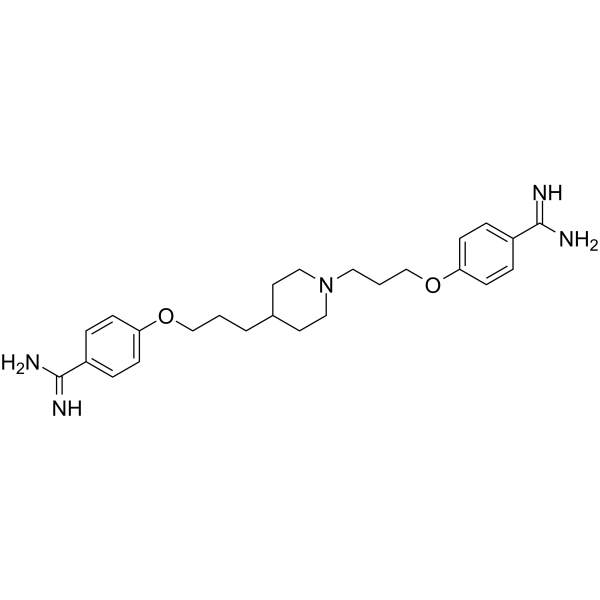
T-2307 is an antifungal agent with blood-brain barrier penetration. T-2307 exhibits broad-spectrum antifungal activity against Candida species, including echinocandin-resistant strains, Cryptococcus neoformans, Cryptococcus gattii, and some Aspergillus species. T-2307 selectively targets fungal mitochondrial respiratory chain complexes III and IV, causing collapse of the fungal mitochondrial membrane potential and exerting fungicidal or fungistatic effects. T-2307 can be used in research related to fungal infections such as invasive candidiasis, cryptococcosis, and aspergillosis.
For research use only. We do not sell to patients.
- Purity : 98.10%
- CAS No.: 873546-31-7
- Formula: C25H35N5O2
- Molecular Weight:437.58
-
Storage:Powder -20°C, 3 years ; In solvent -80°C, 6 months , -20°C, 1 month

To place orders, for customer services and technical support, please contact: MedChemExpress USA
Tel: 609-228-6898 E-mail: [email protected] [email protected]


-
 Biological Activity
-
Chemical Information
-
Solvent & Solubility
- Protocols
- Purity & Documentation
- References
-
 Help & FAQs




Biological Activity
Description
In Vitro
T-2307 (0.0078-0.0625 mg/L; 72 h) exhibits potent in vitro antifungal activity against C. gattii (GM MIC = 0.0394 mg/L)[2].
T-2307 exhibits potent antifungal activity against Candida spp. (MIC range, 0.00025-0.0078 μg/mL), Cryptococcus neoformans (MIC range, 0.0039-0.0625 μg/mL), and Aspergillus spp. (MIC range, 0.0156-4 μg/mL)[3].
MedChemExpress (MCE) has not independently confirmed the accuracy of these methods. They are for reference only.
In Vivo
T-2307 (1-2 mg/kg/day; subcutaneous injection; once daily; 7 days) significantly reduces viable counts in the lungs and brain in a progressive mouse model of intranasal pulmonary C. gattii infection[2].
T-2307 (subcutaneous injection; once daily for 7 consecutive days) shows an ED50 = 0.00755 mg/kg in the mouse disseminated candidiasis model, an ED50 = 0.117 mg/kg in the cryptococcosis model, and an ED50 = 0.391 mg/kg in the aspergillosis model[3].
T-2307 (0.0025-3 mg/kg; subcutaneous injection, administered 2 h post-infection, once daily for 7 consecutive days) dose-dependently increases the survival rate of neutropenic mouse models of disseminated candidiasis, systemic cryptococcosis, and systemic aspergillosis induced by Candida albicans TIMM 1623, Cryptococcus neoformans ATCC 90112, and Aspergillus fumigatus IFM 46895, respectively[1].
MedChemExpress (MCE) has not independently confirmed the accuracy of these methods. They are for reference only.
-
Animal Model:ICR (male, outbred, immunocompetent, 22-25 g)[1]
-
Dosage:0.75, 1.5, 3, 6 mg/kg
-
Administration:s.c.; once daily; 7 days
-
Result:Lengthened median survival time to ≥21 days for each dose.
Achieved 70-95% survival on day 21.
Reduced kidney fungal burdens on day 8 to 1.81, 2.24, 2.12, and 1.50 log10 CFU/g for the 0.75-, 1.5-, 3-, and 6-mg/kg dose groups, respectively.
-
Animal Model:Crlj:CDI (ICR) (male, 4.5 weeks old, specific-pathogen-free)[2]
-
Dosage:2 mg/kg/day (prophylactic, 2 h post-infection)
1, 2 mg/kg/day (progressive infection, 14 days post-infection) -
Administration:s.c.; once daily; 7 days
-
Result:Reduced viable fungal counts in mouse lungs and brains at 2 mg/kg/day with treatment initiated 2 h post‑infection, and at 1 mg/kg/day with treatment initiated 14 days post‑infection.
Prevented alveolar collapse progression triggered by pulmonary C. gattii proliferation at 2 mg/kg/day when therapy started 14 days post‑infection.
-
Animal Model:ICR (4-week-old, immunosuppressed with Cyclophosphamide (HY-17420), intravenously inoculated with Candida albicans TIMM 1623)[3]
-
Dosage:0.0025, 0.005, 0.01, 0.02 mg/kg/dose
-
Administration:s.c.; once daily; 7 days
-
Result:Improved survival of neutropenic mice with disseminated candidiasis caused by Candida albicans TIMM 1623 in a dose‑dependent manner.
-
Animal Model:ICR (4-week-old, male, immunosuppressed with cyclophosphamide, intravenously inoculated with Cryptococcus neoformans ATCC 90112)[3]
-
Dosage:0.03, 0.1, 0.3, 1 mg/kg/dose
-
Administration:s.c.; once daily; 7 days
-
Result:Improved survival of neutropenic mice with systemic cryptococcosis caused by Cryptococcus neoformans ATCC 90112 in a dose‑dependent manner.
-
Animal Model:ICR (4-week-old, male, immunosuppressed with cyclophosphamide, intravenously inoculated with Aspergillus fumigatus IFM 46895)
[3] -
Dosage:0.03, 0.1, 0.3, 1, 3 mg/kg/dose
-
Administration:s.c.; once daily; 7 days
-
Result:Improved survival of neutropenic mice with systemic aspergillosis caused by Aspergillus fumigatus IFM 46895 in a dose‑dependent manner.


Chemical Information
-
CAS No. 873546-31-7
-
Appearance Solid
-
Molecular Weight 437.58
-
Formula C25H35N5O2
-
Color Off-white to light brown
-
SMILES
N=C(C1=CC=C(OCCCN2CCC(CCCOC3=CC=C(C(N)=N)C=C3)CC2)C=C1)N
-
Shipping
Room temperature in continental US; may vary elsewhere.
-
Storage
Powder -20°C 3 years In solvent -80°C 6 months -20°C 1 month


Solvent & Solubility
In Vitro:
DMSO : 50 mg/mL (114.26 mM; ultrasonic and adjust pH to 3 with HCl; Hygroscopic DMSO has a significant impact on the solubility of product, please use newly opened DMSO)
1 M HCl : 12.5 mg/mL (28.57 mM; ultrasonic and warming and heat to 60°C)
Please refer to the solubility information to select the appropriate solvent. Once prepared, please aliquot and store the solution to prevent product inactivation from repeated freeze-thaw cycles.
Storage method and period of stock solution: -80°C, 6 months; -20°C, 1 month. When stored at -80°C, please use it within 6 months. When stored at -20°C, please use it within 1 month.
Please refer to the solubility information to select the appropriate solvent. Once prepared, please aliquot and store the solution to prevent product inactivation from repeated freeze-thaw cycles.
Storage method and period of stock solution: -80°C, 6 months; -20°C, 1 month. When stored at -80°C, please use it within 6 months. When stored at -20°C, please use it within 1 month.
Concentration (start) × Volume (start) = Concentration (final) × Volume (final)
In Vivo:
Select the appropriate dissolution method based on your experimental animal and administration route.
- For the following dissolution methods, please ensure to first prepare a clear stock solution using an In Vitro approach and then sequentially add co-solvents:
- To ensure reliable experimental results, the clarified stock solution can be appropriately stored based on storage conditions. As for the working solution for In Vivo experiments, it is recommended to prepare freshly and use it on the same day.
- The percentages shown for the solvents indicate their volumetric ratio in the final prepared solution. If precipitation or phase separation occurs during preparation, heat and/or sonication can be used to aid dissolution.
Add each solvent one by one: 10% DMSO 90% (20% SBE-β-CD in Saline)
Solubility: ≥ 2.5 mg/mL (5.71 mM); Clear solution
This protocol yields a clear solution of ≥ 2.5 mg/mL (saturation unknown).
Taking 1 mL working solution as an example, add 100 μL DMSO stock solution (25.0 mg/mL) to 900 μL 20% SBE-β-CD in Saline, and mix evenly.
Preparation of 20% SBE-β-CD in Saline (4°C, storage for one week): 2 g SBE-β-CD powder is dissolved in 10 mL Saline, completely dissolve until clear.
In Vivo Dissolution Calculator
Please enter the basic information of animal experiments:
-
-
-
-
Recommended: Prepare an additional quantity of animals to account for potential losses during experiments.
Please enter your animal formula composition:
-
%DMSO +
Recommended: Keep the proportion of DMSO in working solution below 2% if your animal is weak.
-
%+
-
+%Tween-80 + +
-
%Saline +
The co-solvents required include: DMSO, . All of co-solvents are available by MedChemExpress (MCE). , Tween 80. All of co-solvents are available by MedChemExpress (MCE).
Working solution concentration: 0.22 mg/mL
Method for preparing stock solution: mg drug dissolved in μL DMSO. Stock solution concentration: mg/mL.
1. Take μL DMSO stock solution;
2. Add μL .
μL , mix evenly;
3. Then add μL Tween 80, mix evenly;
4. Then add μL
Please ensure that the stock solution in the first step is dissolved to a clear state, and add co-solvents in sequence. You can use ultrasonic heating (ultrasonic cleaner, recommended frequency 20-40 kHz), vortexing, etc. to assist dissolution.


Purity & Documentation
-
Data Sheet (280 KB)
-
SDS (394 KB)
- English - EN (394 KB)
- Français - FR (394 KB)
- Deutsch - DE (394 KB)
- Norwegian - NO (394 KB)
- Español - ES (394 KB)
- Swedish - SV (394 KB)
- Italian - IT (394 KB)
- Korean - KR (394 KB)
- Portuguese - PT (394 KB)
-
Handling Instructions (2659 KB)
References
[1]. Wiederhold NP, et al. The novel arylamidine T-2307 maintains in vitro and in vivo activity against echinocandin-resistant Candida albicans. Antimicrobial agents and chemotherapy. 2015 Feb;59(2):1341-3. [Content Brief]
[2]. Nishikawa H, et al. In vitro and in vivo antifungal activities of T-2307, a novel arylamidine, against Cryptococcus gattii: an emerging fungal pathogen. The Journal of antimicrobial chemotherapy. 2017 Jun 01;72(6):1709-1713. [Content Brief]
[3]. Mitsuyama J, et al. In vitro and in vivo antifungal activities of T-2307, a novel arylamidine. Antimicrobial agents and chemotherapy. 2008 Apr;52(4):1318-24. [Content Brief]


Complete Stock Solution Preparation Table
Please refer to the solubility information to select the appropriate solvent. Once prepared, please aliquot and store the solution to prevent product inactivation from repeated freeze-thaw cycles.
Storage method and period of stock solution: -80°C, 6 months; -20°C, 1 month. When stored at -80°C, please use it within 6 months. When stored at -20°C, please use it within 1 month.
| Optional Solvent | Concentration Solvent Mass | 1 mg | 5 mg | 10 mg | 25 mg |
|---|---|---|---|---|---|
| 1 M HCl / DMSO | 1 mM | 2.2853 mL | 11.4265 mL | 22.8530 mL | 57.1324 mL |
| 5 mM | 0.4571 mL | 2.2853 mL | 4.5706 mL | 11.4265 mL | |
| 10 mM | 0.2285 mL | 1.1426 mL | 2.2853 mL | 5.7132 mL | |
| 15 mM | 0.1524 mL | 0.7618 mL | 1.5235 mL | 3.8088 mL | |
| 20 mM | 0.1143 mL | 0.5713 mL | 1.1426 mL | 2.8566 mL | |
| 25 mM | 0.0914 mL | 0.4571 mL | 0.9141 mL | 2.2853 mL | |
| DMSO | 30 mM | 0.0762 mL | 0.3809 mL | 0.7618 mL | 1.9044 mL |
| 40 mM | 0.0571 mL | 0.2857 mL | 0.5713 mL | 1.4283 mL | |
| 50 mM | 0.0457 mL | 0.2285 mL | 0.4571 mL | 1.1426 mL | |
| 60 mM | 0.0381 mL | 0.1904 mL | 0.3809 mL | 0.9522 mL | |
| 80 mM | 0.0286 mL | 0.1428 mL | 0.2857 mL | 0.7142 mL | |
| 100 mM | 0.0229 mL | 0.1143 mL | 0.2285 mL | 0.5713 mL |


T-2307 Related Classifications
HY-114220 Related Classifications
 Powered by Bioz
Keywords
- T-2307
- 873546-31-7
- T2307
- T 2307
- Fungal
- Mitochondrial Metabolism
- Aspergillus fumigatus
- fungal mitochondrial membrane potential
- Candida spp.
- Cryptococcus gattii
- murine model of invasive candidiasis
- murine model of intranasal pulmonary C. gattii infection
- Candida albicans
- echinocandin-resistant Candida albicans
- Cryptococcus neoformans
- fluconazole-resistant
- Inhibitor
- inhibitor
- inhibit