
1. Search Result
Search Result
Results for "

nasal mucosa

" in MedChemExpress (MCE) Product Catalog:

6

Inhibitors & Agonists

1

Peptides

1

Oligonucleotides

Targets Recommended:
Cat. No. Product Name Target Research Areas Chemical Structure
  • HY-P1014
    HCGRP-(8-37)
    2 Publications Verification

    Human α-CGRP (8-37)

    CGRP Receptor Cardiovascular Disease
    HCGRP-(8-37) (Human α-CGRP (8-37)) is a fragment of human calcitonin gene-related peptide (hCGRP) and an antagonist of the CGRP receptor, with an IC50 of 32.1 pM against the CGRP receptor. HCGRP-(8-37) blocks adenylate cyclase activation induced by CGRP receptor ligands and attenuates vascular responses triggered by CGRP. HCGRP-(8-37) reduces capsaicin-induced vasodilation in porcine nasal mucosa and superficial skin. HCGRP-(8-37) serves as a research tool to distinguish effects mediated by CGRP or calcitonin receptors, and to investigate CGRP-induced vascular effects .
    HCGRP-(8-37)
  • HY-116953

    LXB4

    Endogenous Metabolite Inflammation/Immunology
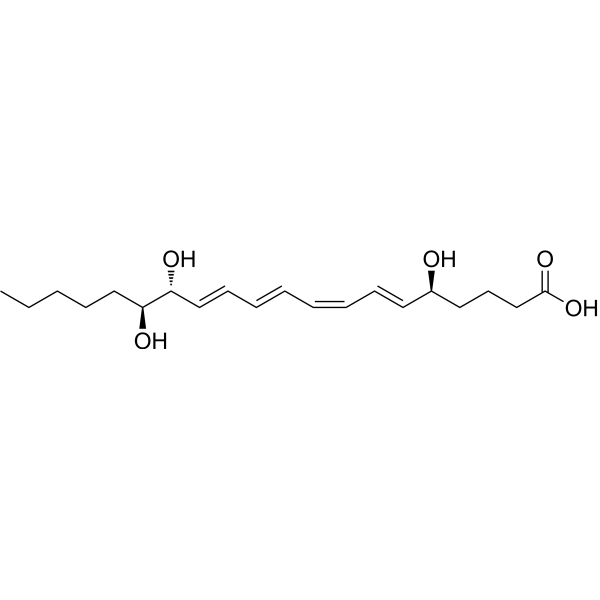
    Lipoxin B4 (LXB4) is a structurally distinct product of arachidonic acid metabolism. Lipoxin B4 reduces leukocyte infiltration and mucus secretion in the nasal mucosa and decreases mast cell and eosinophil degranulation in the upper airway. Lipoxin B4 decreases airway inflammation, mucus metaplasia and hyper- responsiveness in the lower airway. Lipoxin B4 shows mucosal protective actions and has the potential for the research of allergic inflammation in the upper and lower airways .
    Lipoxin B4
  • HY-W015593

    Adrenergic Receptor Cardiovascular Disease
    Methylhexanamine hydrochloride is an aliphatic amine and a vasoconstrictor that can be administered by inhalation to the nasal mucosa to exert its effect as a nasal decongestant .
    Methylhexanamine hydrochloride
  • HY-171948

    Liposome Cancer
    FO-35 is an ionizable lipid that can be used to synthesize lipid nanoparticles (LNPs). FO-35 can be used to delivery mRNA to mouse muscle and nasal mucosa as well as ferret lungs .
    FO-35
  • HY-12709A
    ARC 239 dihydrochloride
    1 Publications Verification

    Adrenergic Receptor Cardiovascular Disease Inflammation/Immunology
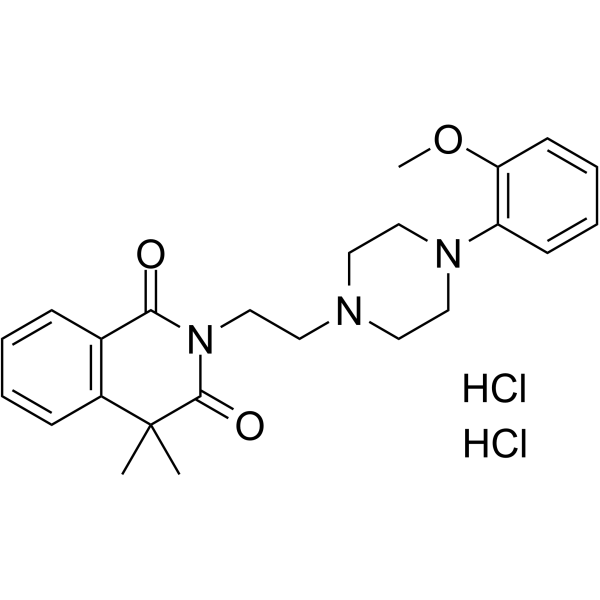
    ARC 239 dihydrochloride is a selective α2B/2C adrenoceptor antagonist (pKd values are 5.95, 7.41 and 7.56 at α2A, α2B, and α2C receptors respectively). ARC 239 dihydrochloride binds to CHO cell membranes expressing human recombinant a2A-, a2B- or a2C-adrenoceptor subtypes with pKis of 5.6, 8.4, and 7.08, respectively .
    ARC 239 dihydrochloride
  • HY-105025B

    Thymopoietin II (32-35) acetate; TP 4 acetate

    Apoptosis Inflammation/Immunology
    Thymocartin (TP 4) acetate is the 32-35 fragment of thymic factor (thymopoietin). Thymocartin acetate inhibits apoptosis of peripheral blood lymphocytes in HIV infected individuals. Thymocartin acetate is potential for immunodeficiency diseases research .
    Thymocartin acetate

Inquiry Online

Your information is safe with us. * Required Fields.

Salutation


Country or Region *

Applicant Name *


Organization Name *

Department *


Email Address *


Product Name *

Cat. No.


Requested quantity *

Phone Number *


Remarks

Inquiry Online

Inquiry Information

Product Name:
Cat. No.:
Quantity:
MCE Japan Authorized Agent:

