



55974-42-0
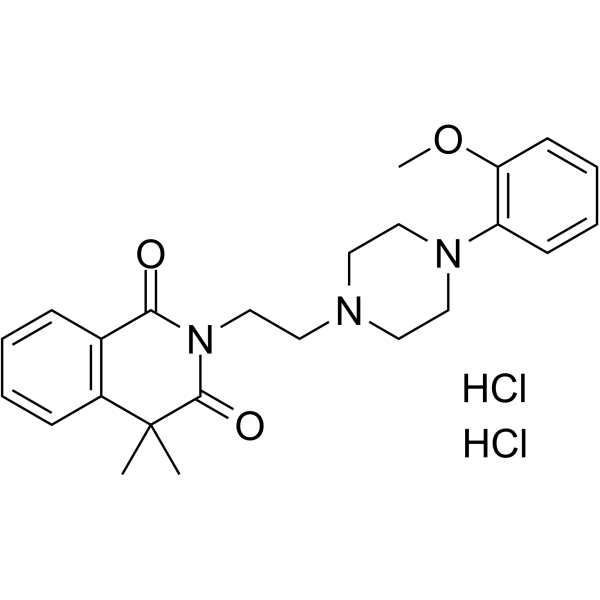
Chemical Structure
ARC 239 dihydrochloride
- CAS No.: 55974-42-0
- Formula:C24H31Cl2N3O3
- Molecular Weight:480.43
IUPAC Name: 2-(2-(4-(2-methoxyphenyl)piperazin-1-yl)ethyl)-4,4-dimethylisoquinoline-1,3(2H,4H)-dione dihydrochloride
InChIKey: SAJKHRHHDGSJEZ-UHFFFAOYSA-N
SMILES: O=C1C2=C(C(C)(C)C(N1CCN3CCN(CC3)C4=C(OC)C=CC=C4)=O)C=CC=C2.Cl.Cl
Biological Activity: ARC 239 dihydrochloride is a selective α2B/C-adrenoceptor antagonist, with pKi values of 5.45, 7.06, and 6.95 for α2A, α2B, and α2C receptors, respectively. ARC 239 dihydrochloride selectively antagonizes α2B-AR, blocking norepinephrine signaling and downstream RhoA/ROCK activation and Claudin-5 disruption, without altering plasma norepinephrine levels in the distal tail artery of mice, and does not inhibit α2-adrenoceptor-mediated vasoconstriction. ARC 239 dihydrochloride also binds with high affinity to 5-HT1A receptors, with a Ki of 63.1 nM, thereby interfering with subtype-selective α2-adrenoceptor assays. ARC 239 dihydrochloride can be used for research on cardiovascular diseases and inflammatory skin diseases[1][2][3][4][5].
| Cat. No. | Product Name | Purity | Description | Pricing | |||||||||||||||||||
|---|---|---|---|---|---|---|---|---|---|---|---|---|---|---|---|---|---|---|---|---|---|---|---|
|
|
ARC 239 dihydrochloride | 99.20% | ARC 239 dihydrochloride is a selective α2B/C-adrenoceptor antagonist, with pKi values of 5.45, 7.06, and 6.95 for α2A, α2B, and α2C receptors, respectively. ARC 239 dihydrochloride selectively antagonizes α2B-AR, blocking norepinephrine signaling and downstream RhoA/ROCK activation and Claudin-5 disruption, without altering plasma norepinephrine levels in the distal tail artery of mice, and does not inhibit α2-adrenoceptor-mediated vasoconstriction. ARC 239 dihydrochloride also binds with high affinity to 5-HT1A receptors, with a Ki of 63.1 nM, thereby interfering with subtype-selective α2-adrenoceptor assays. ARC 239 dihydrochloride can be used for research on cardiovascular diseases and inflammatory skin diseases. | ||||||||||||||||||||
|
loading...
/
|
|||||||||||||||||||||||
-
Similarity Score 0.98
 HY-12709RARC 239 (Standard)
-
Similarity Score 0.68
 HY-19818ARNAN-190 hydrobromide (Standard)
-
Similarity Score 0.68
 HY-19818NAN-190
-
Similarity Score 0.60
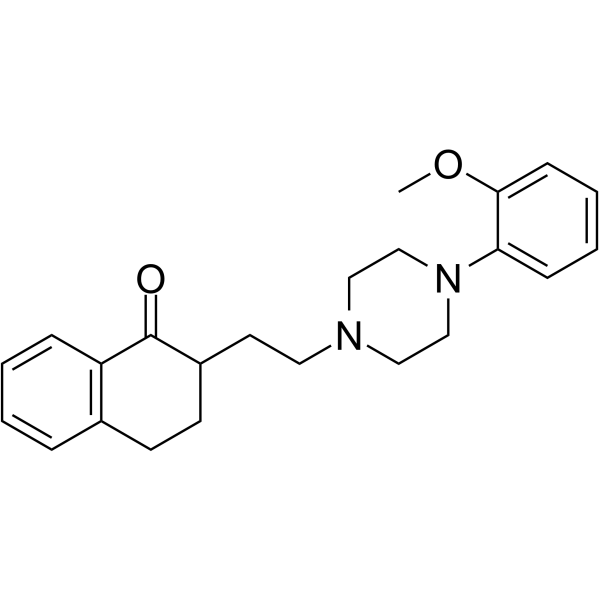 HY-101690QF0301B
-
Similarity Score 0.58
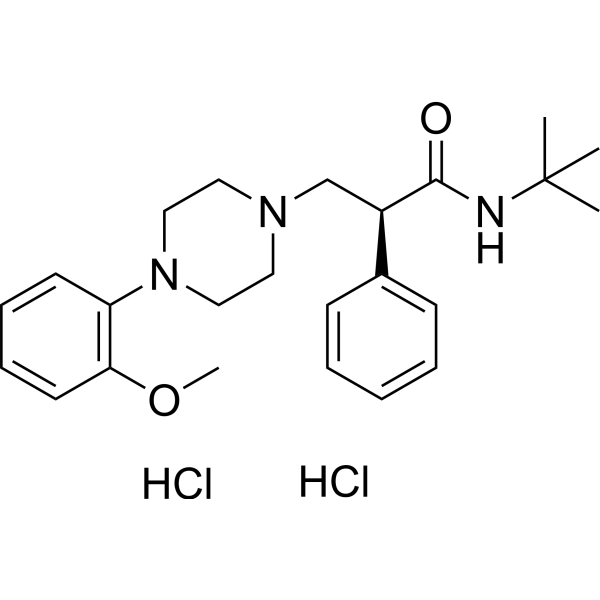 HY-110001(S)-WAY 100135 dihydrochloride
-
Similarity Score 0.58
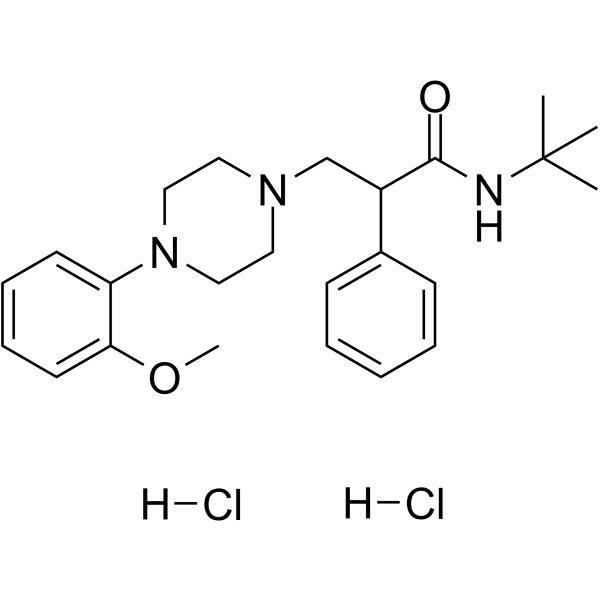 HY-117575AWAY-100135 dihydrochloride
-
Similarity Score 0.58
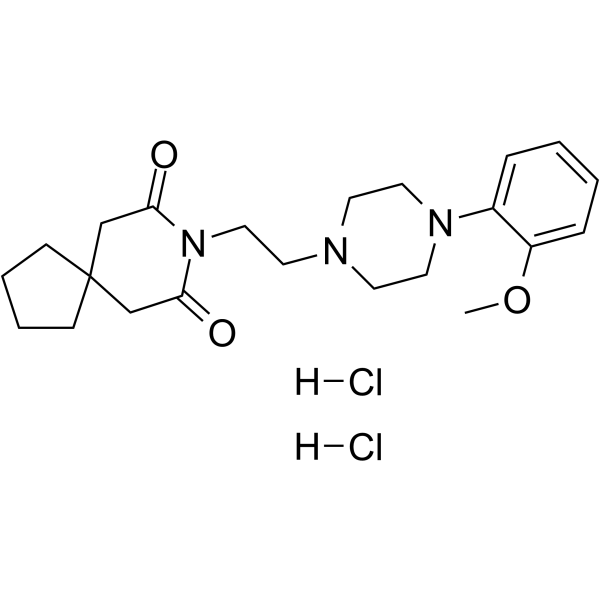 HY-100554BMY 7378
-
Similarity Score 0.57
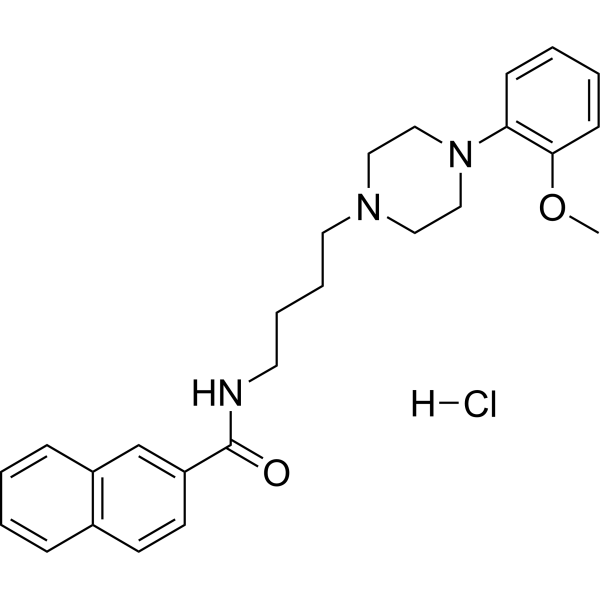 HY-106660BP 897 hydrochloride
-
Similarity Score 0.56
 HY-117575WAY-100135
-

Explore the MedChemAI to find more analogs


References
- [1]. Gavin KT, et al. Alpha 2C-adrenoceptors mediate contractile responses to noradrenaline in the human saphenous vein. Naunyn Schmiedebergs Arch Pharmacol. 1997 Mar;355(3):406-11. [Content Brief]
- [2]. Meana JJ, et al. The subtype-selective alpha 2-adrenoceptor antagonists BRL 44408 and ARC 239 also recognize 5-HT1A receptors in the rat brain. Eur J Pharmacol. 1996 Oct 3;312(3):385-8. [Content Brief]
- [3]. Yu Y, et al. A stress-responsive neurovascular axis shapes skin immune accessibility. iScience. 2026 Mar 20;29(3):115122. [Content Brief]
- [4]. Di Cicco E, et al. A TERRA-NONO axis drives fibroblast reprogramming in cancer. Sci Adv. 2026 Oct 2;12(40):eaed3358. [Content Brief]
- [5]. Chotani MA, et al. Silent alpha(2C)-adrenergic receptors enable cold-induced vasoconstriction in cutaneous arteries. Am J Physiol Heart Circ Physiol. 2000 Apr;278(4):H1075-83. [Content Brief]



