



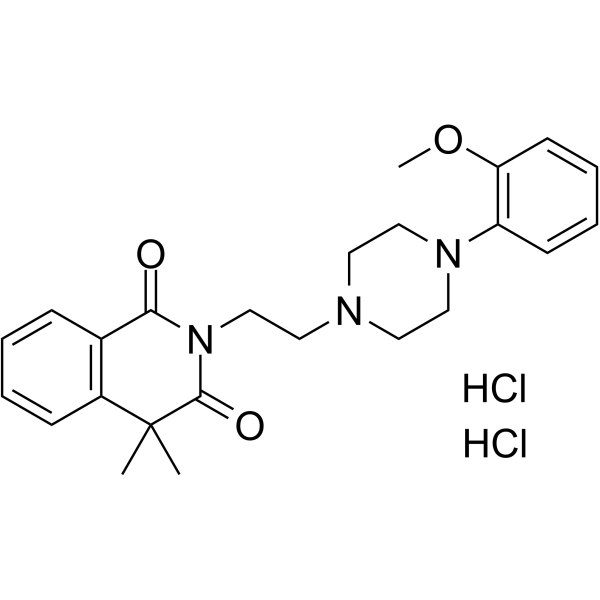
ARC 239 dihydrochloride
Based on 2 publication(s) in Google Scholar
ARC 239 dihydrochloride is a selective α2B/C-adrenoceptor antagonist, with pKi values of 5.45, 7.06, and 6.95 for α2A, α2B, and α2C receptors, respectively. ARC 239 dihydrochloride selectively antagonizes α2B-AR, blocking norepinephrine signaling and downstream RhoA/ROCK activation and Claudin-5 disruption, without altering plasma norepinephrine levels in the distal tail artery of mice, and does not inhibit α2-adrenoceptor-mediated vasoconstriction. ARC 239 dihydrochloride also binds with high affinity to 5-HT1A receptors, with a Ki of 63.1 nM, thereby interfering with subtype-selective α2-adrenoceptor assays. ARC 239 dihydrochloride can be used for research on cardiovascular diseases and inflammatory skin diseases.
For research use only. We do not sell to patients.
- Purity : 99.20%
- CAS No.: 55974-42-0
- Formula: C24H31Cl2N3O3
- Molecular Weight:480.43
-
Storage:
4°C, sealed storage, away from moisture
* In solvent : -80°C, 6 months; -20°C, 1 month (sealed storage, away from moisture)

To place orders, for customer services and technical support, please contact: MedChemExpress USA
Tel: 609-228-6898 E-mail: [email protected] [email protected]


-
 Biological Activity
-
Chemical Information
-
Solvent & Solubility
- Purity & Documentation
- References
-
 Help & FAQs



Publications Citing Use of MedChemExpress (MCE) ARC 239 dihydrochloride
MoreAll Adrenergic Receptor Isoforms
MoreAll 5-HT Receptor Isoforms
More

Biological Activity
Description
|
5-HT1A Receptor 63.1 nM (Ki) |
human α2C-adrenoceptor 6.95 (pKi) |
Alpha-2C adrenergic receptor 7.06 (pKi) |
Alpha-2A adrenergic receptor 5.45 (pKi) |
Alpha-2B adrenergic receptor 4.6 nM (Kd) |
ROCK |
Claudin-5 |
In Vitro
ARC 239 (0.3-1 µM; 60 min) dihydrochloride competitively antagonizes Norepinephrine (HY-13715)-induced contraction of human saphenous vein rings with a pKB of 7.19[1].
ARC 239 (0.1 nM-0.1 mM; incubated at 37°C for 30 min) dihydrochloride recognizes rat cortical 5-HT1A receptors in a [3H]8-OH-DPAT competitive binding assay with a Ki of 63.1 nM[2].
ARC 239 (0.1 nM-0.1 mM; incubated at 25°C for 30 min) dihydrochloride displaces the binding of [3H]RX 821002 to rat hippocampal 5-HT1A receptors under conditions where α2-adrenoceptors are masked, with a Ki of 136 nM[2].
ARC 239 dihydrochloride (30 μM; pretreatment for 30 min + co-incubation for 48 h) prevents Norepinephrine bitartrate monohydrate (HY-13715B) (5 µM)-induced RhoA activation, ROCK-dependent MYPT1 phosphorylation, and loss of Claudin-5 tight junctions in HUVECs[3].
ARC 239 (50 nM; 30 min) dihydrochloride does not inhibit α2-AR-mediated vasoconstriction in isolated distal mouse tail arteries at 37°C or 28°C, which is consistent with its KD of 4.6 nM for α2B-AR and KD >50 nM for mouse tail arteries[5].
MedChemExpress (MCE) has not independently confirmed the accuracy of these methods. They are for reference only.
-
Cell Line:HUVECs
-
Concentration:30 μM
-
Incubation Time:pre-incubation 30 min + co-incubation 48 h
-
Result:Prevented Norepinephrine-induced reduction of Claudin-5 protein levels and disruption of junctional localization, including fragmentation and discontinuity consistent with tight junction disassembly.
-
Cell Line:HUVECs
-
Concentration:30 μM
-
Incubation Time:pre-incubation 30 min + co-incubation 48 h
-
Result:Inhibited Norepinephrine-enhanced RhoA-GTP signaling.\nAbolished norepinephrine-induced increase in p-MYPT1/MYPT1.
In Vivo
MedChemExpress (MCE) has not independently confirmed the accuracy of these methods. They are for reference only.
-
Animal Model:C57BL/6 (7-week-old; female) were subcutaneously injected of Resiniferatoxin (RTX) for 3 consecutive days[3]
-
Dosage:5 mg/kg
-
Administration:i.p.; once daily; administered continuously throughout the stress exposure and psoriasis induction process
-
Result:Effectively suppressed stress-induced skin vascular leakage (confirmed by a significant reduction in Evans blue dye extravasation).
Did not affect plasma norepinephrine (NE) levels in mice, indicating that it functions downstream of NE (i.e., at the receptor level).


Chemical Information
-
CAS No. 55974-42-0
-
Appearance Solid
-
Molecular Weight 480.43
-
Formula C24H31Cl2N3O3
-
Color White to off-white
-
SMILES
O=C1C2=C(C(C)(C)C(N1CCN3CCN(CC3)C4=C(OC)C=CC=C4)=O)C=CC=C2.Cl.Cl
-
Shipping
Room temperature in continental US; may vary elsewhere.
-
Storage
4°C, sealed storage, away from moisture
* In solvent : -80°C, 6 months; -20°C, 1 month (sealed storage, away from moisture)


Publications (2)
-
Journal Impact Factor
-
Most Recent
-
iScience
2026 Feb 23;29(3):115122. PMID: 41852725 -


Solvent & Solubility
In Vitro:
DMSO : 125 mg/mL (260.18 mM; ultrasonic and warming and heat to 60°C; Hygroscopic DMSO has a significant impact on the solubility of product, please use newly opened DMSO)
Please refer to the solubility information to select the appropriate solvent. Once prepared, please aliquot and store the solution to prevent product inactivation from repeated freeze-thaw cycles.
Storage method and period of stock solution: -80°C, 6 months; -20°C, 1 month (sealed storage, away from moisture). When stored at -80°C, please use it within 6 months. When stored at -20°C, please use it within 1 month.
Concentration (start) × Volume (start) = Concentration (final) × Volume (final)
In Vivo:
Select the appropriate dissolution method based on your experimental animal and administration route.
- For the following dissolution methods, please ensure to first prepare a clear stock solution using an In Vitro approach and then sequentially add co-solvents:
- To ensure reliable experimental results, the clarified stock solution can be appropriately stored based on storage conditions. As for the working solution for In Vivo experiments, it is recommended to prepare freshly and use it on the same day.
- The percentages shown for the solvents indicate their volumetric ratio in the final prepared solution. If precipitation or phase separation occurs during preparation, heat and/or sonication can be used to aid dissolution.
Add each solvent one by one: 10% DMSO 40% PEG300 5% Tween-80 45% Saline
Solubility: ≥ 2.08 mg/mL (4.33 mM); Clear solution
This protocol yields a clear solution of ≥ 2.08 mg/mL (saturation unknown).
Taking 1 mL working solution as an example, add 100 μL DMSO stock solution (20.8 mg/mL) to 400 μL PEG300, and mix evenly; then add 50 μL Tween-80 and mix evenly; then add 450 μL Saline to adjust the volume to 1 mL.
Preparation of Saline: Dissolve 0.9 g sodium chloride in ddH₂O and dilute to 100 mL to obtain a clear Saline solution.
Add each solvent one by one: 10% DMSO 90% (20% SBE-β-CD in Saline)
Solubility: ≥ 2.08 mg/mL (4.33 mM); Clear solution
This protocol yields a clear solution of ≥ 2.08 mg/mL (saturation unknown).
Taking 1 mL working solution as an example, add 100 μL DMSO stock solution (20.8 mg/mL) to 900 μL 20% SBE-β-CD in Saline, and mix evenly.
Preparation of 20% SBE-β-CD in Saline (4°C, storage for one week): 2 g SBE-β-CD powder is dissolved in 10 mL Saline, completely dissolve until clear.
In Vivo Dissolution Calculator
Please enter the basic information of animal experiments:
-
-
-
-
Recommended: Prepare an additional quantity of animals to account for potential losses during experiments.
Please enter your animal formula composition:
-
%DMSO +
Recommended: Keep the proportion of DMSO in working solution below 2% if your animal is weak.
-
%+
-
+%Tween-80 + +
-
%Saline +
The co-solvents required include: DMSO, . All of co-solvents are available by MedChemExpress (MCE). , Tween 80. All of co-solvents are available by MedChemExpress (MCE).
Working solution concentration: 0.22 mg/mL
Method for preparing stock solution: mg drug dissolved in μL DMSO. Stock solution concentration: mg/mL. * In solvent : -80°C, 6 months; -20°C, 1 month (sealed storage, away from moisture)
1. Take μL DMSO stock solution;
2. Add μL .
μL , mix evenly;
3. Then add μL Tween 80, mix evenly;
4. Then add μL
Please ensure that the stock solution in the first step is dissolved to a clear state, and add co-solvents in sequence. You can use ultrasonic heating (ultrasonic cleaner, recommended frequency 20-40 kHz), vortexing, etc. to assist dissolution.


Purity & Documentation
-
Data Sheet (295 KB)
-
SDS (536 KB)
- English - EN (536 KB)
- Français - FR (536 KB)
- Deutsch - DE (536 KB)
- Norwegian - NO (536 KB)
- Español - ES (536 KB)
- Swedish - SV (536 KB)
- Italian - IT (536 KB)
- Korean - KR (536 KB)
- Portuguese - PT (536 KB)
-
Handling Instructions (2659 KB)
References
[1]. Gavin KT, et al. Alpha 2C-adrenoceptors mediate contractile responses to noradrenaline in the human saphenous vein. Naunyn Schmiedebergs Arch Pharmacol. 1997 Mar;355(3):406-11. [Content Brief]
[2]. Meana JJ, et al. The subtype-selective alpha 2-adrenoceptor antagonists BRL 44408 and ARC 239 also recognize 5-HT1A receptors in the rat brain. Eur J Pharmacol. 1996 Oct 3;312(3):385-8. [Content Brief]
[3]. Yu Y, et al. A stress-responsive neurovascular axis shapes skin immune accessibility. iScience. 2026 Mar 20;29(3):115122. [Content Brief]
[4]. Di Cicco E, et al. A TERRA-NONO axis drives fibroblast reprogramming in cancer. Sci Adv. 2026 Oct 2;12(40):eaed3358. [Content Brief]
[5]. Chotani MA, et al. Silent alpha(2C)-adrenergic receptors enable cold-induced vasoconstriction in cutaneous arteries. Am J Physiol Heart Circ Physiol. 2000 Apr;278(4):H1075-83. [Content Brief]


Complete Stock Solution Preparation Table
Please refer to the solubility information to select the appropriate solvent. Once prepared, please aliquot and store the solution to prevent product inactivation from repeated freeze-thaw cycles.
Storage method and period of stock solution: -80°C, 6 months; -20°C, 1 month (sealed storage, away from moisture). When stored at -80°C, please use it within 6 months. When stored at -20°C, please use it within 1 month.
| Optional Solvent | Concentration Solvent Mass | 1 mg | 5 mg | 10 mg | 25 mg |
|---|---|---|---|---|---|
| DMSO | 1 mM | 2.0815 mL | 10.4073 mL | 20.8147 mL | 52.0367 mL |
| 5 mM | 0.4163 mL | 2.0815 mL | 4.1629 mL | 10.4073 mL | |
| 10 mM | 0.2081 mL | 1.0407 mL | 2.0815 mL | 5.2037 mL | |
| 15 mM | 0.1388 mL | 0.6938 mL | 1.3876 mL | 3.4691 mL | |
| 20 mM | 0.1041 mL | 0.5204 mL | 1.0407 mL | 2.6018 mL | |
| 25 mM | 0.0833 mL | 0.4163 mL | 0.8326 mL | 2.0815 mL | |
| 30 mM | 0.0694 mL | 0.3469 mL | 0.6938 mL | 1.7346 mL | |
| 40 mM | 0.0520 mL | 0.2602 mL | 0.5204 mL | 1.3009 mL | |
| 50 mM | 0.0416 mL | 0.2081 mL | 0.4163 mL | 1.0407 mL | |
| 60 mM | 0.0347 mL | 0.1735 mL | 0.3469 mL | 0.8673 mL | |
| 80 mM | 0.0260 mL | 0.1301 mL | 0.2602 mL | 0.6505 mL | |
| 100 mM | 0.0208 mL | 0.1041 mL | 0.2081 mL | 0.5204 mL |


ARC 239 dihydrochloride Related Classifications
HY-12709A Related Classifications
 Powered by Bioz
Keywords
- ARC 239
- 55974-42-0
- ARC239
- ARC-239
- Adrenergic Receptor
- 5-HT Receptor
- ROCK
- Claudin
- Beta Receptor
- Serotonin Receptor
- 5-hydroxytryptamine Receptor
- Rho-associated protein kinase
- Rho-associated kinase
- Rho-kinase
- ROK
- 5-HT1A receptor
- Claudin-5
- RhoA
- human saphenous vein
- noradrenaline
- vascular leakage
- α1-adrenoceptor
- α2-adrenoceptor
- α2B-adrenoceptor
- Inhibitor
- inhibitor
- inhibit