1. Search Result
Search Result
Results for "

photochemical reaction

" in MedChemExpress (MCE) Product Catalog:

9

Inhibitors & Agonists

1

Fluorescent Dyes

1

Biochemical Assay Reagents

1

Click Chemistry

1

Oligonucleotides

Cat. No. Product Name Target Research Areas Chemical Structure
  • HY-12809
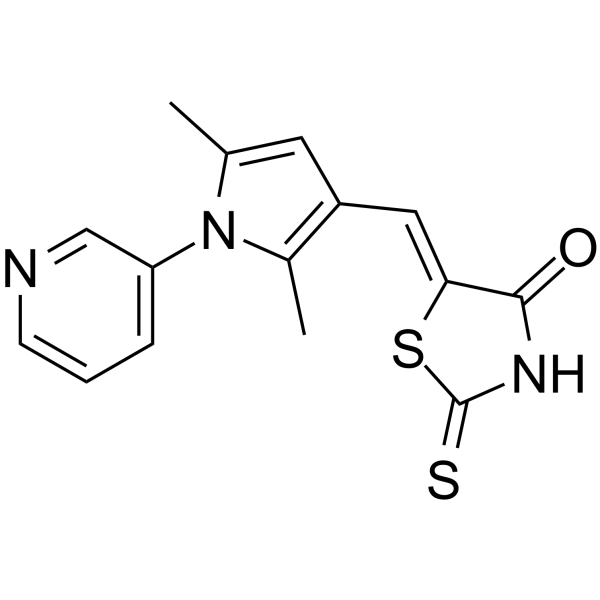
    Optovin
    1 Publications Verification

    TRP Channel Neurological Disease
    Optovin is a reversible photoactivated TRPA1 ligand that enables light-mediated neuronal excitation. Optovin activates TRPA1 via structure-dependent photochemical reactions with redox-sensitive cysteine residues .
    Optovin
  • HY-W020086

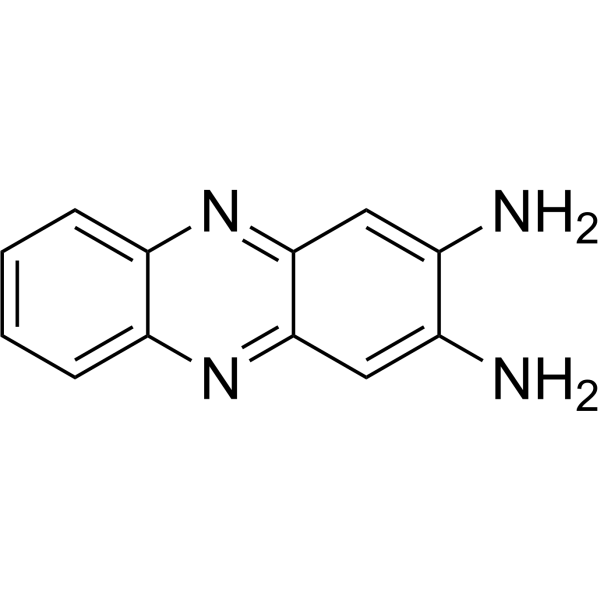
    2,3-Phenazinediamine; NNC39-0028

    DNA Alkylator/Crosslinker Fluorescent Dye Metabolic Disease
    2,3-Diaminophenazine (2,3-Phenazinediamine) is an orally active amino derivative of phenazine. 2,3-Diaminophenazine can intercalate into DNA. 2,3-Diaminophenazine triggers photochemical reactions. 2,3-Diaminophenazine inhibits vascular hypertrophy and tissue AGE deposition in diabetic rats. 2,3-Diaminophenazine can be used for luminescence and diabetes research .
    2,3-Diaminophenazine
  • HY-109116

    Leukomethylene blue

    Biochemical Assay Reagents Others
    Hydromethylthionine (Leukomethylene blue) has a very active photochemically active reagent, especially in its interaction with dissolved oxygen. The photochemical activity of Hydromethylthionine is mainly regulated by the reaction of its triplet state with dissolved oxygen, which reacts with dissolved oxygen to form Methylene Blue (HY-14536) and hydronium ions under ultraviolet light. Hydromethylthionine can be used for the photodegradation of model pollutants in semiconductor photocatalysis and for the study of indicators in chemical analysis .
    Hydromethylthionine
  • HY-118922

    TNF Receptor Neurological Disease Inflammation/Immunology Cancer
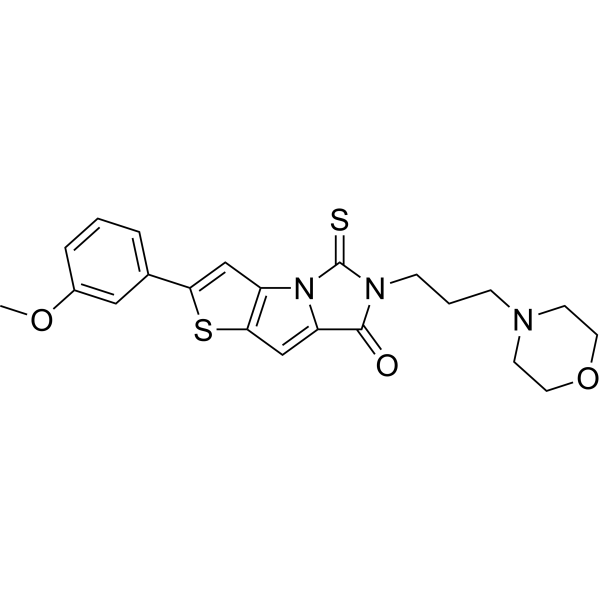
    IW927 is a photochemically enhanced TNF-α-TNFR1 interaction inhibitor that blocks the binding of TNF-α to TNFRc1 with an IC50 value of 50 nM. IW927 binds reversibly to the TNFRc1 with weak affinity (Kd = 40-100 μM), covalently modifies the receptor via a photochemical reaction, and does not bind the related cytokine receptors TNFRc2 or CD40. IW927 disrupts TNFα-induced IκB phosphorylation with an IC50 value of 600 nM. IW927 can be used to develop light-independent inhibitors .
    IW927
  • HY-W576440

    Nucleoside Antimetabolite/Analog Others
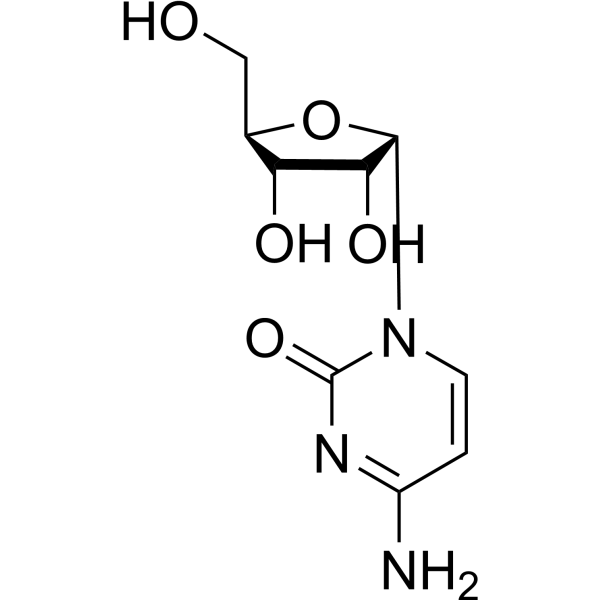
    α-Cytidine is a nucleoside. Under appropriate prebiotic conditions, α-Cytidine can be generated from ribose 5'-phosphate, cyanamide and cyanoacetylene .
    α-Cytidine
  • HY-W008388

    N6-Benzoyladenosine

    Nucleoside Antimetabolite/Analog Others
    Bz-rA (N6-Benzoyladenosine) is a nucleoside derivative with an N6 protecting group. Bz-rA is mainly used as a synthetic intermediate to participate in photocatalytic oxidative cyclization reactions and synthesize oligoribonucleotides. Bz-rA can be used to efficiently construct heterocyclic skeletons in photochemical conversions and protect the ribose moiety to regulate the cyclization pathway .
    Bz-rA
  • HY-W009986

    Environmental Pollutants Biochemical Assay Reagents Others
    9-Methylanthracene is a photoreactive agent. 9-Methylanthracene induces intramolecular and intermolecular [4+4] cycloaddition reactions via photochemical reactions to form dimers. 9-Methylanthracene is promising for research of photomechanical materials and light-responsive crystal dynamics .
    9-Methylanthracene
  • HY-W127719

    Biochemical Assay Reagents Others
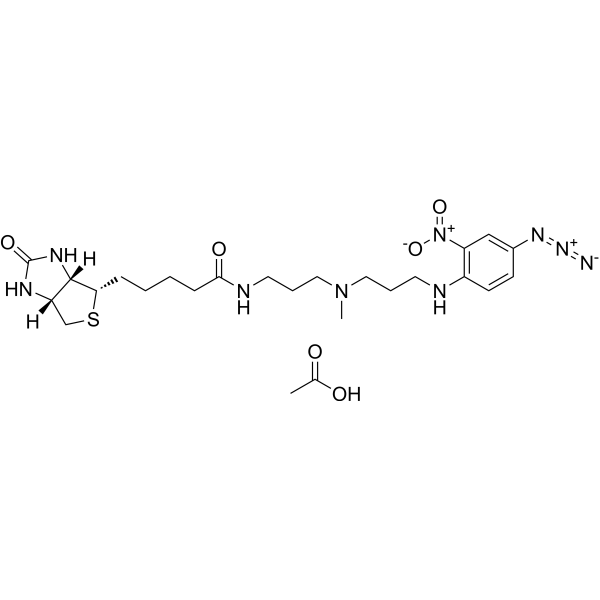
    Photobiotin (acetate)It is a biological probe used to study biochemical processes such as protein interactions and enzymatic reactions. It is a molecule containing a photosensitive group, which can be combined with specific target molecules (such as proteins, nucleic acids, etc.) through photochemical cross-linking technology, so as to realize the labeling and detection of these molecules. During the photosensitive crosslinking process, Photobiotin (acetate)Can participate in the formation of covalent bonds and form stable compounds. In addition, the compound also has high biocompatibility and biological activity, so it is widely used in the field of biomedical research, such as enzymatic research, proteomics, western blotting and other aspects. Photobiotin (acetate) is a click chemistry reagent, it contains an Azide group and can undergo copper-catalyzed azide-alkyne cycloaddition reaction (CuAAc) with molecules containing Alkyne groups. It can also undergo strain-promoted alkyne-azide cycloaddition (SPAAC) reactions with molecules containing DBCO or BCN groups.
    Photobiotin acetate
  • HY-W714182

    Herbicide Others
    Dimethametryn is a methylthio-triazine herbicide mainly used for controlling broadleaf weeds in paddy fields. Dimethametryn blocks plant photosynthesis by inhibiting electron transport and non-cyclic photophosphorylation of photosystem II, ultimately causing chlorosis, necrosis and death of sensitive plants .
    Dimethametryn

Inquiry Online

Your information is safe with us. * Required Fields.

Salutation


Country or Region *

Applicant Name *


Organization Name *

Department *


Email Address *


Product Name *

Cat. No.


Requested quantity *

Phone Number *


Remarks

Inquiry Online

Inquiry Information

Product Name:
Cat. No.:
Quantity:
MCE Japan Authorized Agent:

