1. Search Result
Search Result
Pathways Recommended: Metabolic Enzyme/Protease
Results for "

serine protease active site

" in MedChemExpress (MCE) Product Catalog:

7

Inhibitors & Agonists

1

Biochemical Assay Reagents

1

Inhibitory Antibodies

Cat. No. 상품명 Target 연구분야 Chemical Structure
  • HY-B2228
    Proteinase, Aspergillus oryzae
    1 Publications Verification

    Biochemical Assay Reagents Cancer
    Proteinase, Aspergillus oryzae is a serine protease that hydrolyzes peptide bonds in protein substrates, preferring alkaline conditions (optimal pH 10.5). It efficiently degrades casein, poly-L-glutamic acid, and poly-L-lysine, with activity irreversibly inhibited by diisopropylfluorophosphate (DFP) and potato inhibitor. This enzyme catalyzes proteolysis via serine residues in its active site, finding applications in food processing (e.g., soy sauce fermentation), detergents, and leather industries due to its high yield in solid-state fermentation and cost-effective production.
    Proteinase, Aspergillus oryzae
  • HY-153552A

    FAP Cancer
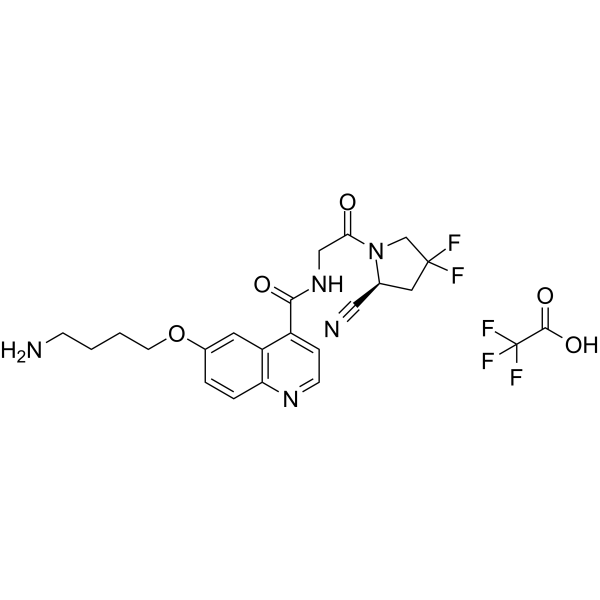
    NH2-UAMC1110 TFA is an aminobutoxy derivative of the fibroblast activation protein (FAP) inhibitor UAMC1110 (HY-100684), and is a precursor compound for the synthesis of FAP inhibitor probes, not directly used in bioactivity experiments. For example, NH2-UAMC1110 TFA is involved in the synthesis of the radiotracer FAPI-QS, which exhibits high tumor selectivity and high dose effect, and has been used in tumor diagnosis. NH2-UAMC1110 TFA structurally incorporates an active amino group, allowing it to form covalent bonds with various molecules (such as DOTA, DATA5m, radionuclide chelators, etc.) to synthesize molecular imaging probes or targeted compounds with the ability to target FAP. NH2-UAMC1110 TFA specifically binds to the FAP active site, inhibiting its proline-selective serine protease activity (including dipeptidyl peptidase and endopeptidase activity), blocking FAP-mediated tissue remodeling-related processes. Its key activity is high targeting and high affinity, and its core function is to act as a targeting module coupled with bifunctional chelators (such as DOTA, DATA5m). NH2-UAMC1110 TFA can be applied to diagnostic imaging studies of tumors expressing FAP (such as colorectal cancer, pancreatic cancer, etc.), and also provides molecular tools for targeted research of FAP-related diseases with high FAP expression, such as fibrosis and arthritis .
    NH2-UAMC1110 TFA
  • HY-153552

    FAP Cancer
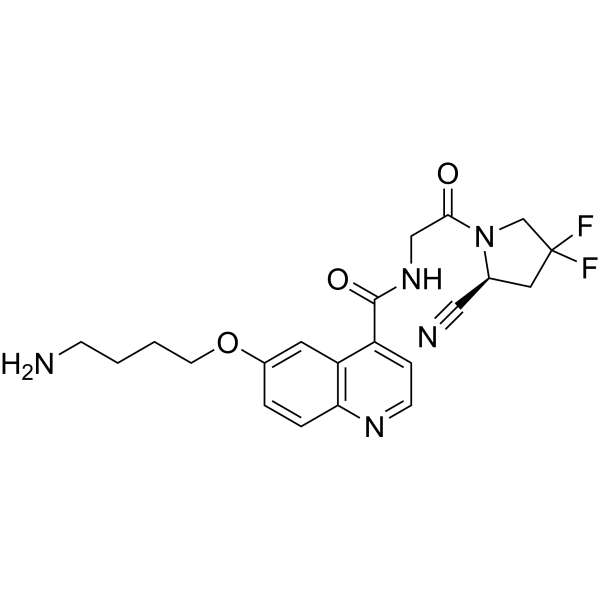
    NH2-UAMC1110 is an aminobutoxy derivative of the fibroblast activation protein (FAP) inhibitor UAMC1110 (HY-100684), and is a precursor compound for the synthesis of FAP inhibitor probes, not directly used in bioactivity experiments. For example, NH2-UAMC1110 is involved in the synthesis of the radiotracer FAPI-QS, which exhibits high tumor selectivity and high dose-response, and has been used for tumor diagnosis. NH2-UAMC1110 introduces an active amino group into its structure, enabling it to form covalent bonds with various molecules (such as DOTA, DATA5m, radionuclide chelators, etc.), thereby synthesizing molecular imaging probes or targeted compounds with the ability to target FAP. NH2-UAMC1110 specifically binds to the FAP active site, inhibiting its proline-selective serine protease activity (including dipeptidyl peptidase and endopeptidase activity), blocking FAP-mediated tissue remodeling processes. Its key activity is high targeting and high affinity, and its core function is to be coupled with bifunctional chelators (such as DOTA, DATA5m) as a targeting module. NH2-UAMC1110 can be applied to diagnostic imaging studies of tumors expressing FAP (such as colorectal cancer, pancreatic cancer, etc.), and also provides molecular tools for targeted research of FAP-related diseases with high FAP expression, such as fibrosis and arthritis .
    NH2-UAMC1110
  • HY-171781

    SARS-CoV Virus Protease Infection
    FL-166 is a SARS coronavirus main protease (Mpro) inhibitor (Ki: 40 nM). FL-166 exerts its inhibitory effect by targeting a cluster of serine residues near the active site of the protease. FL-166 can be used in the study of SARS-CoV .
    FL-166
  • HY-P992451

    KY1066

    Ser/Thr Protease Hepcidin Reactive Oxygen Species (ROS) Apoptosis Cardiovascular Disease
    RLYB331 (KY1066) is a is a monoclonal antibody targeting Matriptase-2 (TMPRSS6) . RLYB331 binds to the serine protease active site of matriptase-2, blocking protease activity to increase hepcidin expression. RLYB331 reduces iron overload, inhibits α-aggregates, reduces ROS, inhibits apoptosis, and enhances erythroid differentiation. RLYB331 ameliorates ineffective erythropoiesis in β-thalassemic mouse models. RLYB331 can be used for the research of β-thalassemia .
    RLYB331
  • HY-E70933

    Endogenous Metabolite Metabolic Disease
    Protease, Streptomyces griseus, exhibits broad substrate specificity. Its active site consists of one aspartic acid residue, one histidine residue, and one serine residue. Protease tends to hydrolyze the peptide bond on the carboxyl side of glutamate or aspartate.
    Protease, Streptomyces griseus
  • HY-P2974A

    Elastase Metabolic Disease
    Elastase, Rat (EC 3.4.21.35) is a form of elastase that is produced in the acinar cells of the pancreas, initially produced as an inactive zymogen and later activated in the duodenum by trypsin. Elastases form a subfamily of serine proteases, characterized by a distinctive structure consisting of two beta-barrel domains converging at the active site that hydrolyze amides and esters amongst many proteins in addition to elastin, a type of connective tissue that holds organs together.
    Elastase, Rat

온라인 문의

Your information is safe with us. * Required Fields.

호칭


Country or Region *

고객명 *


회사명 *

Department *


메일주소 *


상품명 *

Cat. No.


Requested quantity *

전화번호 *


비고

온라인 문의

Inquiry Information

상품명:
Cat. No.:
수량:
MCE Japan Authorized Agent:

