7 Results for "

susceptible mice

" in MedChemExpress (MCE) Product Catalog:
Products (7)

7 Results for "susceptible mice" in MCE Product Catalog:

Cat. No.: HY-P5462A
Target:  

IFNAR TNF Receptor

Research Areas:  

Inflammation/Immunology

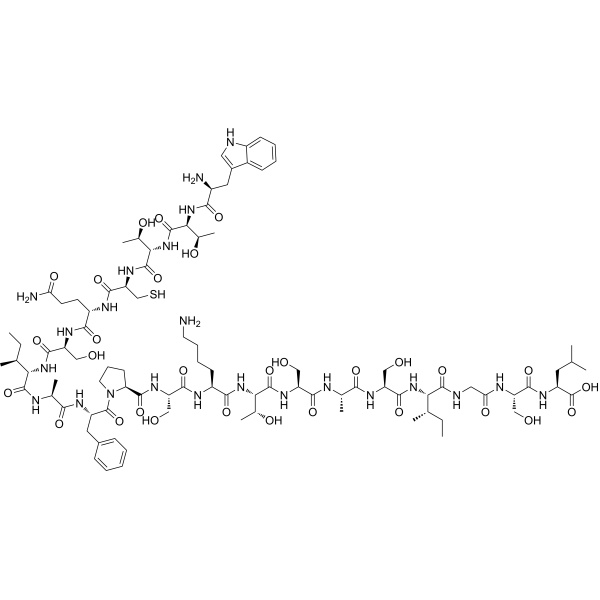
PLP (180-199) TFA is a myelin proteolipid protein-derived peptide corresponding to amino acids 180-199 of PLP. PLP (180-199) TFA acts as an encephalitogenic peptide and induces experimental autoimmune encephalomyelitis (EAE) in susceptible BALB/c mice. PLP (180-199) TFA can stimulate antigen-specific T-cell responses, promote inflammatory cytokine production including IFN-γ and TNF-α, and is used for the study of autoimmune encephalomyelitis and multiple sclerosis-related immune responses .
loading...
    loading...
Cat. No.: HY-169853
CAS No.: 1189495-81-5
M351-0056 is an orally active VISTA agonist with a Kd value of 12.60 μM. M351-0056 inhibits the activation of the JAK2-STAT2 pathway, reduces the phosphorylation levels of JAK2 and STAT2, and regulates type I interferon (IFN-I) and non-canonical NF-κB pathways. M351-0056 decreases the levels of cytokines (IFN-γ, IL-17A, TNF-α, IL-2 and IL-1β). M351-0056 improves imiquimod (HY-B0180)-induced psoriasis-like skin inflammation, reduces autoantibody levels, kidney damage and immune cell expansion in mice susceptible to chronic graft-versus-host disease and lupus, and delays the progression of systemic lupus erythematosus. M351-0056 can be used in research related to psoriasis-like dermatitis and systemic lupus erythematosus .
loading...
    loading...
Cat. No.: HY-P5462
CAS No.: 165549-58-6
Target:  

IFNAR TNF Receptor

Research Areas:  

Inflammation/Immunology

PLP (180-199) is a myelin proteolipid protein-derived peptide corresponding to amino acids 180-199 of PLP. PLP (180-199) acts as an encephalitogenic peptide and induces experimental autoimmune encephalomyelitis (EAE) in susceptible BALB/c mice. PLP (180-199) can stimulate antigen-specific T-cell responses, promote inflammatory cytokine production including IFN-γ and TNF-α, and is used for the study of autoimmune encephalomyelitis and multiple sclerosis-related immune responses .
loading...
    loading...
Cat. No.: HY-113619
CAS No.: 186293-38-9
Target:  

Bacterial

Research Areas:  

Infection

ABT-255 free base is an orally active anti-bacterial agent. ABT-255 free base exhibits potent in vitro potency (MIC = 0.016-0.031 μg/mL) against drug-susceptible and Rifampin (HY-B0272)- or Ethambutol (HY-B0535)-resistant Mycobacterium tuberculosis. ABT-255 free base shows efficacy against S. aureus, S. pneumoniae and E. coli and reduces viable counts of drug-resistant Mycobacterium tuberculosis in CF-1 mice. ABT-255 free base can be used for the study of pulmonary tuberculosis .
loading...
    loading...
Cat. No.: HY-P10039
CAS No.: 1123154-43-7
Target:  

Amyloid-β

Research Areas:  

Neurological Disease

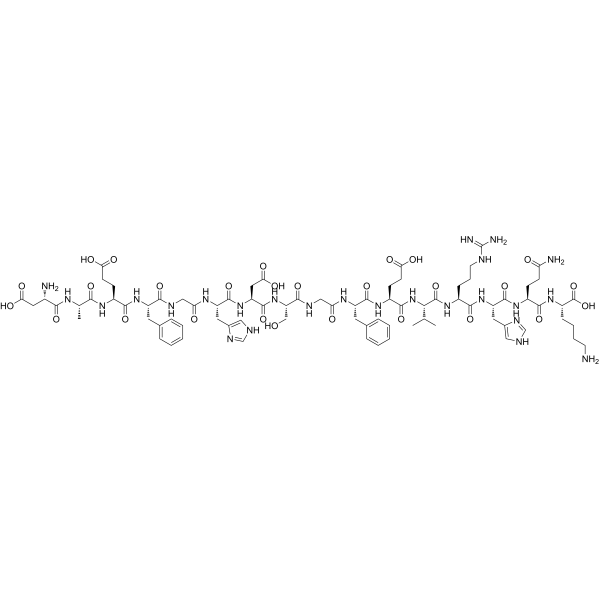
β-Amyloid (1-16) rat is a β-amyloid peptide (Abeta), a metal-binding domain fragment of amyloid. Three amino acid substitutions in β-Amyloid (1-16) rat that differ from humans render rats and mice less susceptible to AD-like neurodegeneration .
loading...
    loading...
Cat. No.: HY-113619A
CAS No.: 181141-52-6
Target:  

Bacterial

Research Areas:  

Infection

ABT-255 hydrochloride is an orally active anti-bacterial agent. ABT-255 hydrochloride exhibits potent in vitro potency (MIC = 0.016-0.031 μg/mL) against drug-susceptible and Rifampin (HY-B0272)- or Ethambutol (HY-B0535)-resistant Mycobacterium tuberculosis. ABT-255 hydrochloride shows efficacy against S. aureus, S. pneumoniae and E. coli and reduces viable counts of drug-resistant Mycobacterium tuberculosis in CF-1 mice. ABT-255 hydrochloride can be used for the study of pulmonary tuberculosis .
loading...
    loading...
Cat. No.: HY-P992380

Target:  

PD-1/PD-L1

Research Areas:  

Neurological Disease

IBC-Ab002 is a humanized anti-PD-L1 monoclonal antibody with a modified Fc backbone that shortens its circulating half-life. IBC-Ab002 inhibits PD-L1, triggers immune responses by blocking the PD-1/PD-L1 pathway, promotes the recruitment of myeloid-derived immune cells to the brain, enhances the clearance of toxic substances in the brain, improves neuronal function and reduces inflammation. IBC-Ab002 reduces the risk of accelerated onset of autoimmune diabetes in susceptible mice. IBC-Ab002 can be used in research related to Alzheimer's disease .
loading...
    loading...

