5 Results for "

ubiquitin proteolysis pathway

" in MedChemExpress (MCE) Product Catalog:
Products (5)

5 Results for "ubiquitin proteolysis pathway" in MCE Product Catalog:

Cat. No.: HY-175839
Target:  

PROTACs EGFR ATP Synthase

Research Areas:  

Inflammation/Immunology Cancer

PROTAC EGFR degrader 15 is a Pomalidomide (HY-10984)-based Gefitinib (HY-50895) EGFR PROTAC degrader. PROTAC EGFR degrader 15 triggers EGFR degradation via ubiquitin-proteasome-dependent proteolysis and autophagy-lysosome activation pathways. PROTAC EGFR degrader 15 targets ETFA to enhance ATP production. PROTAC EGFR degrader 15 significantly suppresses tumor growth in a Gefitinib-acquired resistant HCC-827 xenograft model. PROTAC EGFR degrader 15 can be used for the study of non-small cell lung cancer (NSCLC) .
loading...
    loading...
Cat. No.: HY-153322
CAS No.: 2858738-65-3
Target:  

PROTACs Itk

Research Areas:  

Inflammation/Immunology Cancer

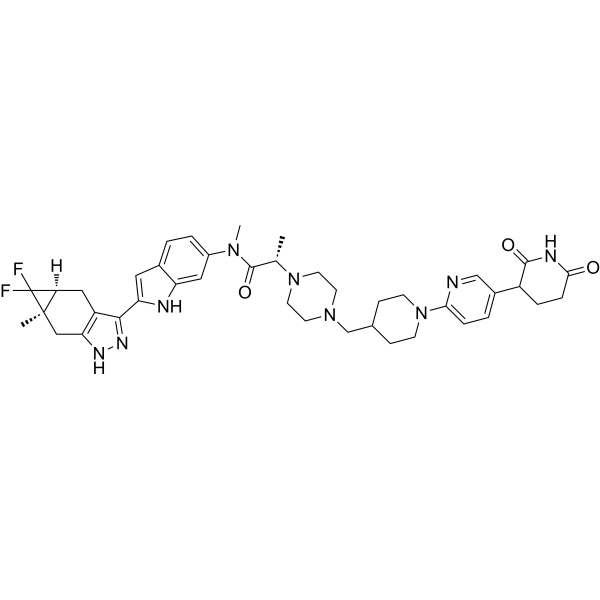
ITK degrader 2 is an orally active ITK PROTAC degrader with a DC50 < 0.001 nM. ITK degrader 2 degrades ITK via the ubiquitin-proteasome pathway. ITK degrader 2 can be used in the research of cancer, autoimmune diseases and inflammatory diseases .
loading...
    loading...
Cat. No.: HY-178496
Research Areas:  

Cancer

DDO3602 is a PARP1 HSPTAC (HSP90-mediated proteolysis-targeting chimera) degrader, with a DC50 of 490.3 nM against PARP1; its Kd values for PARP1 and HSP90 are 66.5 nM and 1.64 nM, respectively. DDO3602 induces the formation of an unnatural PARP1-HSP90 ternary complex, recruits E3 ubiquitin ligase, and promotes PARP1 degradation via the ubiquitin-proteasome pathway. DDO3602 induces G2/M cell cycle arrest, DNA damage, inhibits cell migration, and exhibits antiproliferative activity in breast cancer cells. DDO3602 can be used in breast cancer-related research .
loading...
    loading...
Cat. No.: HY-173437
Target:  

PROTACs PARP

Research Areas:  

Cancer

CW-2 is a CRBN-recruited PARP1 PROTAC degrader. CW-2 triggers multiple downstream biological effects including DNA damage accumulation, impaired DNA repair, mitochondrial-mediated apoptosis, intracellular ROS buildup and G1/S cell cycle arrest, as well as the regulation of oxidative phosphorylation, p53, PI3K-Akt and MAPK alongside ubiquitin proteolysis pathways. CW-2 enhances cell membrane permeability and intracellular platinum enrichment, exhibits detectable pharmacokinetic profiles after intraperitoneal administration in rats and drives differential gene expression. CW-2 can be applied to research on triple-negative breast cancer, non-small cell lung cancer, cisplatin-resistant non-small cell lung cancer, colon cancer and pancreatic cancer .
loading...
    loading...
Cat. No.: HY-L151
544 compounds

PROTACs (Proteolysis-targeting chimeras) is a class of molecules that utilize ubiquitin-proteasome system (UPS) to ubiquitinate and degrade target proteins. The PROTACs molecule consists of two ligands joined by a linker. The one-to-one interaction between PROTACs and target proteins determines the high efficiency of PROTACs, making it a potential molecule for targeted protein degradation (TPD) therapy.

MCE supplies a unique collection of 544 PROTACs that effectively degrade target proteins with more powerful screening capability. MCE PROTAC Library is a useful tool for signal pathway research, protein degradation therapy research, drug discovery and drug repurposing, etc.

