



TASIN-1 hydrochloride
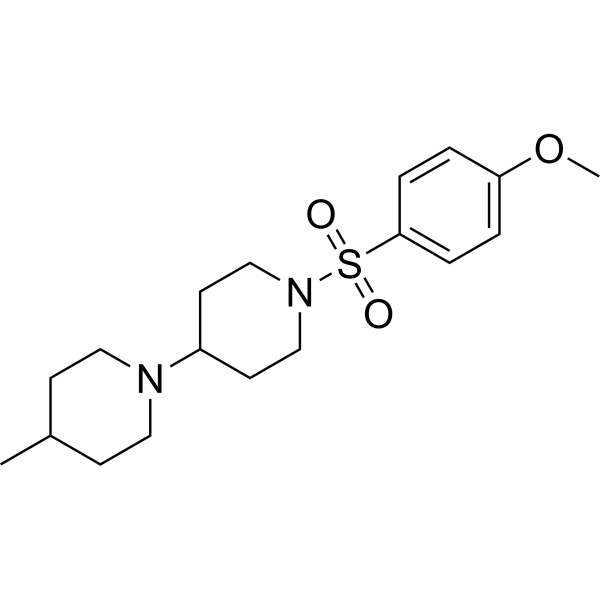
TASIN-1 hydrochloride is a selective inhibitor of truncated APCTR (adenomatous polyposis coli gene) that exerts cytotoxic effects by inhibiting cholesterol biosynthesis. TASIN-1 hydrochloride specifically targets colorectal cancer (CRC) cells carrying APC truncated mutations, while having no significant toxicity to wild-type APC cells. TASIN-1 hydrochloride exerts cytotoxic effects by targeting Emopamil binding protein (EBP) to inhibit cholesterol biosynthesis, triggering endoplasmic reticulum (ER) stress, reactive oxygen species (ROS) generation, and JNK-mediated apoptosis, and inhibiting Akt survival signaling. TASIN-1 hydrochloride can be used to prevent and intervene in APC mutant colorectal cancer.
For research use only. We do not sell to patients.
- CAS No.: 1678515-13-3
- Formula: C18H29ClN2O3S
- Molecular Weight:388.95
-
Storage:
Please store the product under the recommended conditions in the Certificate of Analysis.


To place orders, for customer services and technical support, please contact: MedChemExpress USA
Tel: 609-228-6898 E-mail: [email protected] [email protected]


-
 Biological Activity
-
Chemical Information
- Purity & Documentation
- References
-
 Help & FAQs


All Caspase Isoforms
More

Biological Activity
Description
IC50 & Target
|
Caspase 3 |
Caspase-7 |
In Vitro
TASIN-1 hydrochloride selectively inhibits adenomatous polyposis coli truncated (APCTR) in DLD1 cells with IC50=70 nM[1].
TASIN-1 hydrochloride (70 nM; 72 h) significantly inhibits the proliferation of human colon cancer cells DLD1 (APCTR) with IC50 of 70 nM, and has a high selectivity against HCT116 (APCWT) cells with IC50 >50 μM[1].
TASIN-1 hydrochloride (2.5 μM; 7 d) inhibits soft agar colony formation of DLD1 cells, but has no significant effect on HCT116[1].
TASIN-1 hydrochloride (2.5 μM; 2-48 h) reduced the cholesterol synthesis rate and endogenous cholesterol levels in DLD1 cells, but had no effect on HCT116 cells[1].
TASIN-1 hydrochloride (2.5 μM; 24 h) induced the expression of endoplasmic reticulum stress marker CHOP and JNK phosphorylation, and activated caspase 3/7 activity in DLD1 cells, but no significant changes were observed in HCT116 cells[2].
MedChemExpress (MCE) has not independently confirmed the accuracy of these methods. They are for reference only.
-
Cell Line:DLD1 (APCTR), HCT116 (APCWT)
-
Concentration:0.01-100 μM
-
Incubation Time:72 h
-
Result:Showed an IC50 of 70 nM in DLD1 cells and >50 μM in HCT116 cells, demonstrating >700-fold selectivity for APCTR cells.
In Vivo
TASIN-1 (20, 40 mg/kg; ip; twice weekly; 90 or 100 days) hydrochloride reduces the number and size of colon polyps and inhibits tumor progression in the CPC;Apc mouse genetic colorectal cancer model without significant liver and kidney damage or weight loss[1].
MedChemExpress (MCE) has not independently confirmed the accuracy of these methods. They are for reference only.
-
Animal Model:Female athymic nude mice (5-6 weeks old, ~20 g) with DLD1/HT29 (APCTR) or HCT116 (APCWT) subcutaneous xenograft model[1]
-
Dosage:40 mg/kg TASIN-1
-
Administration:Intraperitoneal (i.p.) injection, twice daily (bid), 18 days
-
Result:Reduced DLD1 and HT29 tumor volumes by 40%-60% compared to vehicle control, with increased cleaved caspase 3 and PARP in tumor lysates.
Showed no significant growth inhibition against HCT116 tumors.
Tumor histology revealed fragmented nuclei and increased apoptotic cells in treated groups.


Chemical Information
-
CAS No. 1678515-13-3
-
Molecular Weight 388.95
-
Formula C18H29ClN2O3S
-
SMILES
CC1CCN(C2CCN(S(=O)(C3=CC=C(OC)C=C3)=O)CC2)CC1.Cl
-
Shipping
Room temperature in continental US; may vary elsewhere.
-
Storage
Please store the product under the recommended conditions in the Certificate of Analysis.


Purity & Documentation
References
[1]. Zhang L, et al. Selective targeting of mutant adenomatous polyposis coli (APC) in colorectal cancer. Sci Transl Med. 2016 Oct 19;8(361):361ra140. [Content Brief]
[2]. Zhang L, et al. Cholesterol Depletion by TASIN-1 Induces Apoptotic Cell Death through the ER Stress/ROS/JNK Signaling in Colon Cancer Cells. Mol Cancer Ther. 2018 May;17(5):943-951. [Content Brief]
[3]. Wang W, et al. Design and Synthesis of TASIN Analogues Specifically Targeting Colorectal Cancer Cell Lines with Mutant Adenomatous Polyposis Coli (APC). J Med Chem. 2019 May 23;62(10):5217-5241. [Content Brief]

Calculators
Concentration (start) × Volume (start) = Concentration (final) × Volume (final)


TASIN-1 hydrochloride Related Classifications
HY-116572 Related Classifications
 Powered by Bioz