



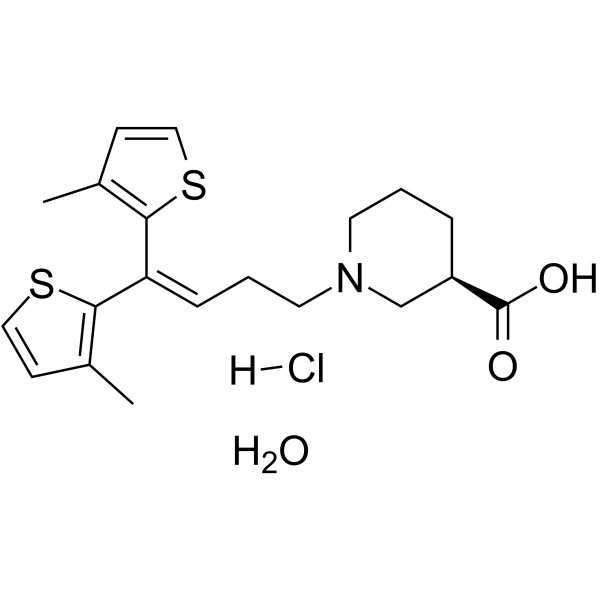
Tiagabine hydrochloride hydrate
Tiagabine (NO050328; NO328; TGB) hydrochloride hydrate is an orally active, highly selective, and reversible GAT-1 inhibitor and anticonvulsant that crosses the blood-brain barrier. By blocking the reuptake of GABA in neurons and glial cells, tiagabine increases extracellular GABA levels to enhance inhibitory signal transduction, thereby exerting multiple activities such as anticonvulsant, neuroprotective, and antioxidant effects. Tiagabine hydrochloride hydrate exhibits linear pharmacokinetic properties. Although it is metabolized by CYP3A and has a high protein binding rate, it carries a low risk of cognitive impairment. Tiagabine hydrochloride hydrate is widely used in research on related diseases including epilepsy (including refractory partial seizures), alcohol withdrawal symptoms, and Huntington's disease.
For research use only. We do not sell to patients.
- CAS No.: 145821-57-4
- Formula: C20H28ClNO3S2
- Molecular Weight:430.02
-
Storage:
Please store the product under the recommended conditions in the Certificate of Analysis.

To place orders, for customer services and technical support, please contact: MedChemExpress USA
Tel: 609-228-6898 E-mail: [email protected] [email protected]


-
 Biological Activity
-
Chemical Information
- Purity & Documentation
- References
-
 Help & FAQs




Biological Activity
Description
In Vitro
Tiagabine hydrochloride hydrate (0.1-5 μM; 4 days) protects Tet-off PC12 cells expressing mutant huntingtin against toxicity, with significant effects detected at concentrations of 0.5, 2, and 5 μM after 4 days of treatment[1].
Tiagabine hydrochloride hydrate potently and selectively inhibits GABA uptake in glial, neuronal, and synaptosomal preparations, with IC50 values of 0.18 μmol/L, 0.45 μmol/L, and 0.07 μmol/L, respectively[3].
Tiagabine hydrochloride hydrate (2-100 μM; 5-15 min) induces long-lasting, repetitive slow depolarizations in cortical wedges from 20-30 day-old DBA/2 mice, with consistent amplitude and frequency across tested concentrations of 2, 5, 50, and 100 μM following 15-min perfusion, and following shorter 5-10 min perfusions of 50 μM[4].
Tiagabine hydrochloride hydrate (50 μM; 15 min)-induced depolarizations in cortical wedges from 20-30 day-old DBA/2 mice are Ca2+-dependent, mediated via GABAA receptors, require voltage-dependent sodium channel activity, are unaffected by NMDA receptor blockade, are partially inhibited by AMPA receptor blockade, are abolished by Dextromethorphan, and are potentiated by potassium channel blockade[4].
Tiagabine hydrochloride hydrate (50 μM; 15 min) induces depolarizations in cortical wedges from 50 day-old DBAr2 mice and BALB/c mice, similar to responses in 20-30 day-old DBAr2 mice[4].
MedChemExpress (MCE) has not independently confirmed the accuracy of these methods. They are for reference only.
In Vivo
Tiagabine (5 mg/kg; i.p.; daily; lifelong administration) hydrochloride hydrate extends the survival of male and female R6/2 transgenic Huntington's disease mice (17.8 days of extension at the dose of 5 mg/kg), improves their motor function, and alleviates brain atrophy[1].
Tiagabine (0.4 mg/kg; i.p.; single administration; 30 min prior to seizure testing) hydrochloride hydrate exerts a protective effect against audiogenic tonic seizures in male DBA/2 mice, with an ED50 of 0.4 mg/kg[2].
Tiagabine (1.2-1.3 mg/kg; i.p.; single administration; 30 min prior to seizure tests) hydrochloride hydrate exerts a protective effect against PTZ-induced tonic convulsions in male NMRI mice, with an ED50 of 1.2 mg/kg, while providing approximately 50% partial protection against clonic convulsions[2].
Tiagabine (15-30 mg/kg; p.o.; twice daily; for consecutive 21 days) hydrochloride hydrate induces tolerance to cognitive effects in mice, but does not induce tolerance to its anticonvulsant effects in DMCM-induced epileptic mice[3].
Tiagabine (9 mg/kg; subcutaneous injection; once daily for 8 consecutive days; single injection 30 min prior to locomotor activity test) hydrochloride hydrate initially reduces short-term spontaneous ethanol intake in ad libitum-fed C57BL/6 mice, but tolerance develops rapidly, resulting in ethanol intake exceeding pre-treatment levels on days 7-8[5].
MedChemExpress (MCE) has not independently confirmed the accuracy of these methods. They are for reference only.


Chemical Information
-
CAS No. 145821-57-4
-
Molecular Weight 430.02
-
Formula C20H28ClNO3S2
-
SMILES
O=C([C@H]1CN(CC/C=C(C2=C(C)C=CS2)/C3=C(C)C=CS3)CCC1)O.[H]Cl.O
-
Synonyms
NO050328 hydrochloride hydrate; NO328 hydrochloride hydrate; TGB hydrochloride hydrate
-
Shipping
Room temperature in continental US; may vary elsewhere.
-
Storage
Please store the product under the recommended conditions in the Certificate of Analysis.


Purity & Documentation
References
[2]. Nielsen EB, et al. Characterization of tiagabine (NO-328), a new potent and selective GABA uptake inhibitor. Eur J Pharmacol. 1991;196(3):257-266. [Content Brief]
[4]. Hu RQ, et al. Tigabine hydrochloride, an inhibitor of gamma-aminobutyric acid (GABA) uptake, induces cortical depolarizations in vitro. Brain Res. 1997;753(2):260-268. [Content Brief]
[5]. Nguyen SA, et al. Tiagabine reduces ethanol reward in C57BL/6 mice under acute and chronic administration regimens. Synapse. 2005;56(3):135-146. [Content Brief]
[6]. Javaid S, et al. Tiagabine suppresses pentylenetetrazole-induced seizures in mice and improves behavioral and cognitive parameters by modulating BDNF/TrkB expression and neuroinflammatory markers. Biomed Pharmacother. 2023;160:114406. [Content Brief]

Calculators
Concentration (start) × Volume (start) = Concentration (final) × Volume (final)


Tiagabine hydrochloride hydrate Related Classifications
HY-B0696B Related Classifications
 Powered by Bioz