



Tildipirosin (Standard)
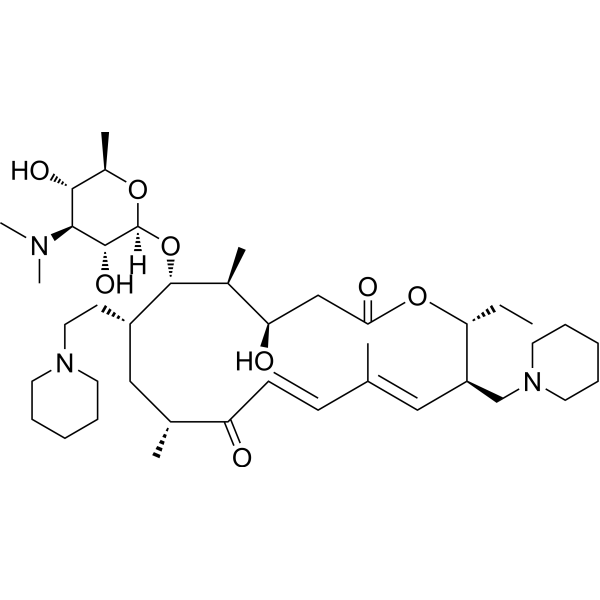
Tildipirosin (Standard) is the analytical standard of Tildipirosin. This product is intended for research and analytical applications. Tildipirosin, a long-acting macrolide, has antibiotic activity.
For research use only. We do not sell to patients.
- Purity : 98%
- CAS No.: 328898-40-4
- Formula: C41H71N3O8
- Molecular Weight:734.02
-
Storage:
Please store the product under the recommended conditions in the Certificate of Analysis.


To place orders, for customer services and technical support, please contact: MedChemExpress USA
Tel: 609-228-6898 E-mail: [email protected] [email protected]


-
 Product Information
-
Chemical Information
- Purity & Documentation
-
 Help & FAQs




Product Information
Information
Application
The compound is the grade of analytical standard, which is the reference standard supplied assay. It is commonly used in qualitative, quantitative and methodological research experiments in HPLC, GC and MS.


Chemical Information
-
CAS No. 328898-40-4
-
Molecular Weight 734.02
-
Formula C41H71N3O8
-
SMILES
O[C@H]([C@H]([C@H](O)[C@@H](C)O1)N(C)C)[C@]1([H])O[C@H]2[C@H](C[C@H](C(/C=C/C(C)=C/[C@H](CN3CCCCC3)[C@@H](CC)OC(C[C@@H](O)[C@@H]2C)=O)=O)C)CCN4CCCCC4
-
Shipping
Room temperature in continental US; may vary elsewhere.
-
Storage
Please store the product under the recommended conditions in the Certificate of Analysis.


Purity & Documentation
References
[1]. Rose M, et al. A microbiological assay to estimate the antimicrobial activity of parenteral tildipirosin against foodborne pathogens and commensals in the colon of beef cattle and pigs. J Vet Pharmacol Ther. 2016 Jun;39(3):277-86. [Content Brief]
[2]. Angell JW, et al. In vitro susceptibility of contagious ovine digital dermatitis associated Treponema spp. isolates to antimicrobial agents in the UK. Vet Dermatol. 2015 Dec;26(6):484-7, e114-5. [Content Brief]
[3]. Confer AW, et al. Clinical disease and lung lesions in calves experimentally inoculated with Histophilus somni five days after metaphylactic administration of tildipirosin or tulathromycin. Am J Vet Res. 2016 Apr;77(4):358-66. [Content Brief]
[4]. Michael GB, et al. Increased MICs of gamithromycin and tildipirosin in the presence of the genes erm(42) and msr(E)-mph(E) for bovine Pasteurella multocida and Mannheimia haemolytica. J Antimicrob Chemother. 2012 Jun;67(6):1555-7. [Content Brief]

Calculators
Concentration (start) × Volume (start) = Concentration (final) × Volume (final)


Tildipirosin (Standard) Related Classifications
HY-A0071R Related Classifications
 Powered by Bioz