



Topics
Drug Screening
Drug screening is the process of testing a large number of compounds to determine whether they produce appropriate biochemical or cellular effects, which is usually an important step in the drug discovery pathway. Small molecule drugs screening is a time-consuming and expensive process to select potential drugs from a large number of natural or synthetic compounds. For drug screening, quality is more important than quantity. And the focus of the entire industry is shifting from quickly screening the maximum number of compounds to screening high-quality compounds with robust drug characteristics.
High-throughput screening (HTS) is one of the common technologies used in drug screening, which is used to find the lead compound with pharmaceutical properties from the compound libraries. HTS has become an important method for most pharmaceutical companies and biotechnology companies in the world to discover new drugs.
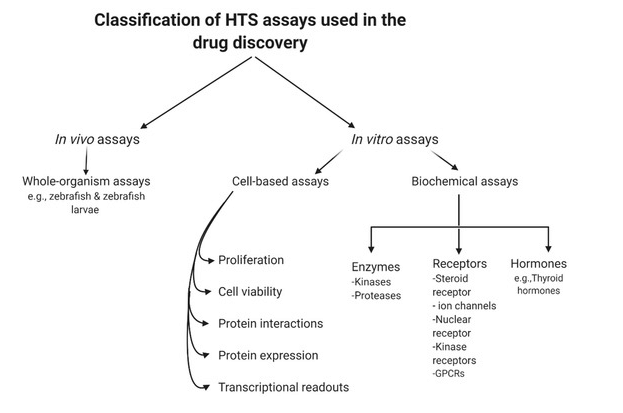
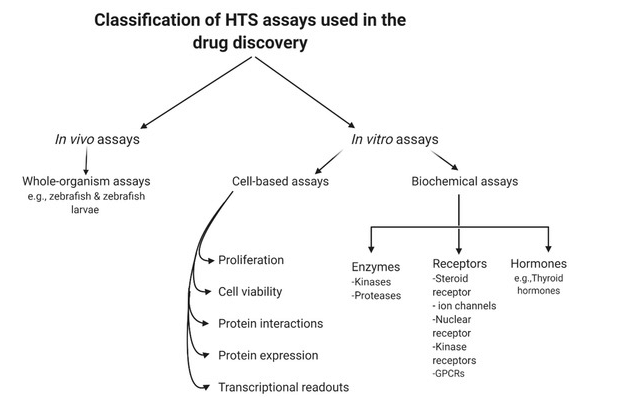
Classification of HTS Analysis Methods Used in Drug Discovery[3]
In addition, HTS technology is increasingly used in target verification, detection development, secondary screening, ADME/Tox, lead compound optimization and other fields. HTS has been used to screen small molecule compounds, chemical mixtures, natural product extracts, oligonucleotides and antibodies with known structures.
There are many methods available for compound analysis in HTS screening, including cell experiments, biochemical experiments and in vivo experiments. A commonly used method is cell level screening, which can detect data that cannot be obtained from biochemical assays, such as whether compounds have pharmacological activity at specific targets. Therefore, cell-based screening is expected to become an important tool for studying cell growth and differentiation, detecting the effects of small molecules and cell growth conditions on cell function and physiological characteristics, and understanding animal cell signaling pathways.
MedChemExpress (MCE) can provide more than 100 ready-to-use active compound libraries, such as Bioactive Compound Library (HY-L001), Drug Repurposing Compound Library (HY-L035), Natural Product Library (HY-L021), FDA-Approved Drug Library (HY-L022), Traditional Chinese Medicine Monomer Library (HY-L065), etc. A total of 20,000+ small molecule compounds with biological activity can be used for HTS and high-intensity screening (HCS). It is a professional tool for conducting research on drug screening and new indications discovery.
-
25,274 compoundsHY-L001
-
5,296 compoundsHY-L021
-
23,342 compoundsHY-L032
-
Traditional Chinese Medicine Active Compound Library
3,219 compoundsHY-L065 -
Drug Repurposing Compound Library
5,349 compoundsHY-L035
 LinkedIn
 Researchgate
 Instagram
 X
X Facebook
 WhatsApp
 Reddit
 Mail
MailReferences
[1]. Adam Smith. Screening for drug discovery: the leading question. Nature. 2002 Jul 25;418(6896):453-9. [Content Brief]
[2]. Sandra Fox, et al. High-throughput screening: update on practices and success. J Biomol Screen. 2006 Oct;11(7):864-9. [Content Brief]
[3]. Hasan Aldewachi, et al. High-Throughput Screening Platforms in the Discovery of Novel Drugs for Neurodegenerative Diseases. Bioengineering (Basel). 2021 Feb 23;8(2):30. [Content Brief]
