



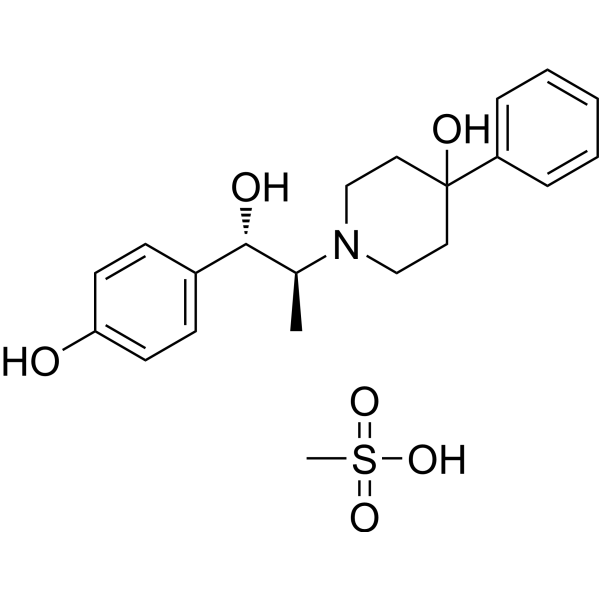
Traxoprodil mesylate
Based on 2 publication(s) in Google Scholar
Traxoprodil mesylate (CP101,606) is a potent and selective NMDA antagonist and protect hippocampal neurons with an IC50 of 10 nM.
For research use only. We do not sell to patients.
- CAS No.: 188591-67-5
- Formula: C21H29NO6S
- Molecular Weight:423.52
-
Storage:
Please store the product under the recommended conditions in the Certificate of Analysis.

To place orders, for customer services and technical support, please contact: MedChemExpress USA
Tel: 609-228-6898 E-mail: [email protected] [email protected]


-
 Biological Activity
-
Chemical Information
- Protocols
- Purity & Documentation
- References
-
 Help & FAQs


Publications Citing Use of MedChemExpress (MCE) Traxoprodil mesylate
MoreAll iGluR Isoforms
More

Biological Activity
Description
In Vivo
MedChemExpress (MCE) has not independently confirmed the accuracy of these methods. They are for reference only.
Clinical Trial
| NCT Number | Sponsor | Condition | Start Date |
Phase

|
|---|---|---|---|---|
| NCT01329991 | Plexxikon| | 2011-05 | PHASE1 |


Chemical Information
-
CAS No. 188591-67-5
-
Molecular Weight 423.52
-
Formula C21H29NO6S
-
SMILES
CS(=O)(O)=O.OC1(C2=CC=CC=C2)CCN(CC1)[C@@H](C)[C@H](C3=CC=C(C=C3)O)O
-
Synonyms
CP101,606 mesylate
-
Shipping
Room temperature in continental US; may vary elsewhere.
-
Storage
Please store the product under the recommended conditions in the Certificate of Analysis.


Publications (2)
-
Journal Impact Factor
-
Most Recent
-
J Biochem
Upregulated mGluR5 induces ER stress and DNA damage by regulating the NMDA receptor subunit NR2B. [Abstract]2022 Mar 3;171(3):349-359. PMID: 34908130 -

Protocols
-
Cell Cytotoxicity Assay
Cytotoxicity assays are usually based on the assessment of cell membrane damage, which can also be indirectly detected by measuring cell viability. Detection methods include MTT assay, CKK-8 assay, LDH assay and ATP assay, etc.
-
Primary Embryonic Hippocampal Neuron Culture
Primary embryonic hippocampal neuron culture is an in vitro method in which hippocampi from embryonic rodents are dissected, enzymatically or mechanically dissociated, plated on adhesive substrates, and maintained in defined neuronal medium or in low-density sandwich/co-culture formats to support neuronal attachment, neurite extension, polarity formation, dendritic arborization, and synapse formation. The main readouts are cell survival, neuronal purity, neurite outgrowth, axon-dendrite polarization, synaptic marker development, and functional neuronal activity, assessed by phase-contrast microscopy, immunocytochemistry for neuronal/glial markers, live imaging, or electrophysiology depending on the downstream experiment.


Purity & Documentation
References
[1]. Chenard BL, et al. (1S,2S)-1-(4-hydroxyphenyl)-2-(4-hydroxy-4-phenylpiperidino)-1-propanol: a potent new neuroprotectant which blocks N-methyl-D-aspartate responses. J Med Chem. 1995 Aug 4;38(16):3138-45. [Content Brief]
[2]. Poleszak E, et al. Traxoprodil, a selective antagonist of the NR2B subunit of the NMDA receptor, potentiates the antidepressant-like effects of certain antidepressant drugs in the forced swim test in mice. Metab Brain Dis. 2016 Aug;31(4):803-14. [Content Brief]
[3]. Naspolini AP, et al. Traxoprodil decreases pentylenetetrazol-induced seizures. Epilepsy Res. 2012 Jun;100(1-2):12-9. [Content Brief]

Calculators
Concentration (start) × Volume (start) = Concentration (final) × Volume (final)


Traxoprodil mesylate Related Classifications
HY-W018061A Related Classifications
 Powered by Bioz