



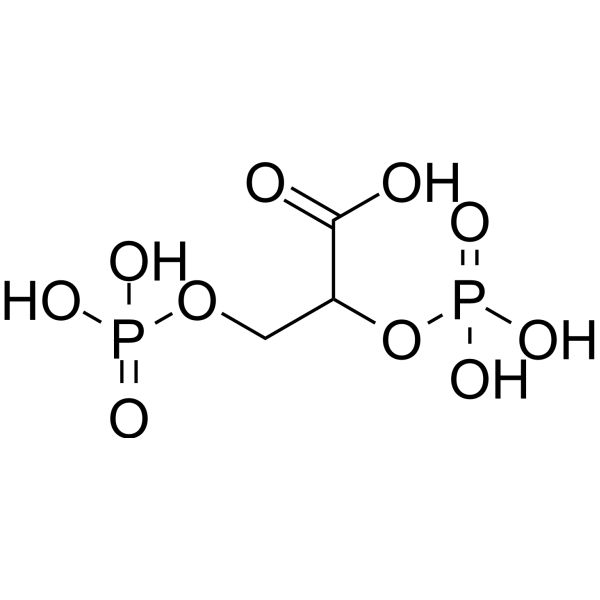
2,3-Diphosphoglyceric acid
2,3-Diphosphoglyceric acid (2,3-DPG) is an intermediate metabolite of the 2,3-BPG shunt in erythrocytes, capable of binding to hemoglobin and modulating oxygen affinity. 2,3-Diphosphoglyceric acid stabilizes the deoxyhemoglobin T-state conformation, reduces hemoglobin oxygen affinity, and promotes oxygen release in tissues. 2,3-Diphosphoglyceric acid inhibits the growth of Plasmodium falciparum within erythrocytes without causing hemolysis or a decrease in ATP levels. 2,3-Diphosphoglyceric acid is useful for research related to malaria and Alzheimer's disease.
For research use only. We do not sell to patients.
- CAS No.: 138-81-8
- Formula: C3H8O10P2
- Molecular Weight:266.04
-
Storage:
Please store the product under the recommended conditions in the Certificate of Analysis.

To place orders, for customer services and technical support, please contact: MedChemExpress USA
Tel: 609-228-6898 E-mail: [email protected] [email protected]


-
 Biological Activity
-
Chemical Information
- Protocols
- Purity & Documentation
- References
-
 Help & FAQs




Biological Activity
Description
IC50 & Target
[1]|
Human Endogenous Metabolite |
Cellular Effect
|
Cell Line

|
Type | Value | Description | References |
|---|---|---|---|---|
| T-cell | EC50 |
1580 μM
Compound: 2,3-diphosphoglycerate
|
Effective concentration to activate gammadelta T cells
Effective concentration to activate gammadelta T cells
|
[PMID: 12383012] |
In Vitro
2,3-Diphosphoglyceric acid (0.25-16 mM; 0-96 h) does not induce hemolysis in healthy human RBCs[2].
2,3-Diphosphoglyceric acid (0.25-16 mM; 48 h) exhibits cytotoxicity against HEPG2 cells with an IC50 of 6.40 mM[2].
2,3-Diphosphoglyceric acid (0.25-16 mM; 12-96 h) exhibits antimalarial activity against 3D7 P. falciparum, with its IC50 showing time dependence[2].
2,3-Diphosphoglyceric acid (8 mM; 48 h) reduces the number of merozoites produced by 3D7 P. falciparum schizonts in human erythrocytes[2].
2,3-Diphosphoglyceric acid (8 mM; 96 h) inhibits the invasion and maturation of 3D7 P. falciparum without depleting ATP in human RBCs, whereas pretreatment of RBCs before infection has no effect[2].
2,3-Diphosphoglyceric acid (8 mM) does not block the escape or re-invasion of 3D7 P. falciparum from untreated human RBCs[2].
2,3-Diphosphoglyceric acid (8 mM; 30 h) shifts the metabolic profile of 3D7 P. falciparum-infected human RBCs closer to that of uninfected RBCs, possibly involving specific metabolites[2].
2,3-Diphosphoglyceric acid (8 mM; 48 h) impairs the growth of 3D7 P. falciparum and prevents its normal entry into a new cycle[2].
MedChemExpress (MCE) has not independently confirmed the accuracy of these methods. They are for reference only.


Chemical Information
-
CAS No. 138-81-8
-
Molecular Weight 266.04
-
Formula C3H8O10P2
-
SMILES
O=C(O)C(OP(O)(O)=O)COP(O)(O)=O
-
Synonyms
2,3-DPG
-
Structure Classification
-
Initial Source
-
Shipping
Room temperature in continental US; may vary elsewhere.
-
Storage
Please store the product under the recommended conditions in the Certificate of Analysis.


Purity & Documentation
-
Data Sheet (301 KB)
-
SDS (252 KB)
- Français - FR (252 KB)
- Deutsch - DE (252 KB)
- Norwegian - NO (252 KB)
- Español - ES (252 KB)
- Swedish - SV (252 KB)
- Italian - IT (252 KB)
- Korean - KR (252 KB)
- Portuguese - PT (252 KB)
-
Handling Instructions (2659 KB)
References
[1]. Płoszczyca K, et al. Red Blood Cell 2,3-Diphosphoglycerate Decreases in Response to a 30 km Time Trial Under Hypoxia in Cyclists. Frontiers in physiology. 2021;12:670977. [Content Brief]
[2]. Morais I, et al. Synthetic Red Blood Cell-Specific Glycolytic Intermediate 2,3-Diphosphoglycerate (2,3-DPG) Inhibits Plasmodium falciparum Development In Vitro. Front Cell Infect Microbiol. 2022 Mar 15;12:840968. [Content Brief]
[3]. Kosenko EA, et al. Relationship between chronic disturbance of 2,3-diphosphoglycerate metabolism in erythrocytes and Alzheimer disease. CNS & neurological disorders drug targets. 2016;15(1):113-23. [Content Brief]

Calculators
Concentration (start) × Volume (start) = Concentration (final) × Volume (final)


2,3-Diphosphoglyceric acid Related Classifications
HY-113050 Related Classifications
 Powered by Bioz
Keywords
- 2,3-Diphosphoglyceric acid
- 138-81-8
- 2,3-DPG
- Endogenous Metabolite
- Parasite
- parasite growth and maturation
- merozoite progeny
- oxygen dissociation curve
- Luebering-Rapoport pathway
- T-state conformation of hemoglobin
- 3D7 P. falciparum
- hemoglobin oxygen affinity
- glycolytic intermediate metabolite
- HEPG2 cells
- hemoglobin-binding modulator
- Inhibitor
- inhibitor
- inhibit