



Ipramidil
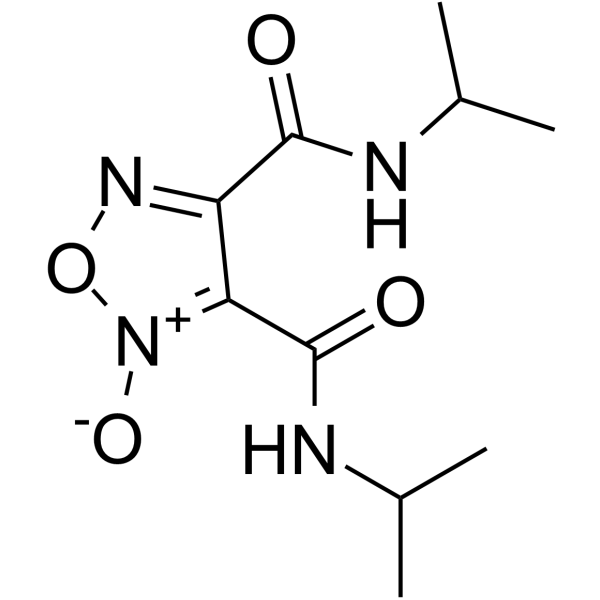
Ipramidil (C80-1324) is a vasodilator with significant active dilation of coronary circulation in isolated hearts. Ipramidil can cause an increase in NO release and stimulate guanylate cyclase activity.
Nur für Forschungszwecke. Wir verkaufen nicht an Patienten.
- CAS. Nr.: 83656-38-6
- Formel: C10H16N4O4
- Molecular Weight:256.26
-
Speicherung:Powder -20°C, 3 years , 4°C, 2 years ; In solvent -80°C, 6 months , -20°C, 1 month

To place orders, for customer services and technical support, please contact: MedChemExpress USA
Tel: 609-228-6898 E-mail: [email protected] [email protected]


-
 Biologische Aktivität
-
Chemical Information
- Reinheit & Dokumentation
- Verweise
-
 Help & FAQs




Biologische Aktivität
Beschreibung
In Vitro
The vasodilator action of Ipramidil (C80-1324) on coronary vessels is more potent than that of GTN and appears to be biphasic. The increase in coronary flow caused by furoxans as well as by glyceryl trinitrate (GTN) is blunted upon coinfusion of the guanylate cyclase inhibitor methylene blue. NO sign of tachyphylaxis of the vasodilator response is seen upon the repeated or continuous (60 min) application of Ipramidil at a concentration of 1 μg/mL,which induces an increase in coronary flow of 67±9%. Moreover, the vasodilatoreffect of Ipramidil is not different from control when Ipramidil is given after a 60 min preinfusion of 10 μg/mL GTN, i.e. under conditions of nitrate tolerance. However,when GTN is applied after a 30 min infusion of Ipramidil, its dilator response is significantly diminished. Unlike GTN, Ipramidil concentration independently increases the spontaneous beating rate of the hearts by 10-30 beats per minute and appeared to have a weak positive inotropic effect[1].
MedChemExpress (MCE) has not independently confirmed the accuracy of these methods. They are for reference only.


Chemical Information
-
CAS. Nr. 83656-38-6
-
Appearance Solid
-
Molecular Weight 256.26
-
Formel C10H16N4O4
-
Color Off-white to light yellow
-
SMILES
O=C(C1=[N+]([O-])ON=C1C(NC(C)C)=O)NC(C)C
-
Synonyms
C80-1324
-
Versand
Room temperature in continental US; may vary elsewhere.
-
Speicherung
Powder -20°C 3 years 4°C 2 years In solvent -80°C 6 months -20°C 1 month


Reinheit & Dokumentation
-
Data Sheet (273 KB)
-
SDS (251 KB)
- English - EN (251 KB)
- Français - FR (251 KB)
- Deutsch - DE (251 KB)
- Norwegian - NO (251 KB)
- Español - ES (251 KB)
- Swedish - SV (251 KB)
- Italian - IT (251 KB)
- Korean - KR (251 KB)
- Portuguese - PT (251 KB)
-
Handling Instructions (2659 KB)
Verweise
[1]. Feelisch M, et al. Thiol-mediated generation of nitric oxide accounts for the vasodilator action of furoxans. Biochem Pharmacol. 1992 Sep 25;44(6):1149-57. [Content Brief]
[2]. Feelisch M, et al. Thiol-mediated generation of nitric oxide accounts for the vasodilator action of furoxans. Biochem Pharmacol. 1992 Sep 25;44(6):1149-57. [Content Brief]

Calculators
Konzentration (Stammlösung) × Volumen (Stammlösung) = Konzentration (Ziellösung) × Volumen (Ziellösung)


Ipramidil Related Classifications
HY-U00172 Related Classifications
 Powered by Bioz