



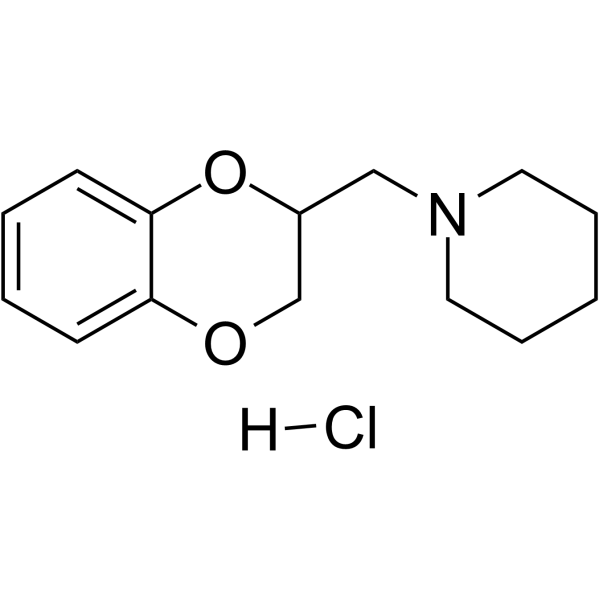
Piperoxan hydrochloride

Based on 1 Customer Validation
Piperoxan (Benodaine) hydrochloride is an α2 adrenoceptor antagonist. Piperoxan hydrochloride is the first-generation antihistamine.
For research use only. We do not sell to patients.
- Purity : 99.66%
- CAS No.: 135-87-5
- Formula: C14H20ClNO2
- Molecular Weight:269.77
-
Storage:
4°C, sealed storage, away from moisture
* In solvent : -80°C, 6 months; -20°C, 1 month (sealed storage, away from moisture)

To place orders, for customer services and technical support, please contact: MedChemExpress USA
Tel: 609-228-6898 E-mail: [email protected] [email protected]


-
 Biological Activity
-
Chemical Information
-
Solvent & Solubility
- Protocol
- Purity & Documentation
- References
-
 Help & FAQs


All Adrenergic Receptor Isoforms
More

Biological Activity
Description
IC50 & Target
adrenoceptor[1]
In Vitro
When the medulla is superfused with α2 adrenoceptor antagonist Piperoxane (50 μM; 5 min) while the pons is with artificial cerebrospinal fluid (ACSF), the three inactive preparations display rhythmic phrenic bursts at a low frequency (2-4 c/min), and the phrenic burst frequency of the 12 active ones significantly increases during the last 3 min of Piperoxane applications (163±12% of the previous mean frequency). In active medullary preparations, the effects of NA applications (25 μM; 5 min) are compared when the preparations sre superfused either by ACSF (n=8) or by the α2 adrenoceptor antagonist Piperoxane (50 μM; PIP-ACSF; n=5). NA applications either alone (NA-ACSF) or with Piperoxane (PIP-ACSF+NA) significantly increases the phrenic burst frequency. However, the blockage of the medullary α2 adrenoceptors by Piperoxane potentiates a phrenic burst frequency increase: during the fifth minute of NA applications, the phrenic burst frequency reached 171±11% of the mean control value when ACSF is applied alone and 234±21% of the mean control value when PIP-ACSF is applied in control condition[1].
MedChemExpress (MCE) has not independently confirmed the accuracy of these methods. They are for reference only.


Chemical Information
-
CAS No. 135-87-5
-
Appearance Solid
-
Molecular Weight 269.77
-
Formula C14H20ClNO2
-
Color White to off-white
-
SMILES
[H]Cl.N1(CC2OC3=CC=CC=C3OC2)CCCCC1
-
Synonyms
Benodaine hydrochloride
-
Shipping
Room temperature in continental US; may vary elsewhere.
-
Storage
4°C, sealed storage, away from moisture
* In solvent : -80°C, 6 months; -20°C, 1 month (sealed storage, away from moisture)


Solvent & Solubility
In Vitro:
H2O : 50 mg/mL (185.34 mM; Need ultrasonic)
DMSO : ≥ 31 mg/mL (114.91 mM; Hygroscopic DMSO has a significant impact on the solubility of product, please use newly opened DMSO)
* "≥" means soluble, but saturation unknown.
Please refer to the solubility information to select the appropriate solvent. Once prepared, please aliquot and store the solution to prevent product inactivation from repeated freeze-thaw cycles.
Storage method and period of stock solution: -80°C, 6 months; -20°C, 1 month (sealed storage, away from moisture). When stored at -80°C, please use it within 6 months. When stored at -20°C, please use it within 1 month.
* Note: If you choose water as the stock solution, please dilute it to the working solution, then filter and sterilize it with a 0.22 μm filter before use.
Please refer to the solubility information to select the appropriate solvent. Once prepared, please aliquot and store the solution to prevent product inactivation from repeated freeze-thaw cycles.
Storage method and period of stock solution: -80°C, 6 months; -20°C, 1 month (sealed storage, away from moisture). When stored at -80°C, please use it within 6 months. When stored at -20°C, please use it within 1 month.
* Note: If you choose water as the stock solution, please dilute it to the working solution, then filter and sterilize it with a 0.22 μm filter before use.
Concentration (start) × Volume (start) = Concentration (final) × Volume (final)
In Vivo:
For the following dissolution methods, please prepare the working solution directly:
It is recommended to prepare fresh solutions and use them promptly within a short period of time.
The percentages shown for the solvents indicate their volumetric ratio in the final prepared solution. If precipitation or phase separation occurs during preparation, heat and/or sonication can be used to aid dissolution.
Add each solvent one by one: PBS
Solubility: 25 mg/mL (92.67 mM); Clear solution; Need ultrasonic

Protocol
Kinase Assay[1]
The mouse neonates (P0-P3) are ether-anesthetized and decerebrated; the brain stems and the cervical spinal cords are dissected out and placed ventral sides up in a 2 mL chamber superfused with artificial cerebrospinal fluid (ACSF) at 27±0.25°C (mean±SD), renewed at a rate of 2 mL/min. The ACSF [containing (in mM) 129 NaCl, 3.35 KCl, 1.26 CaCl2, 1.15 MgCl2, 21 NaHCO3, 0.58 NaH2PO4, and 30 glucose] is oxygenated and equilibrated (pH 7.4 at 27°C) by bubbling carbogene (95% O2-5% CO2). In the pharmacological experiments, this is replaced by another ACSF in which bioreactive substances are dissolved: noradrenaline at 25 μM (NA-ACSF) or α2 adrenoceptor antagonists, either Piperoxane at 50 μM (PIP-ACSF) or yohimbine at 50 μM (YO-ACSF). In some of the experiments, a patch-clamp microelectrode (1 μm diameter tip) is lowered within the ventral pons into the A5 nucleus where a solution of either ACSF or NA (1 mM) is pressure-ejected. The ejected volume is estimated 20 nL for a pressure pulse lasting 2 s[1].
MedChemExpress (MCE) has not independently confirmed the accuracy of these methods. They are for reference only.
Animal Administration[2]
Mice[2]
Male Balb-C mice are used, weighing between 20 and 25 g. In mice pretreated with the α-adrenoceptor antagonist Piperoxan, or with naloxone, both at a dose of 3×10⁻⁵ mol /kg s.c. given 15 min before the acetic acid, the antinociceptive action of (-)-isoprenaline is only slightly antagonized. Dose-ratios of 1.45 and 1.7, are produced by these two antagonists.
MedChemExpress (MCE) has not independently confirmed the accuracy of these methods. They are for reference only.


Purity & Documentation
-
Data Sheet (276 KB)
-
SDS (393 KB)
- English - EN (393 KB)
- Français - FR (393 KB)
- Deutsch - DE (393 KB)
- Norwegian - NO (393 KB)
- Español - ES (393 KB)
- Swedish - SV (393 KB)
- Italian - IT (393 KB)
- Korean - KR (393 KB)
- Portuguese - PT (393 KB)
-
Handling Instructions (2659 KB)
References
[1]. Viemari JC, et al. Nasal trigeminal inputs release the A5 inhibition received by the respiratory rhythm generator of the mouse neonate. J Neurophysiol. 2004 Feb;91(2):746-58. [Content Brief]
[2]. Bentley GA, et al. The antinociceptive action of some beta-adrenoceptor agonists in mice. Br J Pharmacol. 1986 Jul;88(3):515-21. [Content Brief]


Complete Stock Solution Preparation Table
Please refer to the solubility information to select the appropriate solvent. Once prepared, please aliquot and store the solution to prevent product inactivation from repeated freeze-thaw cycles.
Storage method and period of stock solution: -80°C, 6 months; -20°C, 1 month (sealed storage, away from moisture). When stored at -80°C, please use it within 6 months. When stored at -20°C, please use it within 1 month.
| Optional Solvent | Concentration Solvent Mass | 1 mg | 5 mg | 10 mg | 25 mg |
|---|---|---|---|---|---|
| DMSO / H2O | 1 mM | 3.7069 mL | 18.5343 mL | 37.0686 mL | 92.6715 mL |
| 5 mM | 0.7414 mL | 3.7069 mL | 7.4137 mL | 18.5343 mL | |
| 10 mM | 0.3707 mL | 1.8534 mL | 3.7069 mL | 9.2672 mL | |
| 15 mM | 0.2471 mL | 1.2356 mL | 2.4712 mL | 6.1781 mL | |
| 20 mM | 0.1853 mL | 0.9267 mL | 1.8534 mL | 4.6336 mL | |
| 25 mM | 0.1483 mL | 0.7414 mL | 1.4827 mL | 3.7069 mL | |
| 30 mM | 0.1236 mL | 0.6178 mL | 1.2356 mL | 3.0891 mL | |
| 40 mM | 0.0927 mL | 0.4634 mL | 0.9267 mL | 2.3168 mL | |
| 50 mM | 0.0741 mL | 0.3707 mL | 0.7414 mL | 1.8534 mL | |
| 60 mM | 0.0618 mL | 0.3089 mL | 0.6178 mL | 1.5445 mL | |
| 80 mM | 0.0463 mL | 0.2317 mL | 0.4634 mL | 1.1584 mL | |
| 100 mM | 0.0371 mL | 0.1853 mL | 0.3707 mL | 0.9267 mL |
* Note: If you choose water as the stock solution, please dilute it to the working solution, then filter and sterilize it with a 0.22 μm filter before use.


Piperoxan hydrochloride Related Classifications
HY-100850 Related Classifications
 Powered by Bioz