



EGFR
All Product Categories
-
EGFR Inhibitors
(574)
View all products
-
EGFR Agonist
(1)
View all products
-
EGFR Antagonist
(1)
View all products
-
EGFR Activators
(5)
View all products
-
EGFR Modulators
(6)
View all products
-
EGFR Chemicals
(3)
View all products
-
EGFR Inducers
(3)
View all products
-
EGFR Degraders
(24)
View all products
-
EGFR Controls
(6)
View all products
-
EGFR Substrate
(1)
View all products
-
EGFR Ligands
(12)
View all products
-
EGFR Related Products (743)
Related Products (743)

-
EGFR-IN-216
 0 ImagesCat. No.: HY-187334CAS No.: 1923767-20-7EGFR-IN-216 is an epidermal growth factor receptor (EGFR) tyrosine kinase (TK) inhibitor. EGFR-IN-216 inhibits EGFR tyrosine kinase phosphorylation, blocks downstream signaling pathway activation, suppresses cancer cell proliferation and promotes tumor cell apoptosis (apoptosis). EGFR-IN-216 can be used for the research of non-small cell lung cancer.
-
CH401 peptide
 0 ImagesCat. No.: HY-P10686CAS No.: 503027-61-0CH401 peptide is a HER2-derived antigen peptide. After being bound to the artificial viral capsid by a self-assembled β-cyclic peptide, CH401 peptide is encapsulated in a lipid bilayer containing the lipid adjuvant α-GalCer, and can be studied as a self-adjuvant anti-breast cancer vaccine candidate.
-
EGFR-IN-91
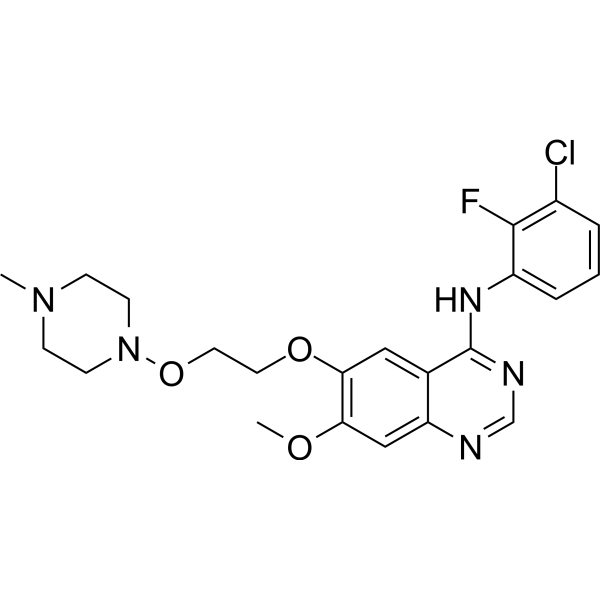 0 ImagesCat. No.: HY-149695CAS No.: 3032113-20-2EGFR-IN-91 (compound 9) is an orally available EGFR inhibitor with blood-brain barrier penetrability. EGFR-IN-91 inhibits EGFRL858R/C797S and EGFRexon 19del/C797S, inducing tumor regression in xenograft (PDX) mouse models. EGFR-IN-91 has the potential to inhibit localized and metastatic non-small cell lung cancer (NSCLC) driven by EGFR mutants.
-
EGFR kinase inhibitor 6
 0 ImagesCat. No.: HY-162483EGFR kinase inhibitor 6 (Compound 4b) is an orally active inhibitor for epidermal growth factor receptor (EGFR) kinase, with IC50 of 24.34 μM. EGFR kinase inhibitor 6 induces apoptosis. EGFR kinase inhibitor 6 exhibits anticancer and anti-inflammatory activity with low toxicity (LD50 range: 500-2000 mg/kg).

-
EGFR-IN-210
 0 ImagesCat. No.: HY-183310EGFR-IN-210 is a EGFR kinase inhibitor with an IC50 of 0.198 μM. EGFR-IN-210 induces antiproliferative, pro-apoptotic, G0/G1 cell cycle arrest, DNA synthesis inhibition and anti-migratory effects in cancer cells. EGFR-IN-210 can be used for the research of various cancers including colorectal cancer.
-
EGFR-IN-160
 0 ImagesCat. No.: HY-173619CAS No.: 2172879-84-2EGFR-IN-160 (Compound R12) is an EGFR inhibitor (IC50 values are 1.62, 0.49 and 0.98 μM for EGFRWT, EGFRT790M and EGFRL858R/T790M/C797S, respectively). EGFR-IN-160 induces G2/M and S phase arrest and apoptosis in NCI-H522 cells, and has anticancer activity. EGFR-IN-160 has antioxidant effects against DPPH (IC50: 12.11 µM) and H2O2 (IC50: 8.89 µM).
-
MM-151
 0 ImagesCat. No.: HY-P991572CAS No.: 1399724-72-1MM-151 is a humanized IgG1 monoclonal antibody targeting EGFR. MM-151 binds multiple regions of the EGFR extracellular domain (ECD) and reduces its mutations in circulating cell-free tumor DNA with EGFR resistance. MM-151 significantly inhibits EGFR signaling and cell growth. MM-151 can be used for drug-resistant cancers research, such as colorectal, non-small cell lung and triple negative breast cancer.
-
EGFR-IN-166
 0 ImagesCat. No.: HY-175173CAS No.: 503443-98-9EGFR-IN-166 (Compound 2) is a EGFR inhibitor. EGFR-IN-166 has potent anticancer activity against breast cancer cells with IC50s of 69.63 and 22.84 μM for MCF-7 and MDA-MB-231 cells, respectively. EGFR-IN-166 significantly inhibits cell migration and EGFR expression. EGFR-IN-166 can be used for breast cancer research.
-
EGFR-PK/JNK-2-IN-1
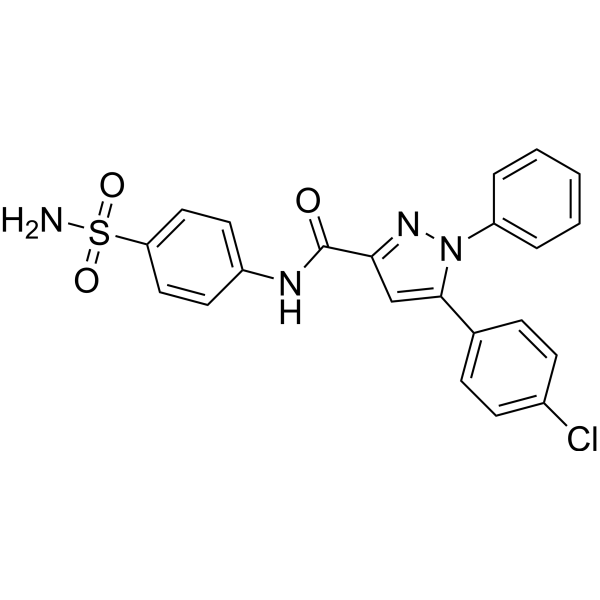 0 ImagesCat. No.: HY-162332CAS No.: 3034838-06-4

-
Erbb2 Mouse Pre-designed siRNA Set A
 0 ImagesCat. No.: HY-RS04467
Erbb2 Mouse Pre-designed siRNA Set A contains three designed siRNAs for Erbb2 gene (Mouse), as well as a negative control, a positive control, and a FAM-labeled negative control.
-
EGFR/microtubule-IN-1
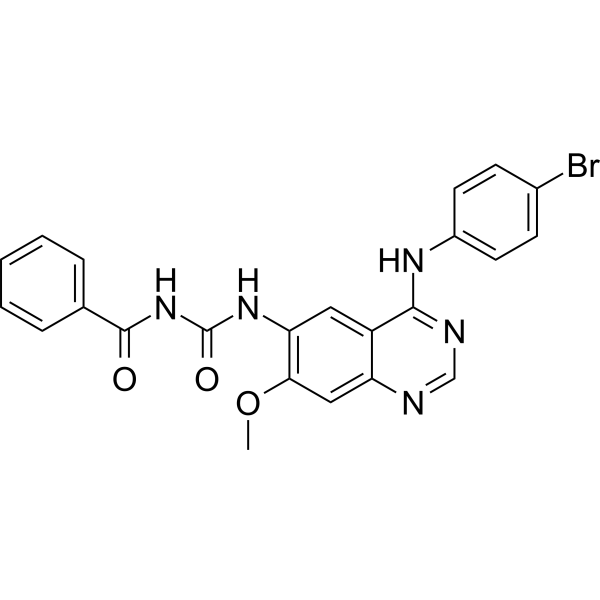 0 ImagesCat. No.: HY-161145CAS No.: 1970269-96-5
-
Anti-Her4 Antibody
 0 ImagesCat. No.: HY-P991985
-
G7-18NATE
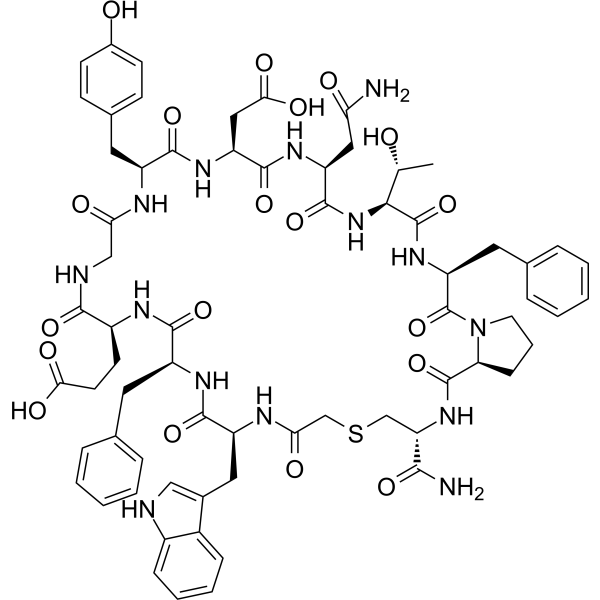 0 ImagesCat. No.: HY-P10224CAS No.: 936728-13-1G7-18NATE is a peptide inhibitor of Grb7. HY-P10224 binds to the Grb7-SH2 domain with micromolar affinity (KD = 18.1 μM). G7-18NATE inhibits cell proliferation, motility, cell invasion and 3D culture formation in several cancer cell lines.


-
Afatinib-d6 dimaleate
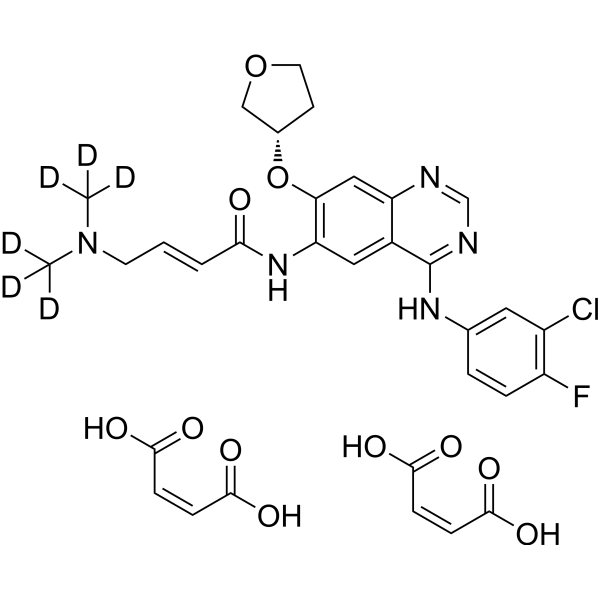 0 ImagesCat. No.: HY-10261ASSynonyms: BIBW 2992MA2-d6Afatinib-d6 (dimaleate) is the deuterium labeled Afatinib dimaleate. Afatinib dimaleate is an irreversible EGFR family inhibitor with IC50s of 0.5 nM, 0.4 nM, 10 nM and 14 nM for EGFRwt, EGFRL858R, EGFRL858R/T790M and HER2, respectively.
-
TAS2940 fumarate
 0 ImagesCat. No.: HY-153856ACAS No.: 2758034-98-7TAS2940 fumarate is a brain-penetrable, orally active, irreversible and selective pan-ERBB inhibitor. TAS2940 fumarate against wild-type HER2, HER2 V777L, and A775_G776insYVMA with IC50 values of 5.6 nM, 2.1 nM, and 1.0 nM, respectively. TAS2940 fumarate can be used for the study of tumors with HER2 and EGFR aberrations.
-
PROTAC EGFR degrader 3
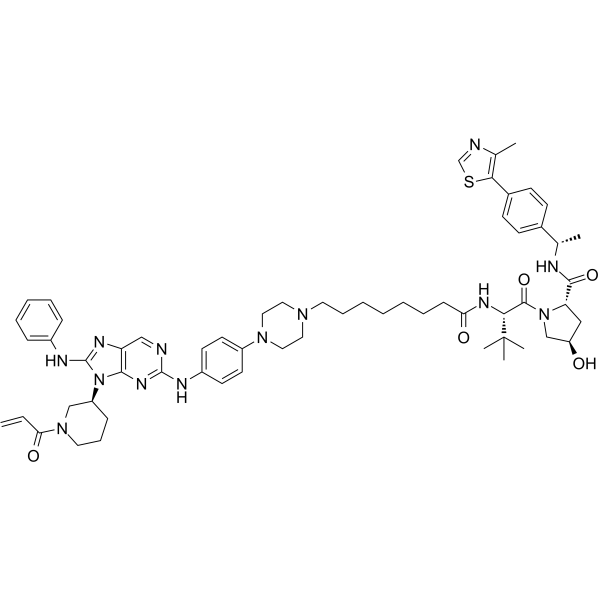 0 ImagesCat. No.: HY-144605CAS No.: 2768472-28-0PROTAC EGFR degrader 3 is a selective EGFR mutant PROTAC degrader with activity against EGFRL858R/T790M and EGFRdel19, with DC50 values of 1.56 nM and 0.49 nM, respectively. PROTAC EGFR degrader 3 induces degradation via formation of a ternary complex with VHL, ubiquitination, and lysosomal processing. PROTAC EGFR degrader 3 inhibits tumor cell proliferation. PROTAC EGFR degrader 3 can be used for the research of non-small cell lung cancer.



