



P2X Receptor Agonist
-
TB500
 0 Images
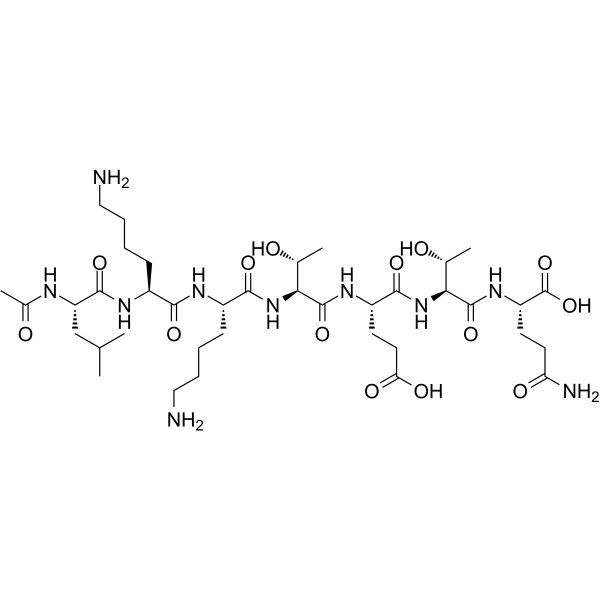
TB500 is a synthetic version of an active region of thymosin β4. TB500 exhibits anti-fibrotic and wound healing activities by inhibiting the Akt signaling pathway and binding to actin. TB500 is claimed to promote endothelial cell differentiation, angiogenesis in dermal tissues, keratinocyte migration, collagen deposition and decrease inflammation.
-
BzATP triethylammonium
 0 ImagesCat. No.: HY-18745CAS No.: 112898-15-4Synonyms: Benzoylbenzoyl-ATP triethylammonium
BzATP triethylammonium acts as a P2X receptor agonist with pEC50s of 8.74, 5.26, 7.10, 7.50, 6.19, 6.31, 5.33 for P2X1, P2X2, P2X3, P2X2/3, P2X4 and P2X7, respectively. BzATP triethylammonium is potent at P2X7 receptors with EC50s of 3.6 μM and 285 μM for rat P2X7 and mouse P2X7, respectively.
-
8-Bromo-ATP
 0 ImagesCat. No.: HY-134262CAS No.: 23567-97-7Synonyms: 8-Bromoadenosine 5'-triphosphate; 8-Br-ATP
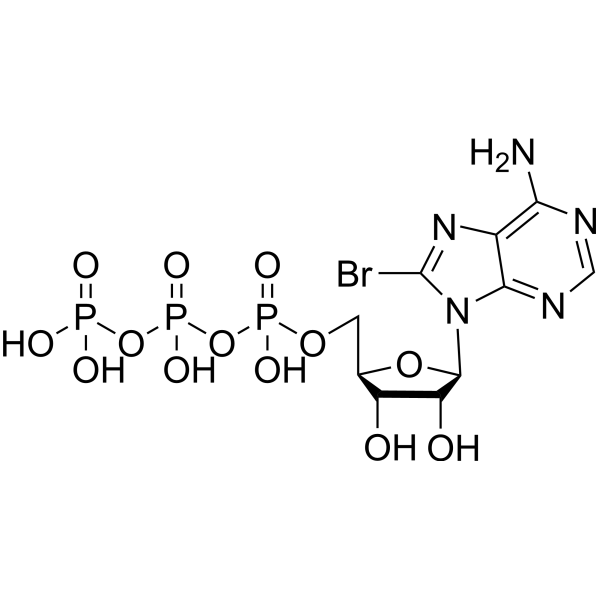
8-Bromo-ATP (8-Bromoadenosine 5'-triphosphate), an ATP analogue, is a purinergic P2X receptor agonist. 8-Bromo-ATP shows cytotoxic to multiple myeloma cells with an IC50 of 23.1 μM.
-
MRS 2219
 0 ImagesCat. No.: HY-102063CAS No.: 14141-47-0Synonyms: Pyridoxol, cyclic 3,4-hydrogen phosphate
MRS 2219 (Pyridoxol) is a selective pharmacological probe of P2X1 receptor. MRS 2219 selectively potentiated ATP-evoked responses at P2X1 receptors with an EC50 of 5.9 μM.
-
α,β-Methylene-ATP
 0 ImagesCat. No.: HY-134440ACAS No.: 7292-42-4
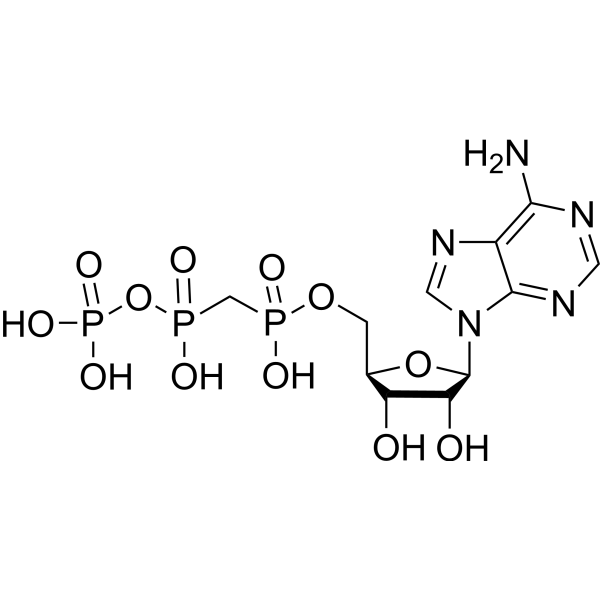
α,β-Methylene-ATP is an agonist of P2X1 and P2X3 receptors and can cross the blood-brain barrier. α,β-Methylene-ATP can trigger a reflex pressor response by activating P2X receptors in peripheral muscles and the central locus coeruleus (LC); this effect can be blocked by the P2X antagonist PPADS (HY-108960). α,β-Methylene-ATP also activates noradrenergic neurons in the central locus coeruleus, mediating antinociceptive effects; this effect can be attenuated by the locus coeruleus damaging agent DSP-4 (HY-103210/HY-121602). α,β-Methylene-ATP can be used to study the pathological mechanisms of neuropathic pain, cardiovascular reflex regulation, and antinociceptive effects of the central nervous system.
-
α,β-Methylene-ATP trisodium (Standard)
 0 ImagesCat. No.: HY-108652RCAS No.: 1343364-54-4
α,β-Methylene-ATP trisodium (Standard) is the analytical standard of α,β-Methylene-ATP (trisodium) (HY-108652). This product is intended for research and analytical applications. α,β-Methylene-ATP trisodium is an agonist of P2X1 and P2X3 receptors and can cross the blood-brain barrier. α,β-Methylene-ATP trisodium can trigger a reflex pressor response by activating P2X receptors in peripheral muscles and the central locus coeruleus (LC); this effect can be blocked by the P2X antagonist PPADS (HY-108960). α,β-Methylene-ATP trisodium also activates noradrenergic neurons in the central locus coeruleus, mediating antinociceptive effects; this effect can be attenuated by the locus coeruleus damaging agent DSP-4 (HY-103210/HY-121602). α,β-Methylene-ATP trisodium can be used to study the pathological mechanisms of neuropathic pain, cardiovascular reflex regulation, and antinociceptive effects of the central nervous system.



