



Wnt
The Wnt signaling pathways are a group of signal transduction pathways made of proteins that pass signals from outside of a cell through cell surface receptors to the inside of the cell. Three Wnt signaling pathways have been characterized: the canonical Wnt pathway, the noncanonical planar cell polarity pathway, and the noncanonical Wnt/calcium pathway. All three Wnt signaling pathways are activated by the binding of a Wnt-protein ligand to a Frizzled family receptor, which passes the biological signal to the protein Dishevelled inside the cell. The canonical Wnt pathway leads to regulation of gene transcription, the noncanonical planar cell polarity pathway regulates the cytoskeleton that is responsible for the shape of the cell, and the noncanonical Wnt/calcium pathway regulates calcium inside the cell. The clinical importance of Wnt signaling pathway has been demonstrated by mutations that lead to a variety of diseases, including breast and prostate cancer, glioblastoma, type II diabetes.
Wnt Isoform Specific Products
All Product Categories
-
Wnt Related Products (441)
Related Products (441)

-
Antibodies (26)
-
Wnt Isoform Comparison
-
BIM-46174
 0 ImagesCat. No.: HY-183400CAS No.: 195450-11-4BIM-46174 is a heterotrimeric G protein complex inhibitor. BIM-46174 blocks GPCR downstream signaling by trapping Gα proteins in a nucleotide-free pocket conformation, thereby inhibiting Gαq-mediated calcium release, Gαs-mediated cAMP production, and GPCR-regulated cancer cell invasion. In vitro, BIM-46174 effectively suppresses a variety of clinically multidrug-resistant cell lines and induces tumor cell apoptosis through activation of caspase-3 and PARP cleavage. BIM-46174 also inhibits activation of the Neu1-MMP-9-GPCR signaling platform and downstream NF-κB signaling, and is widely used in the study of cancer signaling pathways and inflammation-related research, including lung cancer, pancreatic cancer, breast cancer, melanoma, and leukemia.
-
Neurodazine (Standard)
 0 ImagesCat. No.: HY-108439RCAS No.: 937807-66-4Neurodazine (Standard) is the analytical standard of Neurodazine (HY-108439). This product is intended for research and analytical applications. Neurodazine is a neurogenic inducer, serve as a promoter of neurogenesisin pluripotent cells. Neurodazine promotes neurogenesis by activating Wnt and Shh signaling pathways..
-
GNF-6231 (Standard)
 0 ImagesCat. No.: HY-100408RCAS No.: 1243245-18-2GNF-6231 (Standard) is the analytical standard of GNF-6231 (HY-100408). This product is intended for research and analytical applications. GNF-6231 is a porcupine (IC50= 0.8 nM), Pron, and endoplasmic reticulum protein inhibitor with oral activity. GNF-6231 has anticancer activity. GNF-6231 can prevent the activation of the Wnt pathway by blocking the secretion of all Wnt ligands. GNF-6231 can be used in the study of myocardial infarction.
-
TAK-715 (Standard)
 0 ImagesCat. No.: HY-10456RCAS No.: 303162-79-0TAK-715 (Standard) is the analytical standard of TAK-715 (HY-10456). This product is intended for research and analytical applications. TAK-715 is an orally active and potent p38 MAPK inhibitor with IC50s of 7.1 nM, 200 nM for p38α and p38β, respectively. TAK-715 inhibits casein kinase I (CK1δ/ε) to regulate activation of Wnt/β-catenin signaling. TAK-715 shows good significant efficacy in a rat arthritis model.
-
WHN-88
 0 ImagesCat. No.: HY-164547CAS No.: 2490686-86-5
-
Jervine hydriodide
 0 ImagesCat. No.: HY-N0836ACAS No.: 60326-37-6Synonyms: 11-Ketocyclopamine hydriodideJervine hydriodide (11-Ketocyclopamine hydriodide) is an orally active steroidal alkaloid and Hedgehog signaling pathway inhibitor. Jervine hydriodide can be isolated from Veratrum californicum. Jervine hydriodide regulates Wnt, inhibits the AKT/mTOR signaling pathway, and activates the AMPK signaling pathway. Jervine hydriodide induces DNA damage, Apoptosis, Autophagy, ROS production and Mitochondrial damage. Jervine hydriodide exhibits anti-cancer and anti-inflammatory activities. Jervine hydriodide reduces tumor growth rate and weight in xenograft models. Jervine hydriodide can be used in studies related to triple-negative breast cancer, nasopharyngeal carcinoma and non-small cell lung cancer.
-
exo-IWR-1 (Standard)
 0 ImagesCat. No.: HY-108437RCAS No.: 1127442-87-8exo-IWR-1 (Standard) is the analytical standard of exo-IWR-1 (HY-108437). This product is intended for research and analytical applications. exo-IWR-1, an inactive stereoisomer of Endo-IWR-1, is a negative control of IWR-1 (HY-12238). IWR-1 is a tankyrase inhibitor which inhibits Wnt/β-catenin signaling pathway.
-
Gallocyanine
 0 ImagesGallocyanine (NCI8642) is a DKK/LRP interaction inhibitor and Wnt/β-catenin signaling pathway activator. Gallocyanine binds to the YWTD repeat domains of LRP5/6, competitively blocks the interaction between DKK and LRP5/6, with an IC50 of approximately 3 μM for inhibiting DKK1 binding to LRP5, an IC50 of 6.38 μM for inhibiting DKK1 binding to LRP6, and a Ki of 14 μM for inhibiting the DKK2C/LRP6-E3E4 interaction. Gallocyanine reverses the inhibitory effect of DKK1 on WNT3A signaling, with an EC50 of approximately 5 μM. Gallocyanine can be used in studies related to Alzheimer's disease, bone formation and glucose metabolism.
-
Wnt/β-catenin-IN-4
 0 ImagesCat. No.: HY-133179CAS No.: 2131223-69-1Wnt/β-catenin-IN-4 (compound YW1159) is a potent Wnt/β-catenin inhibitor.
-
Flurbiprofen axetil (Standard)
 0 ImagesCat. No.: HY-101481RCAS No.: 91503-79-6Flurbiprofen axetil (Standard) is the analytical standard of Flurbiprofen axetil. This product is intended for research and analytical applications. Flurbiprofen axetil is a non-selective COX inhibitor and a nonsteroidal anti-inflammatory agent with anti-inflammatory and analgesic effects. Flurbiprofen axetil inhibits basal-like breast cancer metastasis by inhibiting the MEK/ERK signaling pathway. Flurbiprofen axetil can promote neuroprotection after focal cerebral ischemia in rats by partially activating PPAR-γ. Flurbiprofen axetil alleviates cerebral ischemia/reperfusion injury by reducing inflammation in a transient global cerebral ischemia/reperfusion rat model. Flurbiprofen axetil can alleviate inflammatory responses and cognitive function in a mild cognitive impairment (MCI) SD rat model through the AMPKα/NF-κB signaling pathway.
-
Specnuezhenide (Standard)
 0 ImagesCat. No.: HY-N0665RCAS No.: 39011-92-2Synonyms: (8E)-Nuezhenide (Standard)Specnuezhenide (Standard) is the analytical standard of Specnuezhenide. This product is intended for research and analytical applications. Specnuezhenide ((8E)-Nuezhenide) is isolated from the fruits of?Ligustrum lucidum. Specnuezhenide ((8E)-Nuezhenide) can inhibit IL-1β-induced inflammation in chondrocytes via inhibition of NF-κB and wnt/β-catenin signaling. Specnuezhenide ((8E)-Nuezhenide) exerts anti-inflammatory effects in a rat model of osteoarthritis (OA).
-
MDGCEL
 0 ImagesCat. No.: HY-P5171CAS No.: 881188-48-3MDGCEL is a WNT5A peptide, that acts as a WNT5A mimicks and exhibits WNT5A antagonistic activity.
-
Sempervirine nitrate
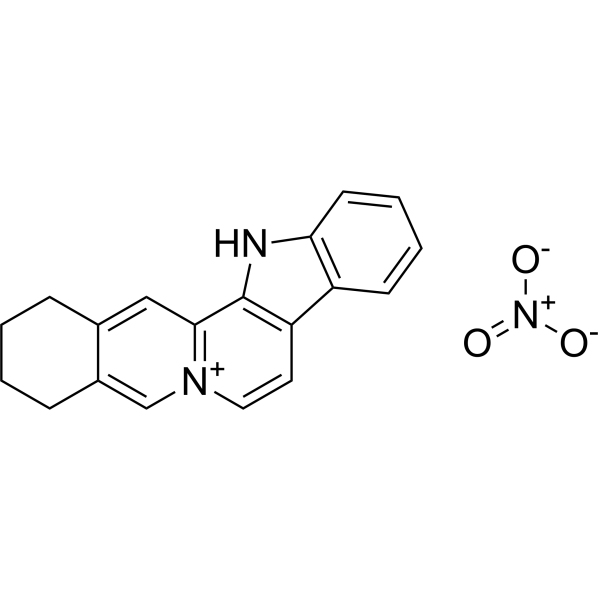 0 ImagesCat. No.: HY-N7507ACAS No.: 17994-15-9Sempervirine is an alkaloid derived from Gelsemium elegans Benth.. Sempervirine inhibits the proliferation of hepatocellular carcinoma (HCC) cells and induces apoptosis by regulating Wnt/β-catenin pathway.
-
cycFWRPW
 0 ImagesCat. No.: HY-P10488CAS No.: 2116533-34-5cycFWRPW is a peptide inhibitor of TLE1. TLE1 is an oncogenic transcriptional co‐repressor that exerts its repressive effects through binding of transcription factors, and inhibits Wnt signaling.
-
Tizanidine (Standard)
 0 ImagesCat. No.: HY-B0194RCAS No.: 51322-75-9Tizanidine (Standard) is the analytical standard of Tizanidine (HY-B0194). This product is intended for research and analytical applications. Tizanidine, a skeletal muscle relaxant, is an orally effective central α2-adrenoceptor agonist (IC50 = 6.9 nmol). Tizanidine primarily exerts muscle relaxation effects by inhibiting the release of excitatory amino acids (glutamate and aspartate) from the presynaptic terminals of spinal cord interneurons. Tizanidine has anti-injury activity and can inhibit gastrointestinal (GI) transport. Tizanidine can inhibit the proliferation, migration, and invasion of lung cancer cells and induce cell apoptosis by upregulating Nischarin and inhibiting the AKT and Wnt3a/β-catenin signaling pathways. Tizanidine can be used to treat spasticity caused by diseases such as multiple sclerosis (MS), stroke, and spinal cord injury (SCI).
-
Combretastatin A-1 (Standard)
 0 ImagesCat. No.: HY-121993RCAS No.: 109971-63-3Combretastatin A-1 (Standard) is the analytical standard of Combretastatin A-1. This product is intended for research and analytical applications. Combretastatin A-1 is a microtubule polymerization inhibitor that binds to the colchicine-binding site of tubulin. Combretastatin A-1 inhibits the Wnt/β-catenin pathway through tubulin depolymerization mediated AKT deactivation. Combretastatin A-1 exhibits anti-tumor and anti-vascular effects.
-
AMG-167
 0 ImagesCat. No.: HY-P991617CAS No.: 1798349-30-0AMG-167 is an anti-cancer monoclonal antibody targeting sclerostin. AMG-167 can be studied in research for osteoporosis.
-
NCB-0846 (Standard)
 0 ImagesNCB-0846 (Standard) is the analytical standard of NCB-0846 (HY-100830). This product is intended for research and analytical applications. NCB-0846 is an orally active, selective inhibitor for Wnt, that inhibits Traf2- and Nck-interacting kinase (TNIK) with an IC50 of 21 nM. NCB-0846 blocks TGF-β signaling pathway by inhibiting SMAD2/3 phosphorylation and nuclear translocation.
-
IM-12 (Standard)
 0 ImagesCat. No.: HY-12292RCAS No.: 1129669-05-1
-
Mirodenafil dihydrochloride (Standard)
 0 ImagesSynonyms: SK-3530 dihydrochloride (Standard)Mirodenafil (dihydrochloride) (Standard) is the analytical standard of Mirodenafil (dihydrochloride). This product is intended for research and analytical applications. Mirodenafil (SK3530) dihydrochloride is an orally active, potent, reversible, and selective phosphodiesterase 5 (PDE5) inhibitor. Mirodenafil dihydrochloride is a glucocorticoid receptor (GR) modulator Mirodenafil dihydrochloride activates the Wnt/β-catenin signaling pathway by downregulating Dkk1 expression. Mirodenafil dihydrochloride can be used for the research of erectile dysfunction (ED), Alzheimer’s disease (AD) and systemic sclerosis (SSc).




